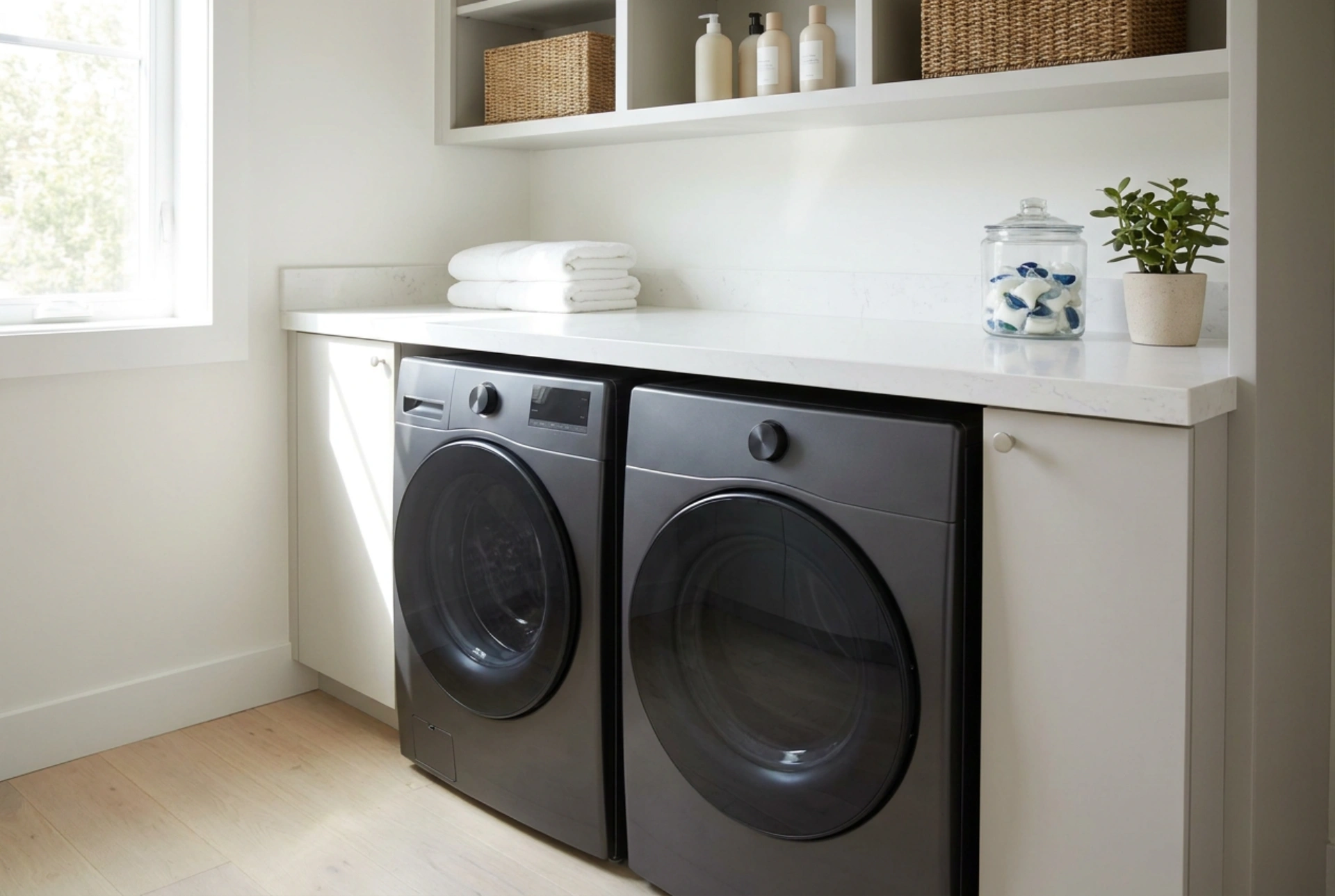


Integrating a laundry column or a side-by-side washer and dryer into a bathroom requires careful planning of thermodynamics, structural load, and plumbing physics to ensure safety and efficiency.
Understanding Space Dynamics and Mechanical Clearances
Before selecting appliances, you must measure the physical envelope of your bathroom. Standard washing machines and tumble dryers require a width of 60 centimeters each. However, the physical dimensions of the appliances are not the only parameters to consider. You must account for mechanical clearances to prevent structural damage and appliance failure.
Always calculate a minimum clearance of 5 to 10 centimeters behind the appliances. This space accommodates utility connections, prevents the severe bending of water supply hoses, and allows the waste pipe to maintain its necessary drainage curve. Side clearances should be at least 1.5 to 2 centimeters to absorb the lateral vibrations generated during the high-speed spin cycle of the washing machine. Without this buffer, the physical oscillation can transfer energy directly to your bathroom tiles, leading to cracked grout and micro-fractures in the walls.
The Physics of Ventilation and Humidity Management
Heat dissipation and moisture management are critical when placing a dryer in a confined bathroom space. Condenser and heat pump dryers work by extracting moisture from clothes and converting it into liquid, but they still release sensible heat into the room. If the ambient temperature in the bathroom rises above 30 degrees Celsius, the cooling efficiency of a condenser dryer drops significantly, extending cycle times and increasing energy consumption.
To prevent this, ensure that your bathroom has active mechanical ventilation, such as an extractor fan capable of maintaining constant air exchange. If placing the appliances inside a closed cabinet or utility niche, the doors must feature ventilation grilles at both the bottom and top. This configuration creates a natural convective chimney effect: cool air enters through the lower grilles, cools the compressor or heating element of the dryer, and escapes as warm air through the upper vents.
Structural Stability in Vertical Stacking
Stacking a dryer on top of a washing machine is a highly efficient way to save floor space, but it introduces specific structural challenges. Because a washing machine undergoes high-speed centrifugal rotation (often up to 1400 RPM), it must always serve as the base of the stack. A dryer, which is significantly lighter and contains fewer heavy dampening components like concrete counterweights, must always be placed on top.
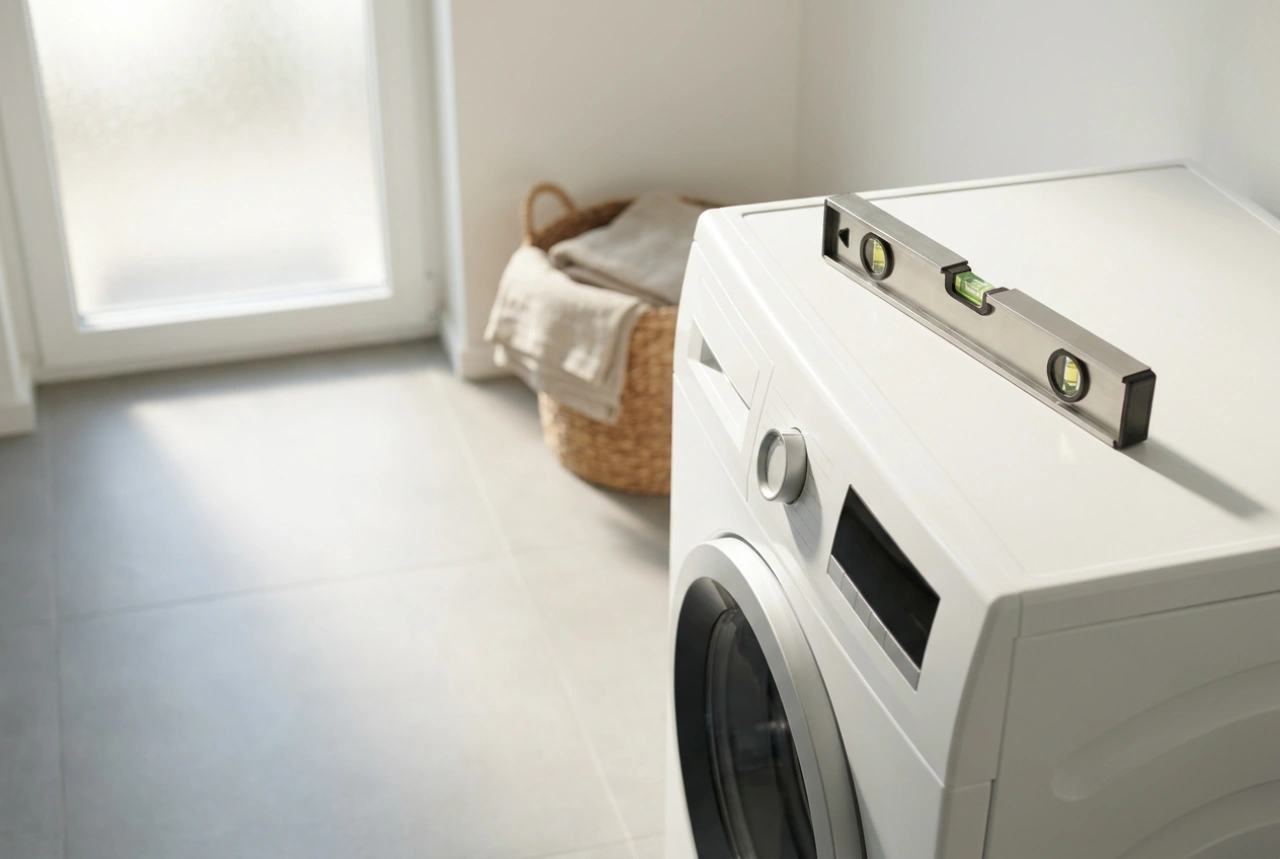
To stack these appliances safely, you must use a dedicated, universal stacking kit. This kit serves two purposes: it distributes the weight of the dryer evenly across the load-bearing frame of the washing machine, and it dampens the vibrations transferred from the base unit. Never place a dryer directly on a washing machine without a securing kit, as the kinetic energy from a spin cycle can cause the top appliance to shift and fall. If your bathroom floor is uneven, adjust the threaded feet of the washing machine using a spirit level to ensure a perfectly horizontal plane before securing the stacking kit.
Plumbing and Electrical Engineering Requirements
A proper laundry setup relies on correct hydraulic and electrical configurations. The drain hose of the washing machine, and optionally the condenser dryer, must connect to the waste pipe via an anti-siphon valve. This prevents wastewater from being siphoned back into the clean drum of the machine. The drain connection should be positioned at a height of 60 to 90 centimeters above the floor to allow gravity to assist the pump while preventing backflow.
From an electrical perspective, both appliances consume significant power. A washing machine during its heating phase and a condenser dryer operating simultaneously can easily overload a single household circuit. Both appliances must be plugged into separate, grounded electrical outlets. Avoid using extension cords or multi-plug adapters, which can overheat under sustained thermal load. Ensure that the outlets have an appropriate IP rating (Ingress Protection) suitable for wet environments like bathrooms.