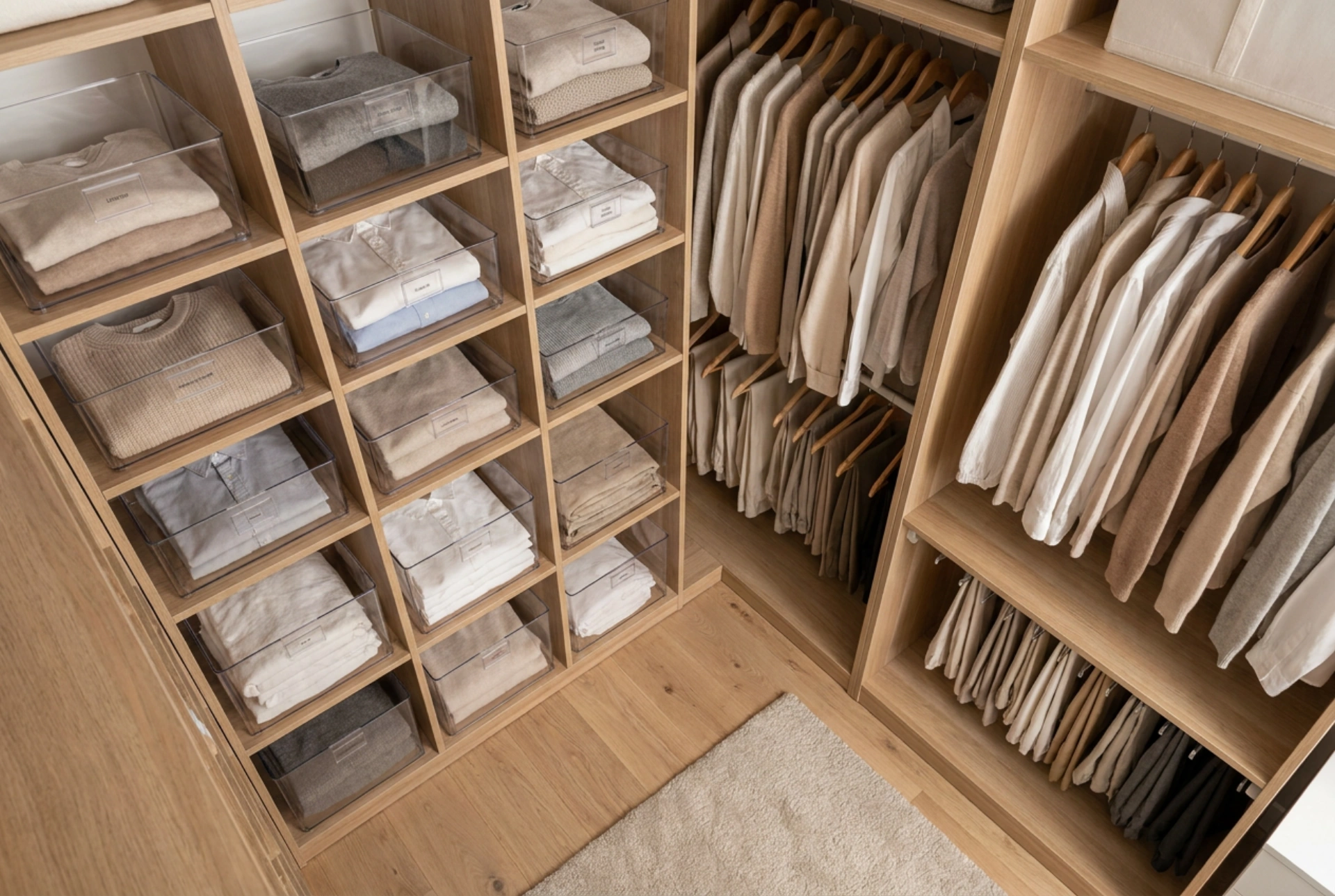


L-shaped wardrobes are excellent for maximizing corner bedroom spaces, but they often suffer from a frustrating layout flaw: the deep, dark corner intersection where items disappear forever.
The Geometry of the Corner Zone: Why It Fails and How to Fix It
The primary issue with L-shaped wardrobes is the overlapping depth of the perpendicular shelves. When two storage planes meet at a ninety-degree angle, they create a blind spot that is deeper than a standard arm’s reach. To solve this, you must change how you access this zone. Instead of static shelves that require you to reach around a corner, the intersection should be dedicated to specific mechanical movements or low-frequency storage.
By installing curved or continuous hanging rails that sweep smoothly through the ninety-degree turn, you eliminate the physical barrier of a partition wall. This allows you to slide garments effortlessly across the corner. If you must use shelving in the corner, the depth should be reduced on one side to create an asymmetrical pathway, ensuring your hands can reach the back corner without obstruction.
Applying the Physics of Motion: Pull-Outs and Rotational Storage
To make every inch of a corner wardrobe functional, you must bring the contents to you rather than reaching for them. This relies on basic mechanical principles of rotation and linear slide extension.
- Rotational Carousel Shelves: Installing half-moon or kidney-shaped carousel trays allows you to spin stored items into view. The rotational axis is offset so that when you open the door, the trays swing completely out of the cabinet frame.
- Heavy-Duty Pull-Out runners: By using full-extension drawer runners in the corner column, you can pull entire storage baskets straight out into the room. This transforms a deep, dark tunnel into an easily accessible vertical stack of drawers.
- The Corner Hanging Rail: A curved metal pipe suspended from the top panel ensures hanger hooks can slide continuously. Always hang seasonal, high-contrast garments in this section to maintain visibility even in lower light.
Strategic Category Mapping and Physical Zoning
Effective organization relies on matching the physical accessibility of a zone with the frequency of use of your items. The wardrobe can be divided into three distinct ergonomic zones based on reachability.
The Primary Reach Zone (The Arms)
This is the area directly in front of you, spanning from your thighs to your shoulders along the straight runs of the L-shape. This space should hold your daily essentials, such as activewear, work trousers, and shirts. Use shallow shelves or standard drawers here to keep items highly visible and prevent stacking piles from toppling over.
The Low-Frequency Corner Zone (The Intersection)
Since the corner requires more physical effort to access, reserve it for items you do not need daily. This includes seasonal bedding, winter coats, travel bags, or spare pillows. Store these items in breathable, clear acrylic bins or labeled canvas boxes. The labels must face outward toward the opening of the L-junction so they can be read at a glance without moving the containers.
The Upper and Lower Extremities
The very top shelves and the floor space beneath hanging garments should be treated as structural storage. Use the bottom floor area for heavy, pull-out shoe racks on wheels. Use the top shelves for lightweight, out-of-season clothing sealed in vacuum bags to protect them from dust and moisture.
Lighting and Visual Engineering for Deep Spaces
Darkness is the greatest enemy of organization. Without proper illumination, even the most structured L-shaped wardrobe will quickly descend into chaos as you search for items in the shadows. Install motion-activated LED strip lights along the inner front edges of the corner panels. Placing the light source at the front, pointing inward, prevents your body from casting shadows over the clothes when you reach inside.