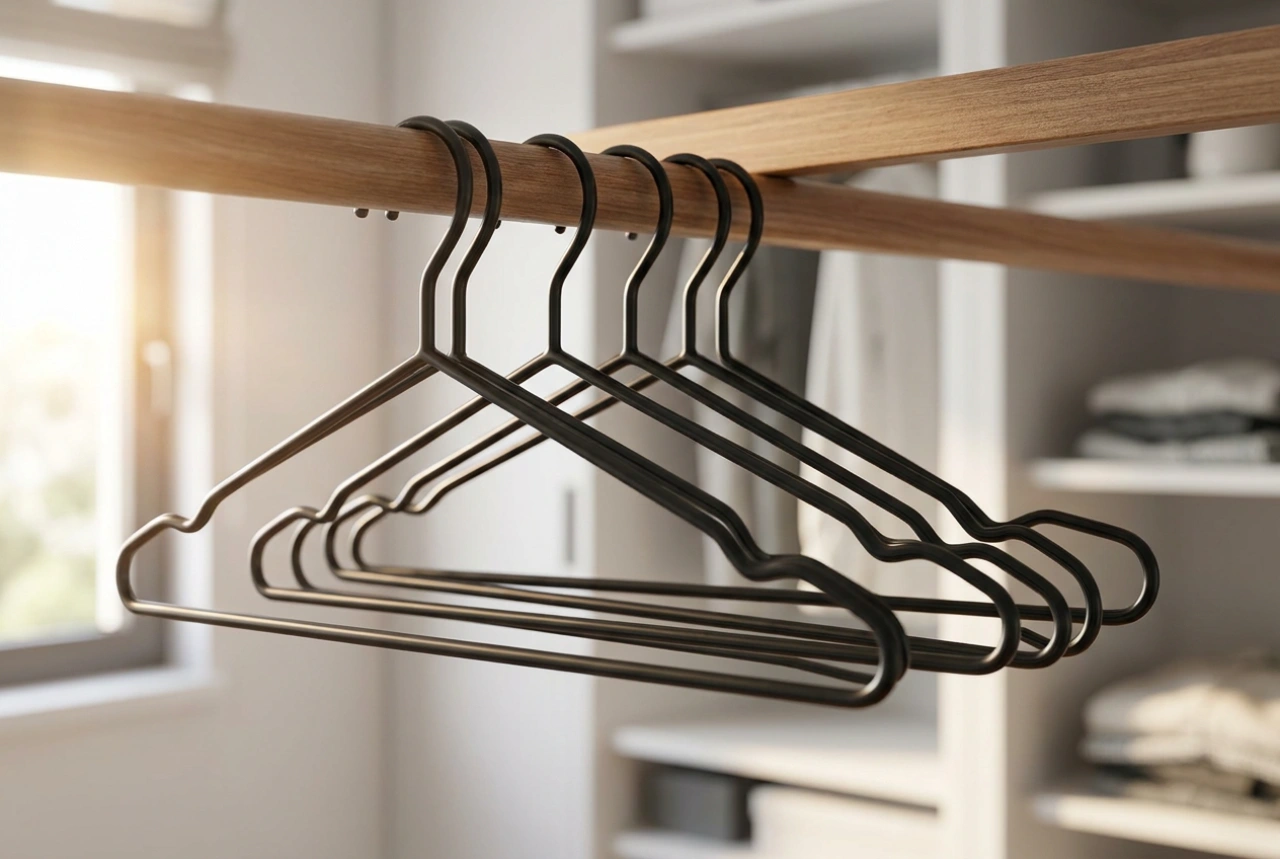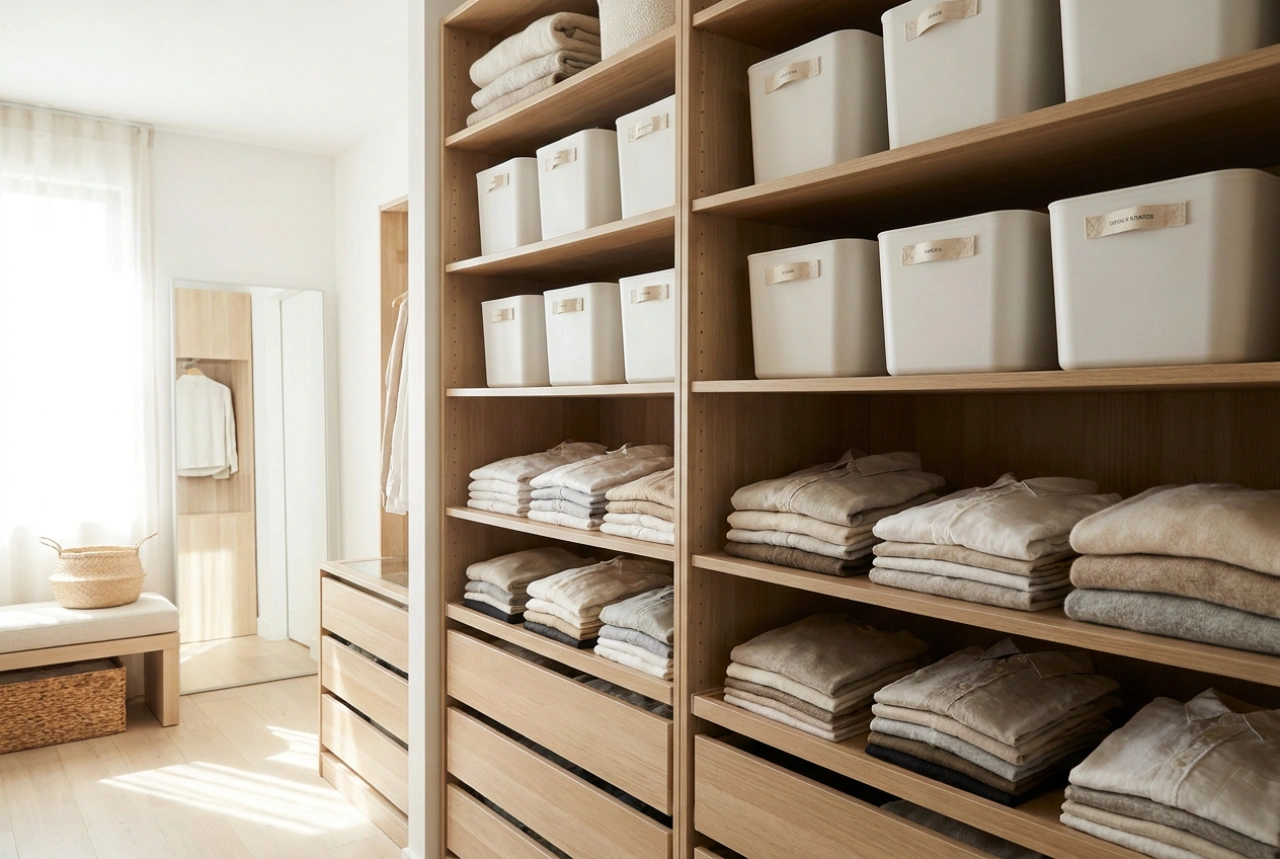


Maximising wardrobe efficiency often comes down to understanding the spatial geometry and physical limits of your storage. Multi-garment hangers, when used with an understanding of fabric weight and friction, can significantly increase vertical density without damaging delicate textile structures.
The Mechanics of Vertical Hanging and Gravity
Standard wardrobes often suffer from unused vertical volume directly beneath hanging rails. Traditional single hangers utilise only a thin horizontal plane, leaving the lower portion of the wardrobe empty while crowding the rail itself. A multi-hanger solves this by shifting the load downward along a single vertical axis. However, this mechanical shift alters the distribution of weight on the wardrobe rail. When you suspend four or five garments from a single point, the concentrated force increases tensile stress on that specific section of the rail. For optimal stability, multi-hangers should be distributed evenly across the rail rather than clustered in one section, preventing the rail from bowing over time.
Friction Coefficients and Fabric Protection
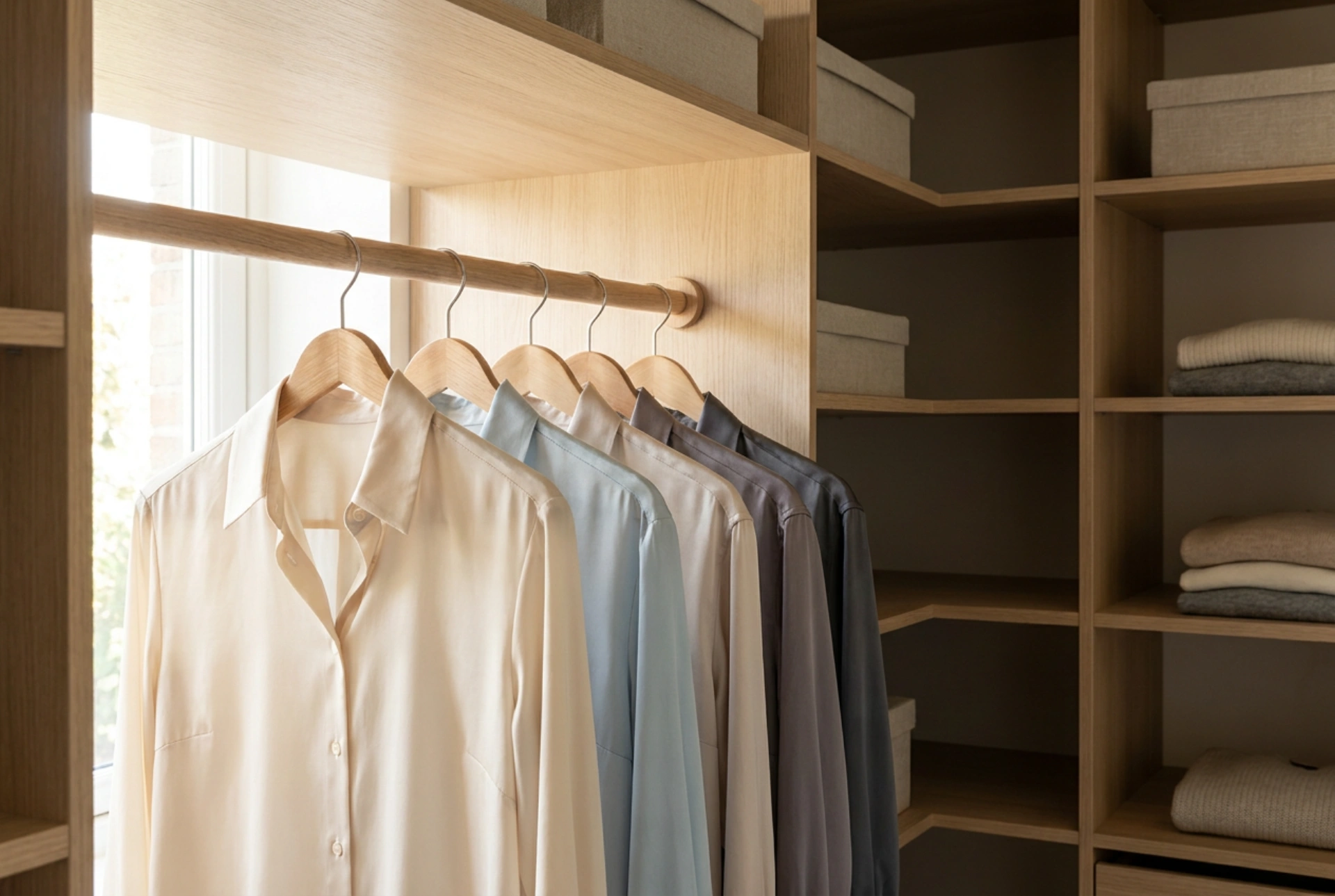
The effectiveness of a multi-hanger depends heavily on the material of the hanger itself and how it interacts with different fabrics. Highly polished metal or wooden multi-hangers have low friction coefficients, making them ideal for heavier, structured garments like trousers, which need to slip on and off easily. Conversely, slippery fabrics such as silk, satin, or fine polyester require hangers with textured coatings or wooden surfaces with sufficient grain friction to prevent sliding and subsequent creasing at the bottom of the wardrobe. When hanging multiple delicate items, the friction between the garments themselves must also be considered; layering highly cohesive fabrics can lead to static buildup and difficult retrieval.
The Physics of Creasing: Bar Thickness and Radius of Curvature
Creasing in folded garments, such as trousers hung over a multi-hanger rung, is a direct result of mechanical stress on the fabric fibres. When a textile is folded over a sharp edge, the fibres on the outer radius stretch, while those on the inner radius compress. If the rung of a multi-hanger is too thin—such as a basic wire hanger—the small radius of curvature concentrates this stress on a narrow band of fabric, leading to sharp, semi-permanent creases. To mitigate this, select multi-hangers with thick, rounded bars (ideally with a diameter of at least one centimetre). A larger radius of curvature distributes the gravitational pressure across a wider surface area of the fabric, preventing the molecular bonds in the fibres from locking into a creased state.
The Order of Operations for Loading Multi-Hangers
To prevent creasing and maintain the balance of a multi-tiered hanger, you must follow a systematic loading sequence. Always load a multi-hanger from the bottom tier upward. This prevents the upper garments from catching on the lower rungs or being dragged down during the process. Furthermore, balance the weight distribution: heavier items, such as thick cotton trousers, should occupy the lowest rungs, while lighter garments, like linen shirts or silk blouses, belong on the upper tiers. This low centre of gravity stabilises the hanger, keeping it perfectly vertical and preventing it from tilting, which would otherwise compress the garments against one another and cause deep, set-in creases.
Air Circulation and Fabric Conservation
While multi-hangers are excellent for space conservation, they compress garments into closer proximity. In closed wardrobes, this density can impede natural air circulation. Natural fibres like wool, cotton, and linen require airflow to dissipate ambient humidity and prevent the development of musty odours or fibre degradation. Therefore, multi-hangers are best reserved for seasonally dry periods or well-ventilated wardrobes. If you must use them in a compact space, ensure that garments are completely dry before hanging, and avoid packing the multi-hangers tightly against each other. Leaving a small gap between each multi-hanger allows air to circulate via convection, preserving the integrity of the textile fibres.
When to Avoid Tiered Hangers
Despite their utility, multi-hangers are not universal solutions. Knitwear, such as woollen jumpers or heavy cardigans, should never be stored on vertical hangers. The gravitational pull on these loosely woven structures causes irreversible stretching, pulling the shoulders out of shape and lengthening the garment unevenly. Similarly, garments with heavy embellishments or structured shoulder pads should remain on dedicated, contoured hangers to preserve their architectural form. Understanding these material limitations ensures that your efforts to save space do not come at the cost of your wardrobe's longevity.