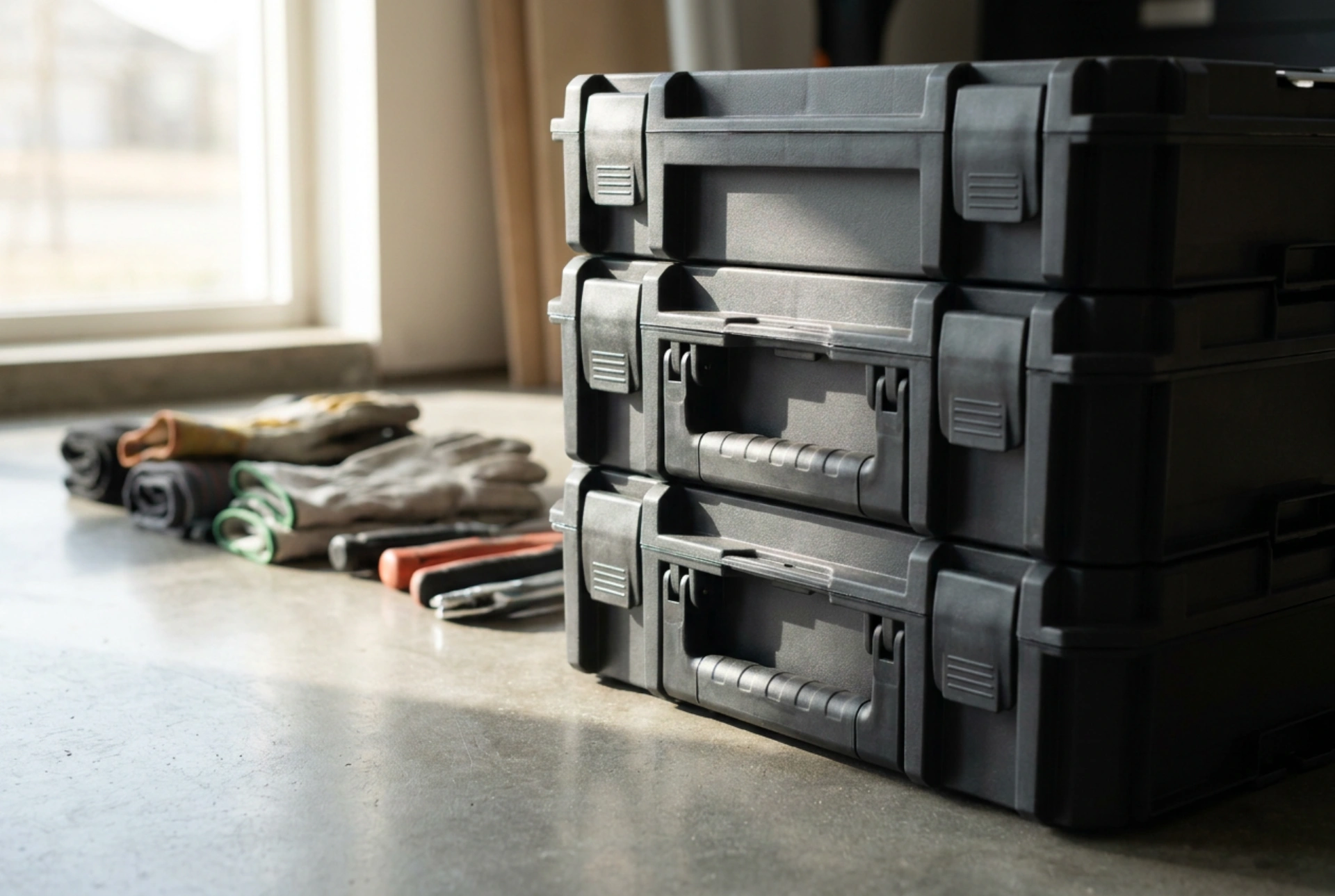


Maintaining a highly functional workspace requires more than just storing equipment; it demands a systematic approach to mobility that protects sensitive instruments and ensures rapid access during complex tasks.
The Physics of Load Distribution and Mobile Stability
When engineering a mobile tool system, the distribution of mass is the primary factor governing stability and ease of transport. Placing heavy items, such as large rotary hammers or solid steel wrenches, at the very bottom of the stack lowers the system’s cumulative centre of gravity. This mechanical arrangement minimises the tipping moment when navigating thresholds, ramps, or uneven workshop floors.
When tilting a wheeled case to roll it, the telescoping handle acts as a lever arm. By concentrating the heaviest objects near the wheelbase, you reduce the effort required to tilt the system, shifting the load directly onto the wheels rather than your wrist and shoulder. Furthermore, securing smaller hand tools in vertical organisers directly above the heavy base ensures that weight remains centred and balanced during motion.
Material Science of Modular Protective Cases
Modern mobile toolcases rely heavily on advanced polymers designed to withstand mechanical stress and environmental exposure. The most common materials used are polypropylene (PP) and acrylonitrile butadiene styrene (ABS). Polypropylene is highly flexible, allowing the case to undergo elastic deformation under sudden impacts without cracking. It also exhibits excellent chemical resistance against oils, solvents, and common workshop detergents.
In contrast, ABS offers superior rigidity and scratch resistance, making it ideal for structural outer frames. However, for maximum protection against moisture and microscopic dust, cases must feature a continuous gasket made of thermoplastic elastomer (TPE) or synthetic rubber. When the heavy-duty latches are closed, they compress this seal, creating a barrier that prevents water vapour from entering and initiating the oxidation process on steel tools.
Kinetic Energy Absorption and Internal Organisation
Tools travelling inside a case are subject to kinetic energy transfer every time the case vibrates or changes direction. Without proper restraint, tools collide, leading to surface abrasion, blunting of cutting edges, and calibration drift in precision instruments. Customisable foam inserts are the scientific solution to this problem, though the type of foam matters immensely.
Closed-cell polyethylene (PE) foam is highly recommended over open-cell polyurethane. Polyethylene foam consists of sealed gas pockets that do not absorb moisture, liquids, or oils, preventing the foam from becoming a damp sponge that promotes rust. It is easily cut to match the exact profile of each tool, distributing any impact forces evenly across the tool’s surface area and dampening harmful vibrations.
Designing a Workflow-Based Layout
An efficient organisation system is structured around the frequency of use and the sequence of operations. The top compartments of a modular stack should always house precision hand tools, measuring devices, and safety gear. These are the items required at the beginning of almost every task. The lower, deep cases should be reserved for bulky power tools and heavy-duty materials that are only retrieved for specific phases of work.
To prevent searching through nested compartments, utilise colour-coded modular bins or transparent lids for small parts like fasteners and washers. By categorising components by material type and thread pitch, you eliminate the cognitive load of searching, transforming the mobile case from a simple container into a highly responsive, portable workstation.