

Cleaning radiators is often neglected, yet dust accumulation inside the metal fins acts as an insulating barrier that significantly reduces heating efficiency. Utilizing a specialized radiator brush relies on mechanical reach and electrostatic physics to restore optimal thermal convection without damaging the appliance surface.
The Thermodynamics of Radiator Dust and Heat Loss
To understand why dust removal is essential, one must look at how a radiator transfers heat. Modern heating units operate primarily through convection. Cool air from the floor is drawn upward into the narrow channels between the metal panels or columns. As the air heats up, it expands, becomes lighter, and rises into the room. This continuous thermal cycle acts like a gentle chimney, but it also means the radiator constantly filters airborne particles, pet hair, and skin cells from the room.
Over time, these particles settle on the inner fins, creating a thick, felt-like layer. Dust has a very low thermal conductivity coefficient. Even a microscopic layer acts as a thermal insulator, trapping the heat inside the metal panels and preventing it from radiating efficiently into the room. Consequently, the heating system must run longer and consume more energy to achieve the desired ambient temperature. Regular removal of this barrier directly restores the rate of heat exchange.
The Mechanical Advantage of a Flexible Core
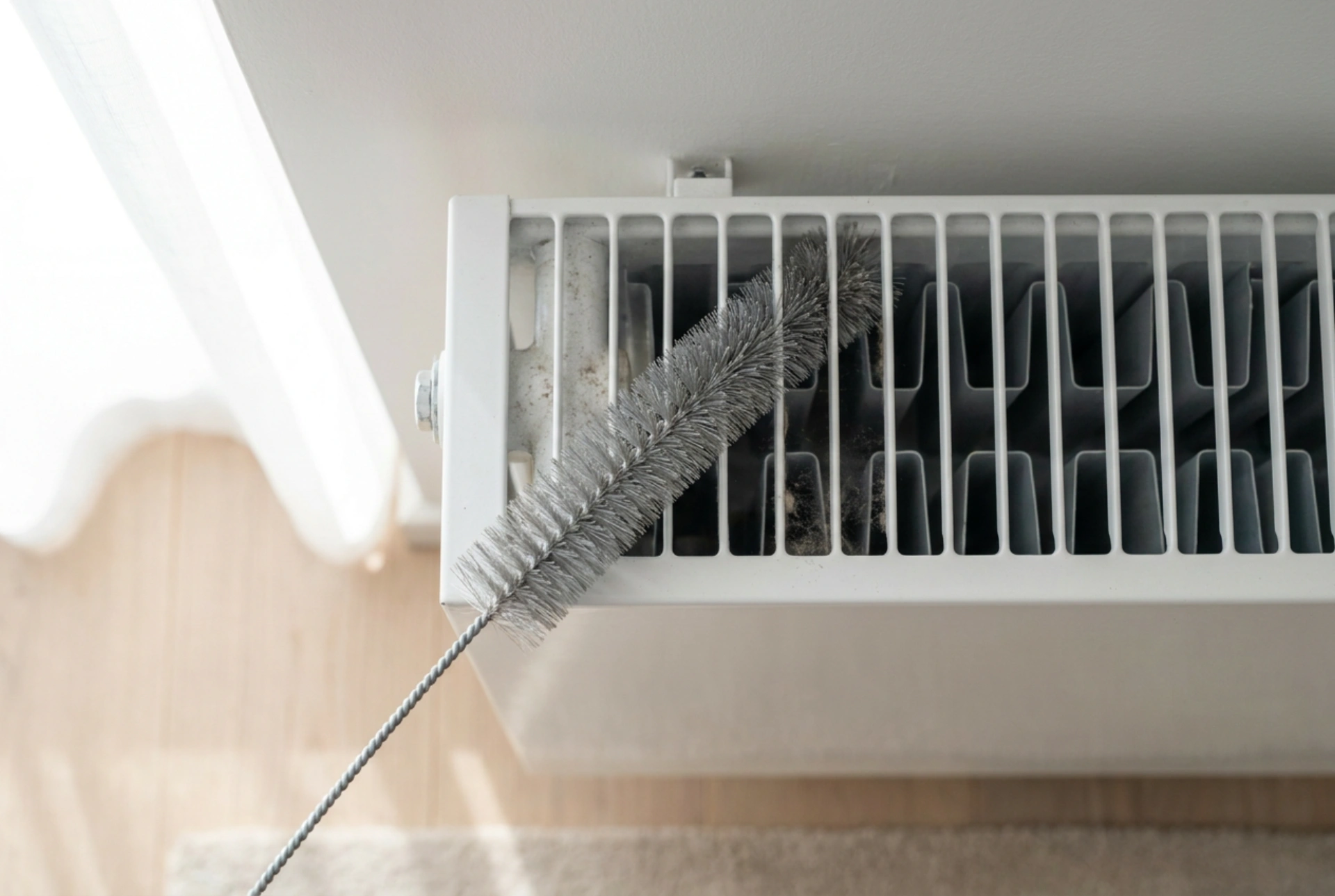
Standard dusting tools, vacuum nozzles, and microfiber cloths are physically incapable of reaching the tight, often zigzagging chambers of modern panel radiators. A dedicated radiator brush solves this structural challenge through its specialized design. It features a long, highly flexible core made of twisted steel wire, which is typically coated with a protective plastic layer to prevent scratching the inner powder-coated metal of the heater.
This flexibility allows the brush to bend around internal structural brackets, welds, and pipe connections without getting stuck. The length of the brush, usually between 60 and 120 centimeters, ensures that a single top-down pass can clear the entire height of the column. The radial arrangement of the bristles provides 300-degree contact with the internal surfaces, ensuring that both the front and rear faces of the narrow fins are cleaned simultaneously.
The Material Science of Dust Retention
The efficiency of a radiator brush depends heavily on the materials used in its bristles. High-quality brushes utilize either natural goat hair or specialized synthetic polymers like nylon. These materials are chosen for their specific physical interactions with dust particles.
- Triboelectric charging: As synthetic bristles rub against the painted metal surface of the radiator, the friction generates a mild electrostatic charge. This static charge acts like a magnet, attracting fine dust particles and holding them to the bristles rather than letting them disperse into the air.
- Microscopic trapping: Natural fibers, such as goat hair, possess a naturally scaled surface texture. These microscopic scales physically hook and trap dust particles within the brush structure, preventing them from falling out prematurely during extraction.
A Step-by-Step Technique for Dust Extraction
To clean a radiator effectively without spreading dust throughout your living space, a specific order of operations and technique must be followed.
1. Thermal Deactivation
Always turn off the heating system and wait for the radiator to cool down completely before beginning. Cleaning a hot radiator is highly inefficient because the active convection currents will carry dislodged dust particles upward into the air, distributing them across walls and ceilings.
2. Gravity and Moisture Barriers
Place a damp towel or a sheet of moist newspaper directly underneath the radiator. When you push the brush through the fins, gravity will pull the heavier dust clumps downward. The moisture on the floor barrier will instantly trap these particles on contact, preventing them from blowing away with drafts.
3. Controlled Vertical Movements
Insert the brush from the top of the radiator and push it downward through each fin channel using a slow, rotating motion. Avoid rapid, jerky movements, as high-velocity shaking can overcome the electrostatic and physical grip of the bristles, releasing dust back into the room air. Pull the brush out slowly, vacuum the collected dust off the bristles, and repeat the process for each column.