

Transforming a cluttered garage into an efficient workspace relies on understanding spatial ergonomics and material physics. By implementing structural tool organisers and dividing the space into logical zones, you protect your equipment from physical damage and chemical degradation while streamlining your workflow.
The Physics of Wall Storage: Pegboards and Load Bearing
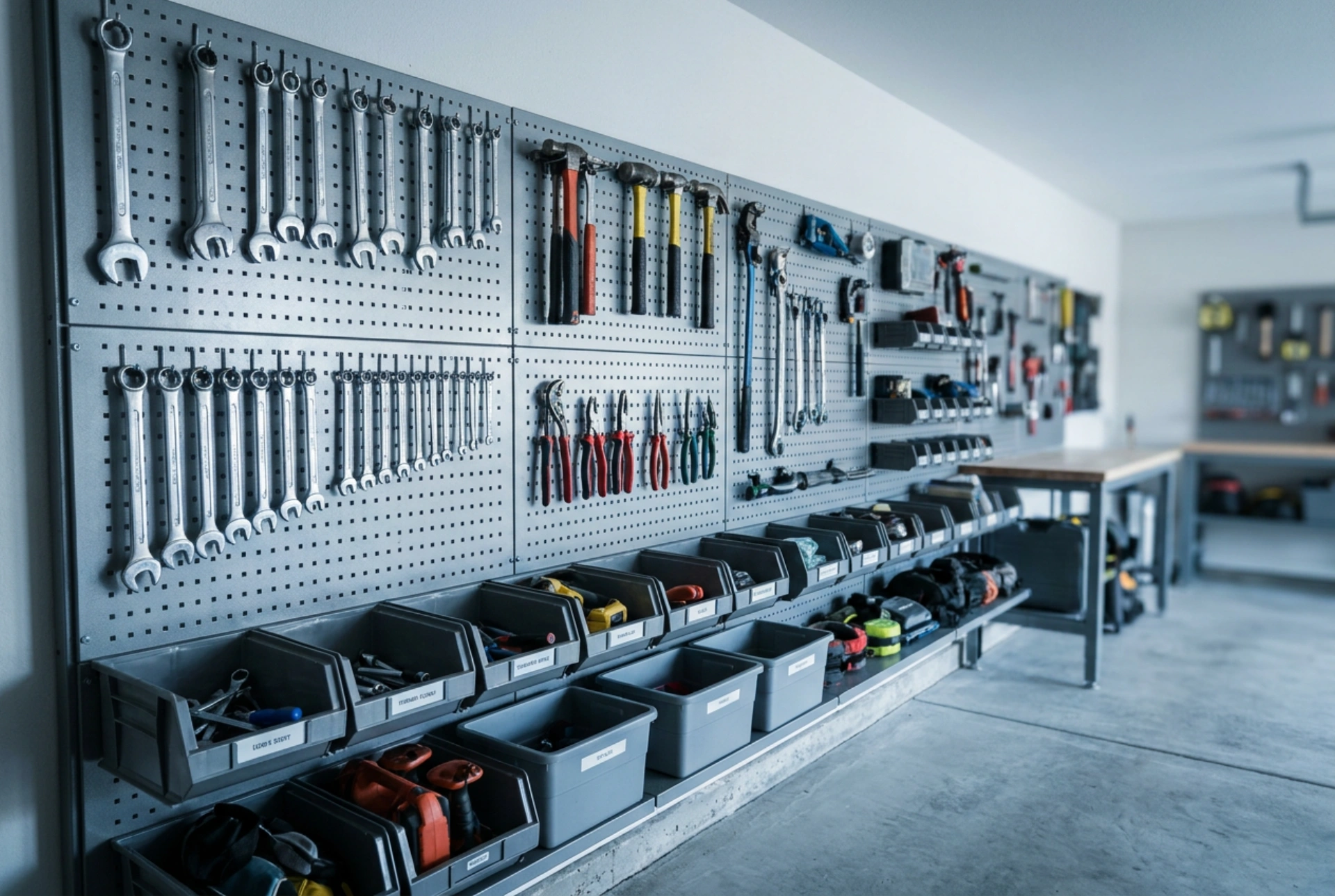
Wall-mounted modular systems, particularly powder-coated steel pegboards, offer the most robust foundation for tool storage. Unlike wood-based alternatives like hardboard or plywood, steel does not absorb moisture, warp under humidity, or degrade when exposed to oils and solvents. When mounting a pegboard, the primary physical force to counteract is shear stress—the downward pull exerted by heavy hand tools on the mounting screws.
To ensure structural integrity, the board must be anchored securely to the wall substrate. For solid masonry or brick walls, expanding nylon anchors or concrete screws are required to distribute the load across the masonry. For plasterboard walls, you must locate the vertical timber studs using a stud finder and secure the mounting brackets directly into the timber frame using heavy-duty wood screws. Spacing the hooks correctly is also vital; heavier items, such as lump hammers and pipe wrenches, should be positioned closest to the mounting points of the board to minimise bending moments on the metal sheet.
Ergonomic Zoning: The Golden Rule of Accessibility
A logical garage layout is determined by the frequency of tool use and the physical effort required to retrieve them. Dividing your wall space vertically into three distinct zones optimises movement and reduces physical strain.
- The Primary Zone (Waist to Eye Level): This is your high-frequency zone, also known as the ergonomic golden zone. Place your most frequently used hand tools here, such as screwdrivers, pliers, spanners, and tape measures. Keeping these tools within immediate reach without bending or stretching reduces repetitive strain during projects.
- The Secondary Zone (Below Waist Level): Reserve this area for heavier hand tools and portable power tool cases. Storing high-mass items lower down lowers the centre of gravity of your storage system and prevents injuries from dropped objects.
- The Tertiary Zone (Above Eye Level): Use this upper boundary for lightweight, infrequently used items, or seasonal gear. Always ensure these items are securely latched or bracketed to prevent them from falling due to vibration or accidental bumps.
Thermodynamics and Tool Care: Combating Condensation
Unheated garages are susceptible to rapid temperature shifts, which create a microclimate prone to condensation. When warm, humid air contacts cold metal tools, the temperature of the air drops below its dew point, causing water vapour to condense into liquid droplets on the tool surfaces. This moisture acts as an electrolyte, accelerating galvanic corrosion and rust on high-carbon steel tools.
To mitigate this chemical degradation, choose storage solutions that promote continuous airflow. Open metal pegboards allow air to circulate freely around tools, preventing moisture traps. Furthermore, high-value precision tools, such as micrometers or chisels, should be stored in sealed, non-porous polymer cases lined with vapour-corrosion inhibitor (VCI) foam or accompanied by silica gel packets. Applying a micro-thin layer of light machine oil or mineral oil to bare steel tools creates a hydrophobic barrier, physically isolating the metal from ambient moisture.
Systematic Categorisation and Visual Controls
An effective organisation system relies on immediate visual recognition. Grouping tools by task—such as mechanical repairs, electrical work, or woodworking—is far more efficient than grouping them purely by size or shape. This functional grouping mimics professional workshop workflows, ensuring all tools required for a specific job are concentrated in one physical location.
To maintain order over time, employ visual control techniques such as shadow boarding. By tracing the outline of each tool onto the pegboard or using pre-cut foam inserts in drawers, you create a dedicated space for every item. This simple visual cue provides instant feedback, alerting you immediately to a missing tool before you finish your work sessions. Standardising the placement of accessories, such as placing sockets in ascending order on magnetic rails, further reduces cognitive load during complex tasks.