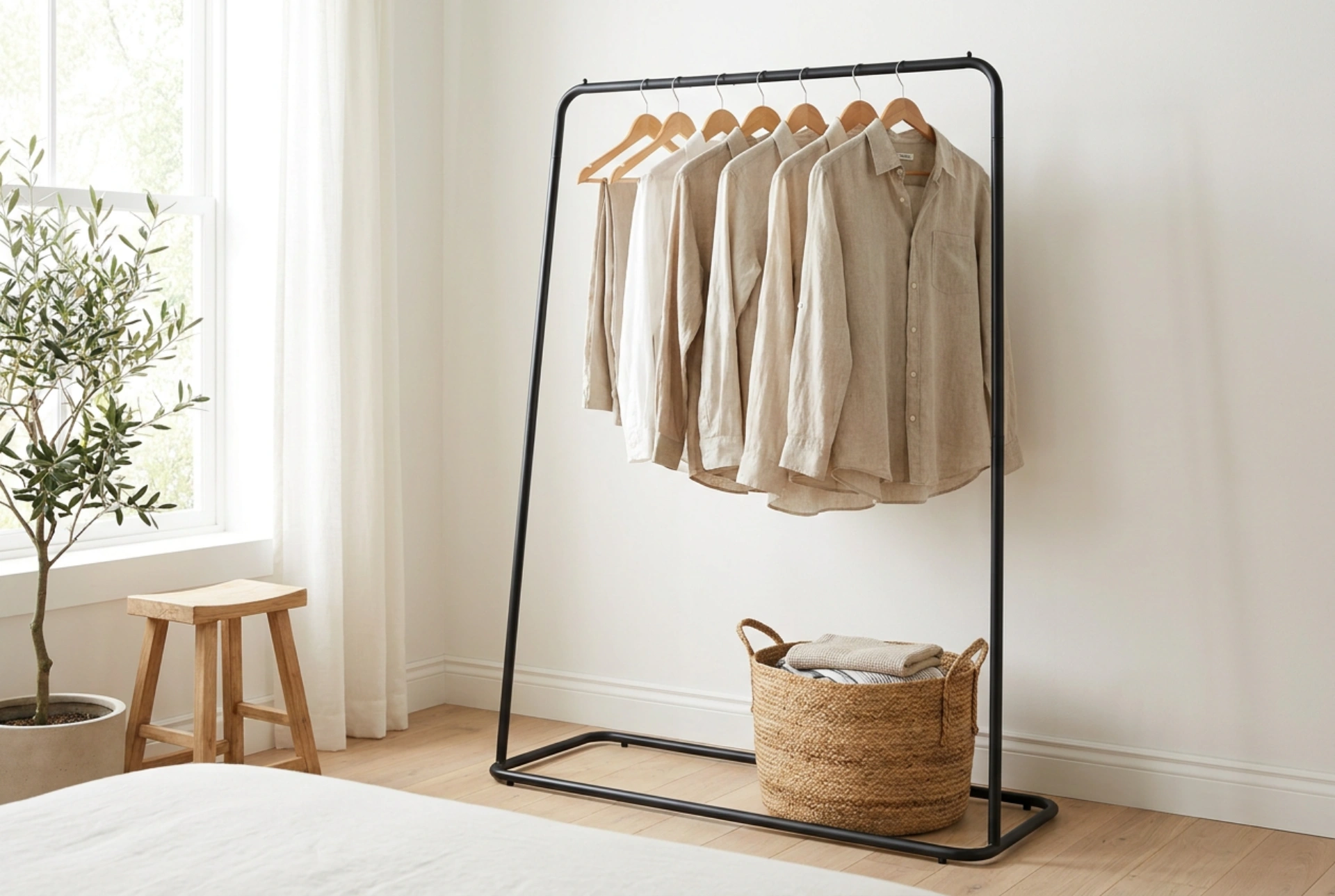


A freestanding clothes rack offers more than just a temporary storage solution; it serves as a highly functional, open-air alternative to a traditional enclosed wardrobe. By utilising physical space and natural ventilation, an open garment rack actively preserves fabric integrity while optimising daily dressing routines.
The Thermodynamics of Open Storage: Airflow and Fabric Health
Enclosed wardrobes often trap ambient moisture, leading to micro-climates where stagnant air promotes the growth of mildew and musty odours. Natural fibres such as wool, silk, and cotton are highly hygroscopic, meaning they absorb moisture from their surroundings. When stored in a sealed cabinet, these fabrics cannot easily release absorbed humidity, which can lead to fibre degradation over time.
A freestanding clothes rack eliminates this barrier. Constant air circulation allows moisture to evaporate freely from the fabric fibres. This continuous ventilation prevents the build-up of volatile organic compounds and keeps garments smelling fresh without the need for chemical deodorisers. Furthermore, exposing clothes to ambient light reduces the survival rate of clothes moths, which thrive in dark, undisturbed environments.
Structural Mechanics: Selecting and Balancing a Garment Rack
To successfully replace a wardrobe section, a clothes rack must handle significant mechanical stress. The structural integrity of a rack depends on its base geometry, tube wall thickness, and joint connections. Racks constructed from industrial steel tubing with welded or heavy-duty threaded joints offer the highest load capacity and stability.
When loading a freestanding rack, understanding the centre of gravity is crucial. To prevent tipping and structural warping, apply the following distribution principles:
- Place heavier items, such as woollen overcoats and leather jackets, closest to the vertical support posts to minimise bending stress on the horizontal bar.
- Utilise a rack with a low-slung bottom shelf or heavy base frame, which lowers the overall centre of gravity and stabilises the structure against lateral forces.
- Ensure the weight is distributed symmetrically from left to right to prevent uneven wear on caster wheels or feet.
Ergonomics and the Physics of Fabric Care
An open rack forces a disciplined approach to wardrobe management, naturally encouraging a capsule collection. Hanging garments on a rack also utilises gravity to maintain their shape. Wrinkles in fabrics like linen and wool often relax naturally when hung under their own weight, especially when exposed to normal room humidity.
For optimal fabric preservation, the spacing between hangers should be maintained at a minimum of two to three centimetres. This prevents frictional wear between different textiles—such as coarse tweed rubbing against delicate silk—and ensures that air can pass freely between each piece. Organising garments by length not only creates visual order but also frees up floor space directly beneath the shorter garments for storage boxes or footwear.
Hanger Selection: Friction and Load Distribution
Replacing a wardrobe with a rack requires careful consideration of hanger physics. Thin wire hangers concentrate the downward force of a garment's weight onto a very narrow surface area, leading to fabric stretching and permanent shoulder puckering. Broad wooden or contoured plastic hangers distribute this gravitational pull over a larger surface area, protecting the shoulder seams of structured garments.
Friction also plays a key role in garment preservation. Smooth wooden hangers are ideal for structured jackets that need to slip on and off easily, whereas velvet-coated or textured hangers prevent slippery fabrics like silk and satin from sliding off and falling to the floor. By matching the hanger material to the fabric properties, you ensure both structural support and ease of access.