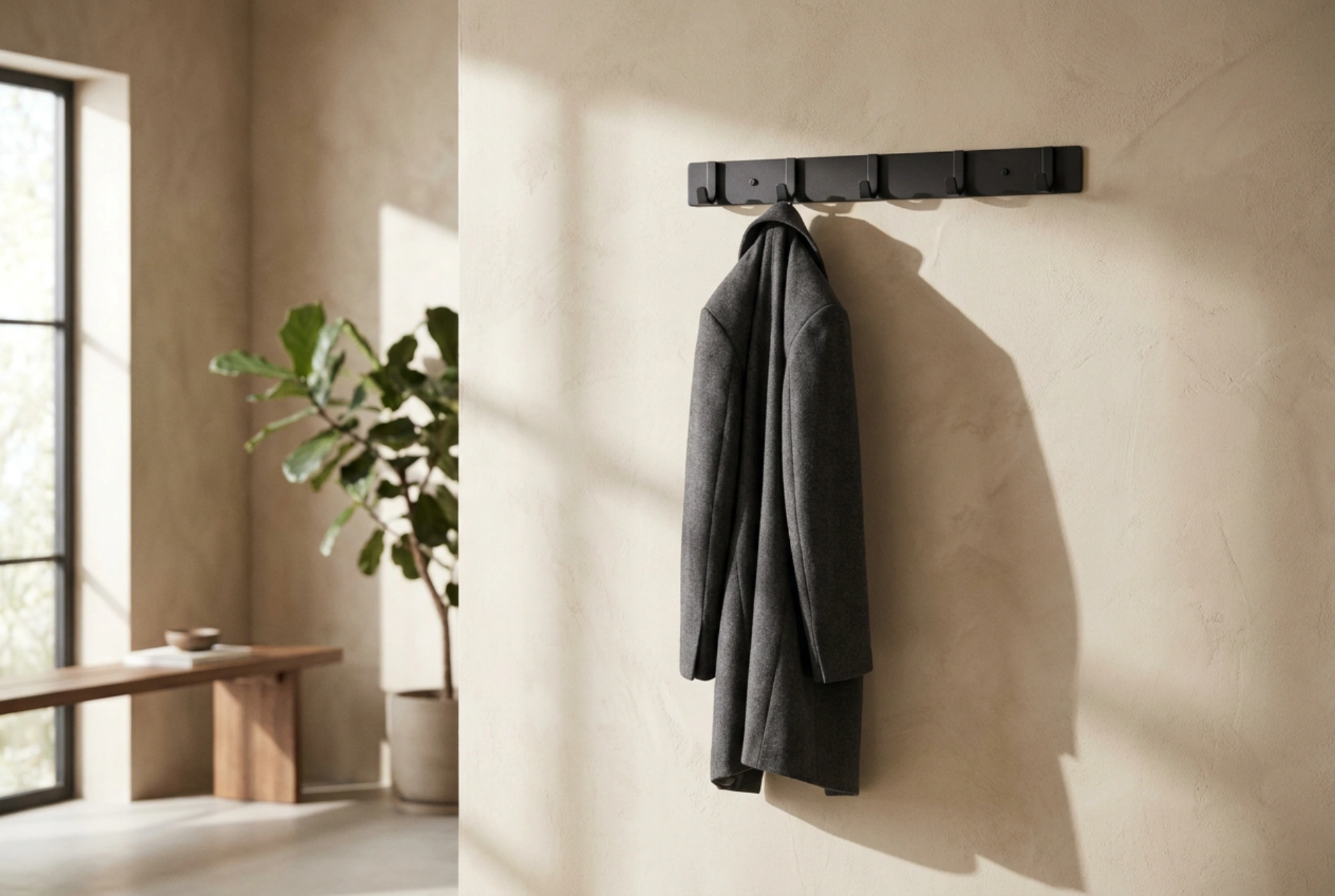


Achieving a pristine, functional entrance hall relies on understanding the physical forces of wall-mounted storage and the material science of garment care. A modern coat rack is not merely an aesthetic choice; it is a structural interface that must support significant static loads while preventing physical damage to heavy winter outerwear.
The Mechanics of Structural Mounting and Load Distribution
A wall-mounted coat rack is subjected to constant downward shear force and outward pulling tension. Before installation, you must identify the substrate of your entryway wall. Drywall or plasterboard requires hollow-wall anchors, such as metal toggle bolts, which expand behind the board to distribute the load across a larger surface area. For solid masonry or brickwork, nylon expansion plugs are ideal, as they rely on friction against the borehole walls when the screw is driven home.
To calculate the load requirements, consider that a damp wool coat can weigh up to five kilograms. Multiplying this by the number of hooks gives the total static load. Standard plastic plugs in drywall will eventually fail under dynamic loading—the sudden downward force applied when hanging a coat. Therefore, mechanical anchors should be rated for at least twice the anticipated maximum load. Ensure the rack is perfectly level using a spirit level to prevent uneven force distribution, which can loosen the fixings over time.
Material Selection and Garment Preservation
The interface between the hook and the garment determines how well a coat retains its structural integrity. Thin, sharp metal hooks concentrate all the weight onto a tiny surface area, leading to localized fiber stretching, punctured linings, and unsightly fabric deformation (often called "hanger bumps"). This is particularly damaging to natural fibers like wool and cashmere, which have low elastic recovery when damp.
To mitigate this, opt for modern racks featuring wide, cylindrical hooks or curved wooden pegs. Wood, being naturally slightly textured, provides grip that prevents garments from sliding off, while its low thermal conductivity prevents condensation. If using metal, matte powder-coated finishes offer a microscopic surface roughness that provides gentle friction without snagging delicate silk or synthetic linings. The radius of the hook should ideally match the natural curvature of a coat collar—minimum two centimetres in width—to distribute the weight evenly across the yoke of the garment.
Thermodynamics of Drying and Moisture Control
Outerwear frequently introduces external moisture into the home environment. Hanging wet coats flush against a plaster wall creates a microclimate of high relative humidity, trapped between the fabric and the wall surface. This lack of airflow prevents evaporation and can lead to localized paint peeling, plaster degradation, and mold growth.
To avoid this, select a coat rack that features an offset design, holding the garments at least five to ten centimetres away from the wall surface. This gap allows for natural convective airflow. Warm, dry indoor air rises, drawing cool, damp air away from the coats. Additionally, when returning home with wet coats, the order of operations is crucial: shake off excess water droplets outdoors, hang coats with sufficient spacing between them to allow air circulation, and ensure the entryway has a consistent temperature of around eighteen to twenty degrees Celsius to facilitate efficient evaporation without damaging wool fibers.
Spatial Ergonomics and Zonal Division
A tidy entryway operates on a strict system of kinetic zones. The primary zone, situated between eye level and waist height (roughly one to one and a half meters from the floor), should be reserved for daily-wear items. Keeping this area clear of out-of-season garments prevents visual clutter and reduces the physical effort required to store and retrieve items.
- Active Storage: Limit the wall rack to two garments per household member at any given time. Excess coats should be transferred to deep storage wardrobe facilities.
- Drying Clearance: Maintain a minimum of fifteen centimetres of horizontal space between active hooks to allow proper air penetration.
- Base Zone: Use the area directly beneath the rack for footwear, employing open-slat shelving to allow damp soles to dry through bottom-up ventilation.