

An unlevelled washing machine is more than just an auditory nuisance; it causes severe mechanical wear due to unbalanced rotational forces. Mastering the precise technique of levelling ensures quiet operation, protects internal components, and prevents the appliance from shifting during high-speed spin cycles.
The Physics of Spin Cycles and Dynamic Imbalance
During the spin cycle, a washing machine drum rotates at speeds exceeding 1,000 revolutions per minute. This rotation generates immense centrifugal force. If the appliance is not perfectly horizontal, the centre of gravity shifts away from the rotational axis, creating a dynamic imbalance. This imbalance causes the drum's suspension springs and dampers to work unevenly, accelerating wear on the shock absorbers and drive bearings. Over time, this structural stress can lead to premature mechanical failure. When the machine is perfectly level, the gravitational pull acts uniformly across all four support legs, distributing the kinetic energy evenly into the subfloor rather than converting it into lateral kinetic energy which causes the machine to walk.
Assessing the Subfloor and Foot Mechanics
Before adjusting the appliance, it is crucial to understand the surface interface. A rigid, non-yielding floor such as concrete or porcelain tile is ideal, as it does not absorb or amplify low-frequency vibrations. If your appliance sits on wooden floorboards or a flexible vinyl layer, structural deflection can occur, mimicking an unlevel state during high-speed rotations. The adjustable feet of a modern washing machine operate on a simple threaded bolt mechanism. Turning the foot clockwise (when viewed from above) retracts the leg, lowering that corner of the machine, while turning it anti-clockwise extends it, raising the corner. Each foot is equipped with a locknut that must be tightened firmly against the chassis base to eliminate thread play and prevent the foot from drifting over time due to vibrational frequency.
The Step-by-Step Levelling Procedure
To achieve a perfectly level alignment, follow this structured, systematic approach to ensure precision on both the lateral and longitudinal axes.
Step 1: Position and Preliminary Diagonal Test
Place the washing machine in its final operating position. Push down firmly on each of the four top corners diagonally (front-left to back-right, and front-right to back-left). If you feel any rocking motion, it indicates that at least one foot is not making firm contact with the floor, creating a diagonal pivot point.
Step 2: Checking the Planes with a Spirit Level
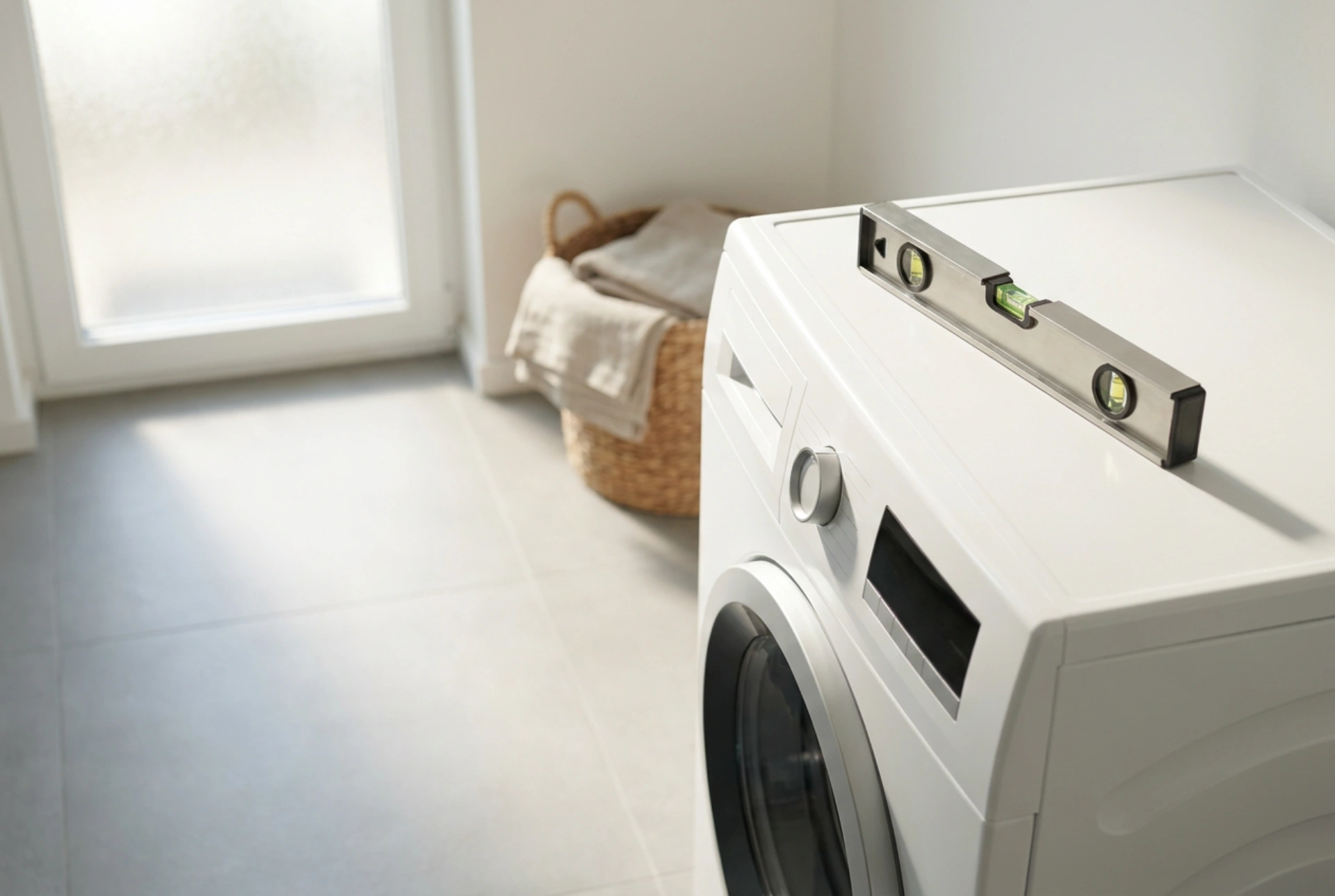
Place a high-quality spirit level flat on the top surface of the machine, aligned parallel to the front edge to check the left-to-right plane. Observe the position of the bubble relative to the centre lines. Next, rotate the spirit level 90 degrees to align it with the side edge, checking the front-to-back plane. Repeat this on the opposite side to account for any slight warping in the appliance's plastic or metal top cover.
Step 3: Adjusting the Threaded Feet
Using an open-ended spanner, loosen the locknut on the leg that requires adjustment. If the bubble in the spirit level sits to the right, the left side of the machine is too low and must be raised, or the right side lowered. Make small, incremental adjustments—usually a half-turn of the foot at a time. After each adjustment, press down on the corners of the machine again to ensure it remains stable and does not rock.
Securing the Locknuts and Final Verification
Once the bubble on the spirit level is perfectly centred in both directions and diagonal movement is entirely eliminated, the adjustment must be locked in place. Hold the adjustable foot steady with one hand or a second spanner, and use your primary spanner to spin the locknut upwards until it is flush against the underside of the washing machine cabinet. Tighten it securely. Failing to lock these nuts allows the vibrational energy of the spin cycle to slowly rotate the threaded rods, undoing your precise work within a few weeks. Finally, run a short test cycle with a small load of damp towels to observe the machine at maximum rotational speed; there should be no structural rattling, minimal cabinet movement, and the spirit level bubble should remain dead centre throughout the process.