

Wardrobe creases and misshapen shoulders are rarely the fault of the fabric alone; they are primarily caused by the incorrect distribution of gravitational force through poor hanger selection. Understanding the physical relationship between hanger geometry, material friction, and textile behaviour allows you to maintain the structure of your garments and significantly reduce ironing time.
The Physics of Fabric Deformation in the Wardrobe
When a garment hangs, gravity exerts a constant downward pull. The entire weight of the fabric is suspended from the points where the garment contacts the hanger. If these contact points are too narrow, such as with thin wire hangers, the concentrated force exceeds the elastic limit of the textile fibres. This localised tensile stress stretches the weave, leaving permanent bumps or "shoulder nipples" in knitted items and heavy woollens.
Different fabrics react uniquely to this tension. Woven cotton and linen possess low elasticity, meaning that once a crease is pressed into the fibre under localised pressure (such as from a neighbouring garment), it remains there until heat and moisture are applied. Conversely, animal fibres like wool have a natural crimp that provides elasticity, but they are highly susceptible to structural distortion if the weight is not evenly distributed across a broad surface area.
Selecting Hanger Materials for Optimal Friction
The friction coefficient of the hanger surface plays a critical role in preventing creases. If a garment constantly slips, it pools at the bottom of the wardrobe or bunches up on one side, leading to severe diagonal creasing. Selecting the right material solves this mechanical issue.
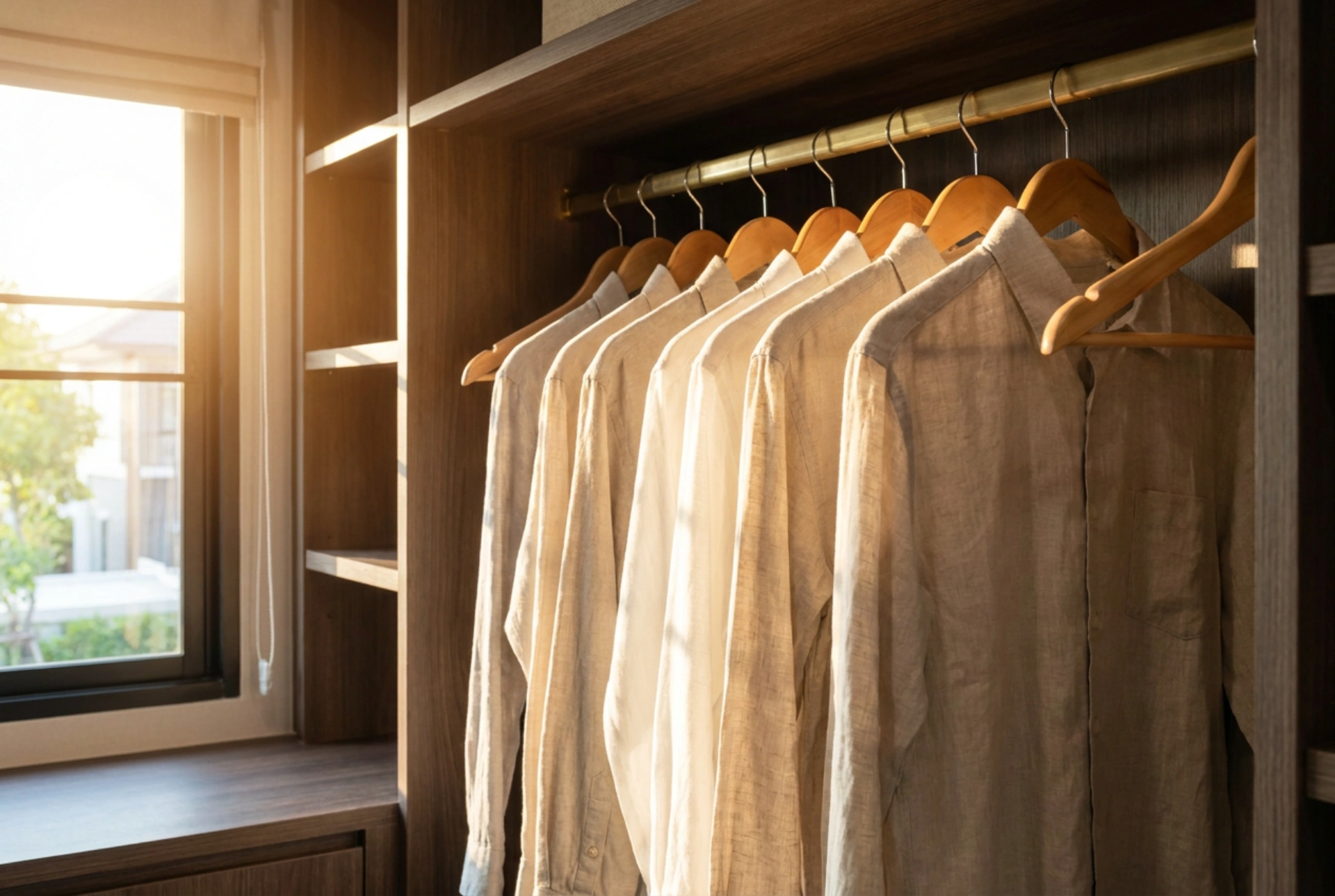
- Wooden Hangers: These provide excellent structural rigidity and a moderate friction coefficient. Broad wooden hangers with contoured shoulders mimic the natural human frame, making them ideal for heavy coats, tailored jackets, and structured blazers. They support the shoulder yoke perfectly, distributing the weight evenly.
- Velvet and Flocked Hangers: These have a high coefficient of friction. The tiny synthetic fibres on the surface grip smooth, lightweight fabrics like silk, satin, and viscose. This prevents the garments from sliding off-centre, which would otherwise concentrate the load on a single shoulder seam and cause distortion.
- Padded Fabric Hangers: Typically wrapped in silk or cotton canvas over a soft batting, these are designed for delicate knits and evening wear. The soft core compresses slightly under the garment's weight, spreading the pressure over a larger surface area and eliminating sharp pressure points.
Hanger Geometry: Matching Shape to Garment Structure
Using a single type of hanger for every item in your wardrobe is a recipe for damaged garments. Different patterns and cuts require specific physical support systems.
Tailored Jackets and Overcoats
Heavy outerwear requires wide, contoured hangers with flared ends (typically 3 to 5 centimetres thick). This mimicking of the human shoulder anatomy keeps the internal padding and lining of the jacket in its intended shape, preventing the shoulder seams from collapsing inward under the weight of the fabric.
Shirts and Blouses
For standard shirts, flat but sturdy hangers with a gentle curve are ideal. The hanger width must match the shoulder-to-shoulder measurement of the shirt. If the hanger is too wide, it will stretch the sleeves; if it is too narrow, the shoulders will drape over the edge, creating a permanent crease right at the upper arm.
Trousers and Skirts
To keep trousers wrinkle-free, they should either be hung by the cuffs using a clamping hanger, allowing gravity to naturally pull down on the fabric and release wear-creases, or folded over a thick, round bar. Thin metal trouser bars create sharp horizontal creases due to the concentrated fold radius. A thick, padded, or felt-covered bar increases the bend radius, preventing the fibres from being compressed into a sharp crease.
Strategic Spacing and Wardrobe Microclimate
Even the best hanger cannot prevent creases if your wardrobe is overcrowded. When garments are packed tightly, they exert lateral compressive force on one another. This pressure, combined with any residual moisture in the air or fabric, sets deep wrinkles into the textiles. Always leave at least two centimetres of space between hangers to allow air circulation, which helps natural fibres shed wrinkles and regulates the humidity inside the wardrobe.