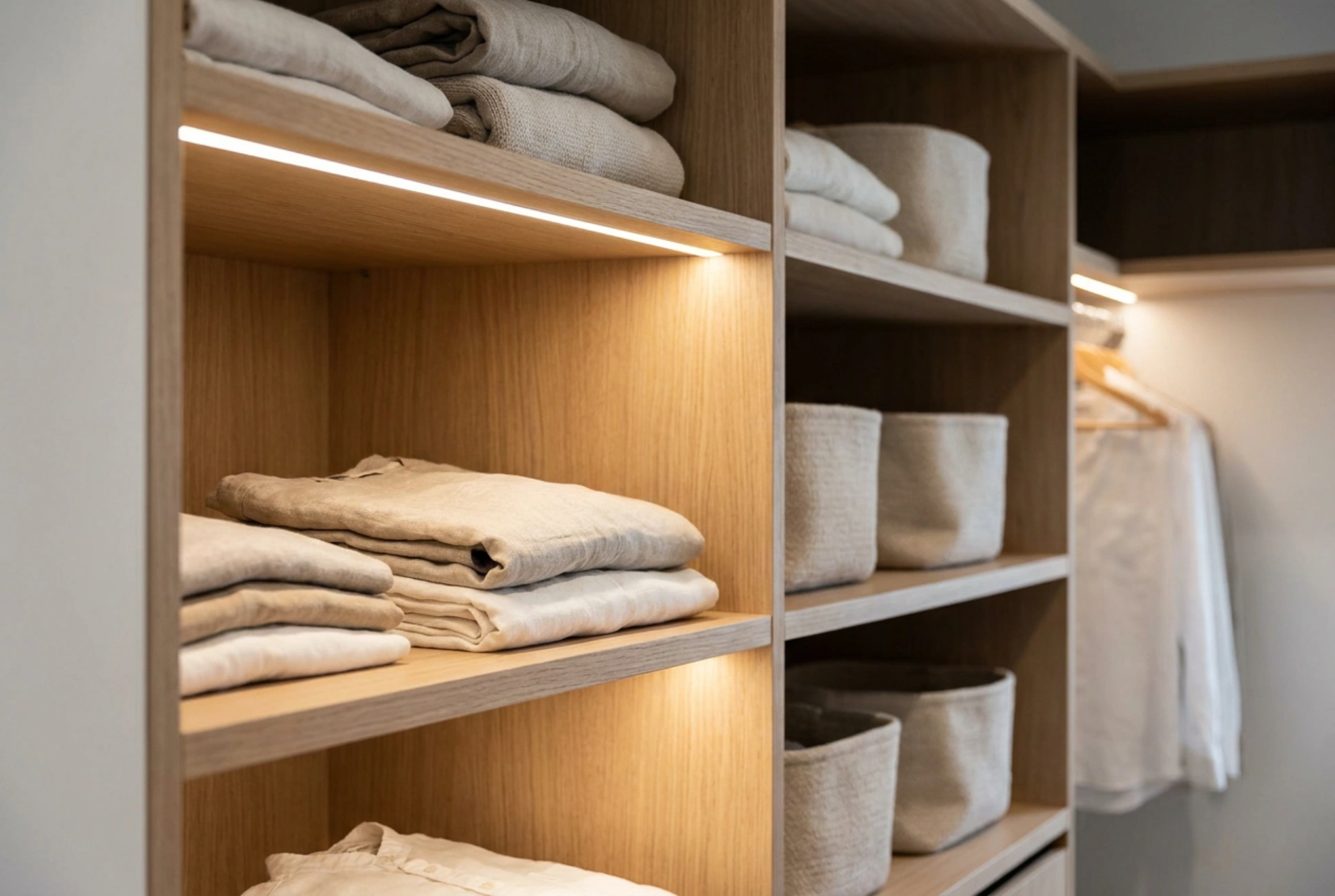


Illuminating a wardrobe effectively requires more than just sticking a light source onto a shelf; it demands an understanding of light quality, thermal dynamics, and electrical properties to ensure both functionality and longevity.
The Science of Color: CRI and Color Temperature
When selecting lighting for a wardrobe, color accuracy is paramount. The Color Rendering Index (CRI), measured as Ra, indicates how faithfully a light source reveals the true colors of objects compared to natural daylight. For wardrobes, you should always select LED strips with a CRI of 90 or higher. Low-CRI lights (under 80) distort hues, making it difficult to distinguish between black and dark navy blue, or altering the perceived saturation of red and green garments.
Color temperature, measured in Kelvins (K), also plays a critical role. A neutral white light of approximately 4000K is ideal for closet interiors. This temperature closely mimics natural midday light, providing a clean, crisp environment that does not alter fabric colors. Warmer light (under 3000K) introduces yellow tones that skew cool-colored fabrics, while extremely cool light (above 5000K) adds a blue cast, making the space feel clinical and altering warm-toned garments.
Diode Density and the Physics of Diffusion
Standard LED strips feature individual Surface Mounted Diodes (SMD) spaced apart along a flexible circuit board. This spacing can create a harsh "dot" effect, resulting in uneven illumination and strong, distracting shadows. To achieve a seamless, continuous line of light, consider two primary factors: diode density and physical diffusion.
- COB (Chip-on-Board) Technology: COB LED strips mount hundreds of tiny chips directly onto a single substrate under a continuous phosphor layer. This eliminates visible hot spots entirely, providing perfectly uniform light distribution even in shallow profiles.
- SMD Density: If using SMD strips, select a high density of at least 120 diodes per meter.
- Diffusion Profiles: Always house the LED strip inside an extruded aluminum profile with a frosted or milky polycarbonate diffuser. The diffuser refracts the light rays in multiple directions, scattering the beam to eliminate harsh glare and soften shadows on your garments.
Thermal Management: Why Aluminum Profiles Are Essential
A common mistake is adhering flexible LED strips directly to wooden or laminated wardrobe panels. Wood is a natural thermal insulator with incredibly low thermal conductivity. Although LEDs run cooler than traditional incandescent bulbs, they still generate significant localized heat at the diode junction. If this heat cannot escape, the temperature of the semiconductor rises, accelerating the degradation of both the adhesive backing and the phosphor layer that determines the light's color temperature.
An aluminum profile acts as a dedicated heat sink. Aluminum has high thermal conductivity, drawing heat away from the diodes and dissipating it into the surrounding air. This thermal management keeps the junction temperature low, preserving the brightness, color consistency, and lifespan of the LED strip over thousands of hours of operation.
Electrical Parameters: Voltage Drop and Power Supplies
Selecting the right power supply (driver) and voltage is crucial for stable operation. LED strips typically operate on constant voltage systems of either 12V or 24V DC. For longer runs within a wardrobe structure, 24V systems are superior. Because higher voltage reduces the current required to deliver the same power, it minimizes "voltage drop"—the gradual loss of voltage along the length of the conductor which causes the LEDs at the far end of the strip to appear dimmer than those near the power source.
To calculate the required capacity of your power driver, multiply the wattage rating per meter of the LED strip by the total length to be installed, then add a 20% safety margin. For example, a 3-meter strip rated at 9.6 watts per meter requires 28.8 watts. Adding the 20% overhead prevents the driver from running at maximum capacity, reducing thermal stress on the transformer components and preventing premature failure.
Automation and Sensor Mechanics
For seamless integration, wardrobe lighting should activate automatically when doors open. This is achieved using two primary sensor technologies:
- Passive Infrared (PIR) Sensors: These detect changes in infrared radiation (heat signatures) caused by human movement. PIR sensors are highly effective for walk-in wardrobes, activating when you step into the space.
- Infrared (IR) Reflection Sensors: Ideal for hinged or sliding doors. These sensors emit a continuous, invisible infrared beam. When the wardrobe door is closed, it reflects the beam back to the receiver, keeping the circuit open (light off). When the door opens, the reflection is broken, completing the circuit and instantly illuminating the cabinet interior.