

Managing the internal micro-space of household drawers is a fundamental challenge in maintaining domestic efficiency. Using plastic drawer organizers provides a highly adaptable, hygienic, and structurally stable solution to control the physical entropy that naturally occurs in high-use storage areas.
The Material Science of Drawer Dividers
When selecting organizing systems, material composition dictates long-term performance. Most high-quality modern organizers are manufactured from thermoplastic polymers, primarily polypropylene (PP) or polyethylene terephthalate (PET). These materials possess specific molecular properties that make them uniquely suited for domestic environments.
- Chemical Inertness: Polypropylene does not react with household acids, oils, or moisture. This prevents the organizer from degrading, emitting volatile organic compounds (VOCs), or absorbing odors over time.
- Non-Porous Surface: Unlike wood or natural fibers, plastics have a closed-cell surface structure. Bacteria, mold spores, and food micro-particles cannot penetrate the material, ensuring a hygienic boundary for kitchen utensils, cosmetics, or cutlery.
- Impact and Flexural Strength: Polymeric structures absorb mechanical energy without breaking. When heavy metal utensils are dropped into a plastic divider, the material flexes microscopically to dissipate the force, protecting both the utensil and the underlying drawer base.
Overcoming Inertia: The Physics of Sliding Items
Every time a drawer is opened or closed, its contents are subjected to acceleration and deceleration. According to Newton’s first law of motion, objects inside will continue moving in their state of motion until acted upon by an external force. In an undivided drawer, this results in items sliding to the back or front, causing chaotic mixing and potential damage.
Dividers solve this by establishing rigid physical boundaries that restrict the distance an object can travel. To maximize this stabilizing effect, the coefficient of friction between the organizer and the drawer liner must be managed. Placing small, elastomeric thermoplastic polyurethane (TPU) feet or silicone pads beneath the plastic organizer increases grip, preventing the entire tray from shifting during rapid drawer movements.
Zonal Ergonomics and Spatial Division
Effective organization relies on matching the physical layout of the divider with human movement patterns. Drawers should be mapped into primary, secondary, and tertiary reach zones based on the ease of physical access. The front section of the drawer, closest to the user, represents high-value ergonomic space where frequently utilized tools should reside.
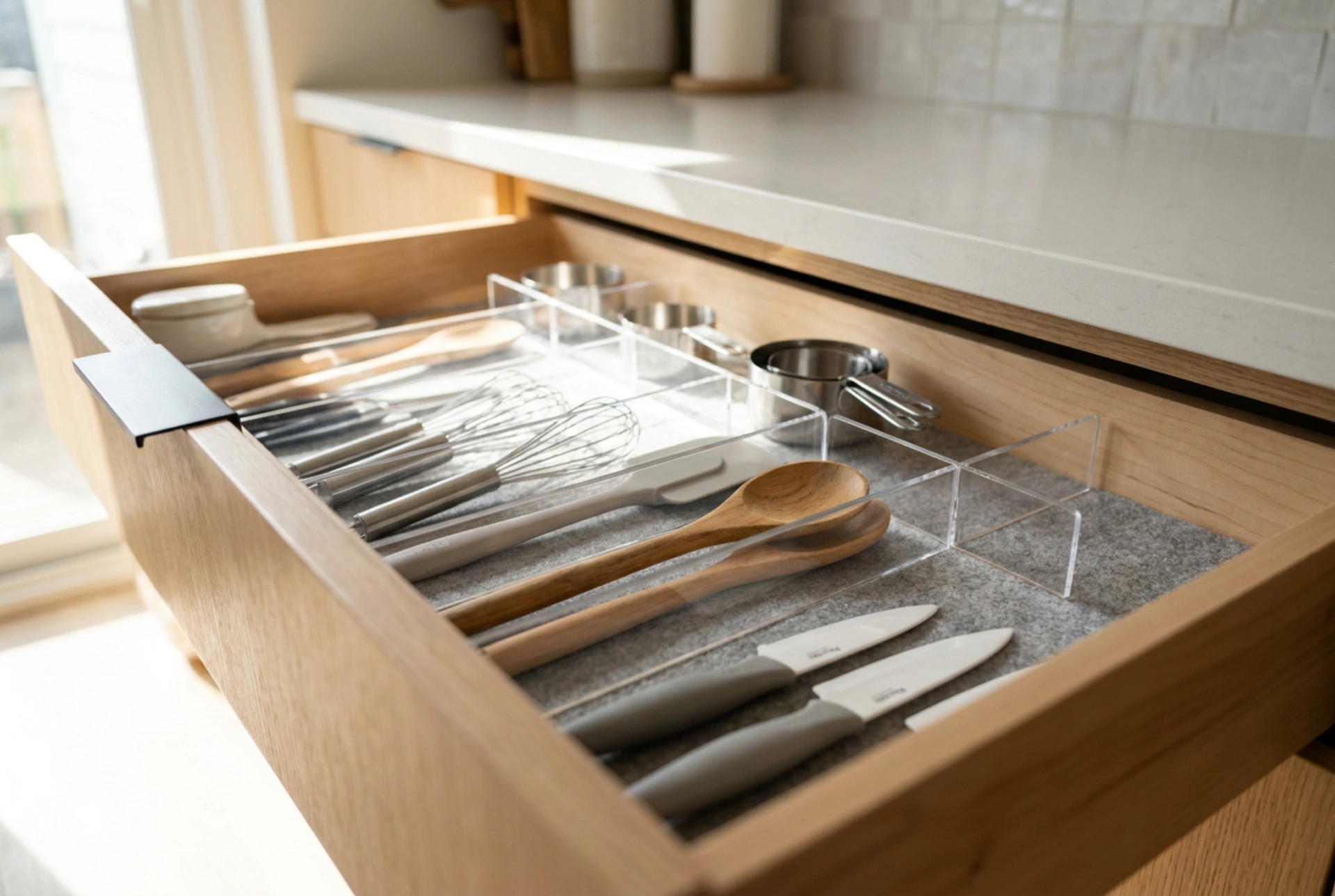
A modular plastic organizing system allows for custom-tailored grids. Linear compartments are ideal for guiding the long axes of cutlery and tools, preventing lateral rotation. Smaller, square compartments prevent tiny, low-mass items from getting lost under larger objects, ensuring that every tool remains visible and immediately accessible at a single glance.
Cleaning Mechanics and Chemical Compatibility
Over time, dust, skin oils, and food residues accumulate within drawer organizers. Cleaning plastic dividers requires an understanding of polymer chemistry to avoid degrading the material. Strong organic solvents, such as acetone or high-concentration alcohol, can disrupt the polymer chains in polystyrene or acrylic, leading to cloudiness, micro-cracking, or structural failure.
The safest and most effective decontamination method involves using mild anionic surfactants (standard dishwashing liquid) dissolved in lukewarm water (under 40 degrees Celsius to prevent thermal warping). Surfactant molecules lower the surface tension of water, allowing it to penetrate greasy residues. For sanitization, a diluted solution of oxygen bleach (sodium percarbonate) can be safely applied to polypropylene to break down organic stains without compromising the polymer structure.