

Selecting the right ironing board for a steam generator is a decision rooted in thermodynamics, as standard boards quickly become saturated, leading to ruined garments and water-damaged floors. To handle the high-volume output of modern steam stations, an ironing board must act as an active ventilation system rather than a solid barrier.
The Physics of Steam: Why Standard Boards Fail
Unlike traditional steam irons that release around 40 grams of moisture per minute, steam generators produce a continuous flow of highly pressurized steam, often exceeding 120 grams per minute. This massive volume of gaseous water must go somewhere. When it hits a standard ironing board made of solid wood or thin plastic, the steam cools rapidly upon contact with the cooler surface, undergoing a phase transition back into liquid water.
This condensation accumulates in the padding, eventually soaking the board cover. The result is a damp fabric that is impossible to crease correctly, alongside water dripping onto your floor. A dedicated steam generator board must be designed to either actively draw this steam away or allow it to pass through the structure entirely unobstructed.
Key Structural Features: The Mesh Core
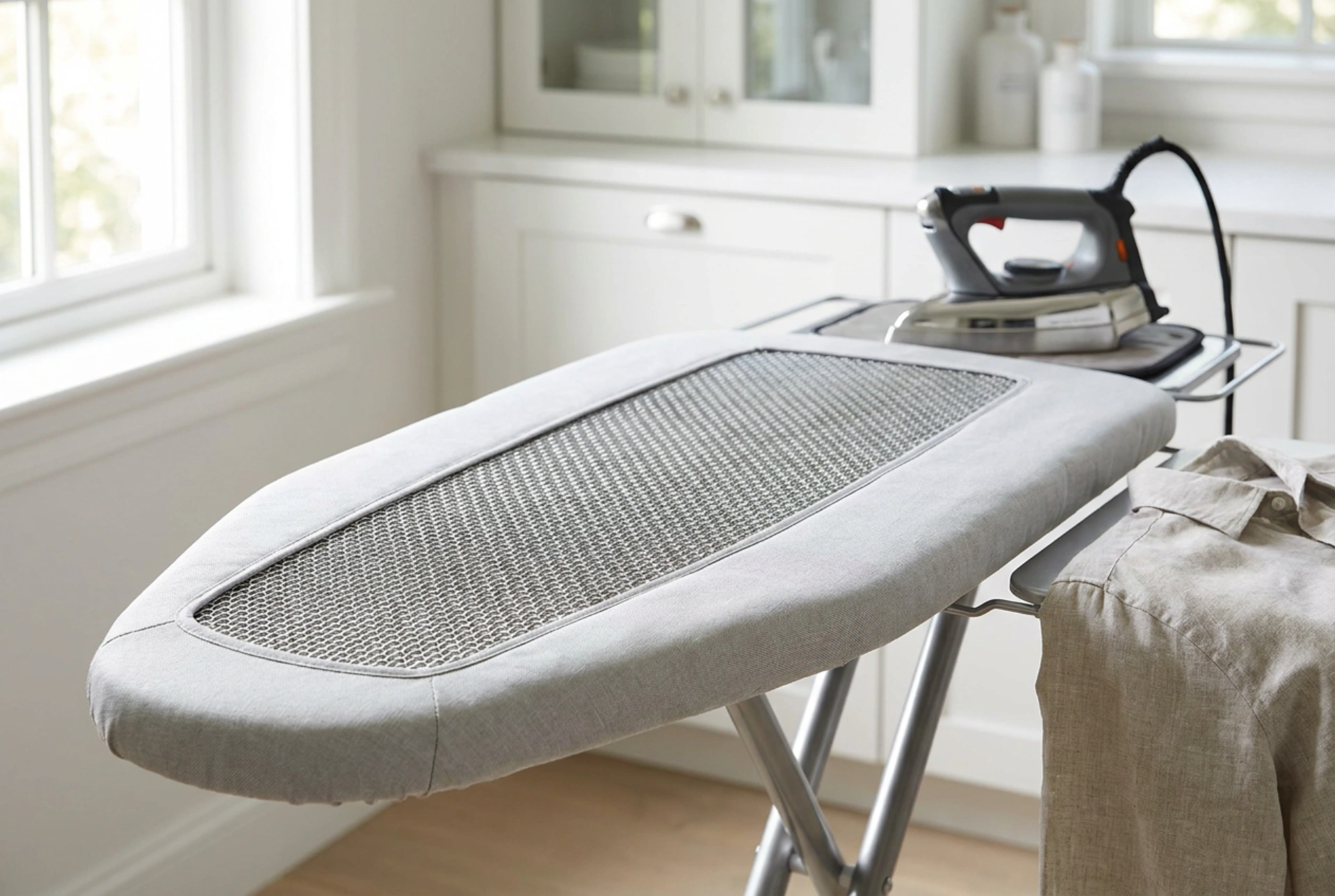
The foundation of a high-quality steam station board is its mesh core. Solid backing materials are entirely unsuitable. Instead, look for a platform made from expanded steel mesh. The size and density of the mesh openings are critical: if the holes are too small, they restrict airflow; if they are too large, the mesh can warp under the heat and pressure of the iron.
A high-quality mesh features a wide grid pattern that allows steam to escape downward. To prevent the pattern of the metal mesh from transferring onto your delicate fabrics, the mesh must be covered by a multi-layered padding system. This ensures that while steam passes through freely, the physical texture of the steel remains insulated from the garment.
Material Science of the Cover and Padding
The layers resting on top of the metal mesh determine how efficiently heat and moisture are managed during the ironing process. A standard foam pad is insufficient because polyurethane degrades quickly under high temperatures and holds onto moisture. Instead, seek a multi-layer composition:
- The Outer Layer: Pure cotton is the ideal material for the exterior cover. Cotton provides the necessary friction to hold garments in place while remaining highly breathable. Many premium covers feature a metallic or ceramic powder coating, which reflects heat back into the fabric, effectively ironing both sides of the garment simultaneously.
- The Intermediate Layer: A dense felt underlay (typically made of polyester or wool needle felt) acts as a thermal barrier and moisture absorber. Felt absorbs excess moisture without losing its structural integrity or flattening over time.
- The Steam-Permeable Layer: Some advanced boards incorporate a specialized waterproof but vapor-permeable membrane that directs steam down and away from the user, preventing steam burns on the hands.
Stability and Weight Management
Steam generators are heavy appliances, often weighing between 4 and 6 kilograms when fully filled with water. Placing this weight on a flimsy, lightweight ironing board is a safety hazard. Look for a frame constructed from thick-walled steel tubing, preferably with a powder-coated finish to prevent corrosion from escaping moisture.
A wide, asymmetrical base (often referred to as a T-leg or Y-leg structure) provides the best resistance against tipping. Furthermore, the iron rest at the end of the board must be specifically engineered to support the footprint of a large steam station. It should feature non-slip, heat-resistant silicone pads that can withstand temperatures up to 230 degrees Celsius without melting or degrading.
Maintenance and Post-Ironing Care
Because of the sheer volume of water introduced during a session, proper maintenance is required to prolong the life of your board. After finishing, do not fold the board immediately. Leave it open in a well-ventilated area for at least 30 minutes to allow the felt and cotton layers to dry completely. This simple habit prevents the formation of mold, mildew, and rust on the underlying steel frame.