

Dishwasher salt is a fundamental component of appliance maintenance, yet its role is frequently misunderstood as a cleaning agent rather than a chemical regenerator. Understanding how this substance interacts with your machine’s internal systems is key to preventing catastrophic limescale build-up and ensuring spotless glassware.
The Chemistry of Dishwasher Salt
At its core, dishwasher salt is nearly 100% pure sodium chloride (NaCl). While this is the same chemical compound found in table salt, the two substances are physically and chemically distinct in ways that are critical to your appliance's survival. Table salt contains microscopic additives, such as anti-caking agents (sodium ferrocyanide or magnesium carbonate) and sometimes potassium iodide. If introduced into a dishwasher, these fine particles can clog the delicate water-softening unit and permanently damage the chemical resin inside.
Furthermore, dishwasher salt features a coarse, granular structure. These large crystals dissolve slowly and uniformly. If fine table salt were used, it would dissolve too rapidly, leading to an over-concentrated brine solution that could crystallise, block the intake valves, or cause premature corrosion of the stainless-steel interior.
How Hard Water Threatens Your Appliance
Tap water naturally contains dissolved minerals, primarily calcium (Ca2+) and magnesium (Mg2+) cations. When heated during a dishwasher cycle, these minerals undergo a thermal precipitation reaction, transforming into insoluble calcium carbonate (CaCO3) – commonly known as limescale. This scale precipitates onto heating elements, reducing thermal efficiency and forcing the appliance to draw more electrical power to reach operating temperatures.
Over time, limescale restricts water flow by narrowing the internal diameters of spray arm nozzles and feed pipes. It also degrades the physical properties of internal rubber seals, leading to micro-leaks. To prevent this mechanical degradation, every modern dishwasher features an integrated ion-exchange water softener.
The Ion-Exchange Mechanism Explained
The water softener built into your dishwasher is a chamber filled with millions of microscopic polymer resin beads. These beads are chemically treated to carry a negative electrostatic charge. In their active state, these beads hold loosely bound, positively charged sodium ions (Na+).
When hard water enters the dishwasher, it must first pass through this resin chamber. Because calcium and magnesium ions carry a stronger positive charge (divalent cations, 2+) than sodium (monovalent cation, 1+), they exhibit a higher affinity for the negatively charged resin. Through a process of electrostatic displacement, the calcium and magnesium ions bind tightly to the resin beads, forcing the weaker sodium ions out into the water. This molecular swap softens the water before it reaches the heating elements and wash tub, preventing any limescale formation on your dishes or the machine's internal components.
Why the Resin Needs Dishwasher Salt
The ion-exchange resin has a finite capacity. Eventually, all the available binding sites on the resin beads become saturated with calcium and magnesium ions, leaving no sodium ions to swap. At this point, the water-softening process stops entirely. This is where dishwasher salt becomes essential.
During the regeneration cycle, the dishwasher bypasses the washing chamber and floods the resin bed with a highly concentrated solution of dissolved dishwasher salt (brine). Because the concentration of sodium ions in this brine is incredibly high, it overwhelms the chemical bond between the resin and the calcium/magnesium ions. Through sheer mass action, the sodium ions force the calcium and magnesium off the resin beads, taking their places once again. The displaced mineral ions, along with the excess salt water, are then pumped directly out through the waste drain, leaving the resin completely regenerated and ready for the next wash cycle.
Proper Maintenance and Corrosion Prevention
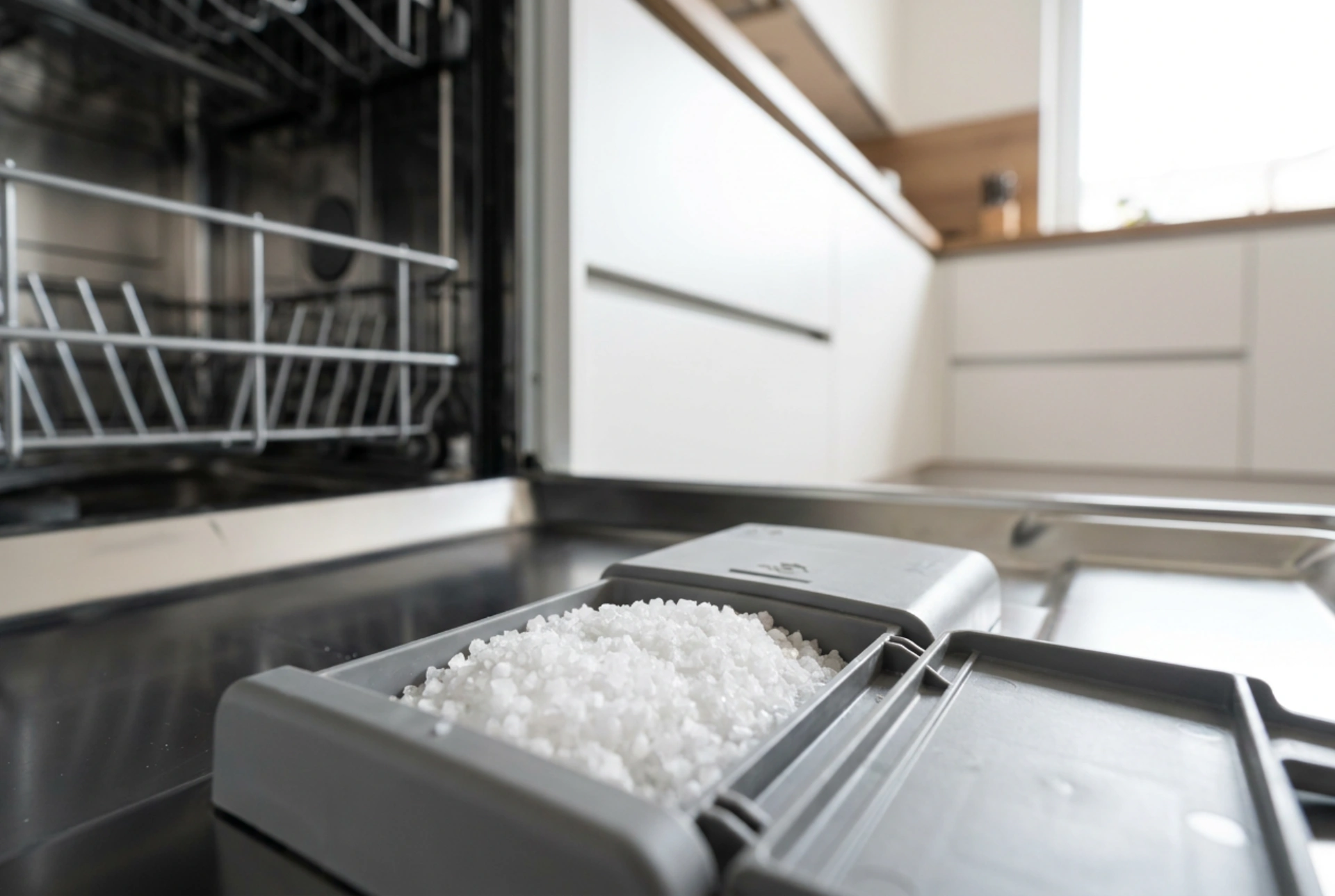
To ensure this chemical process works flawlessly, proper physical handling of dishwasher salt is required. Always use a funnel when pouring salt into the reservoir, which is typically located at the bottom of the wash cabinet. Because sodium chloride is highly corrosive to metal when exposed to oxygen, any spilled salt crystals or saline water must not be allowed to sit on the stainless-steel floor of the tub.
The best practice is to refill the salt reservoir immediately before running a complete hot wash cycle. The mechanical agitation of the water and the elevated temperatures during the cycle will dissolve and flush away any accidental spills, protecting your machine's structural integrity.