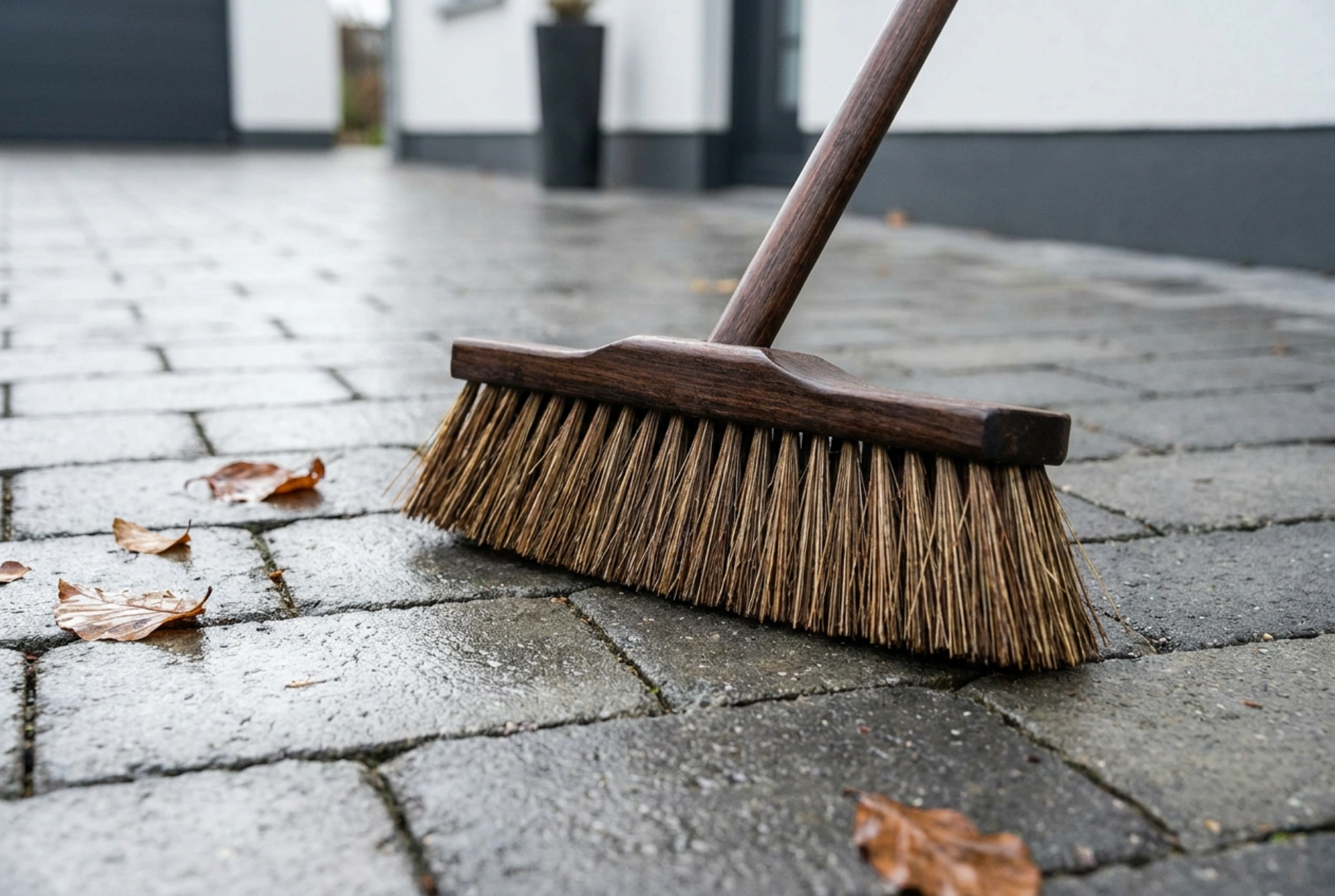


Cleaning paving stones after a downpour or intensive garden work requires more than a standard household broom; damp soil, crushed leaves, and wet sand cling to textured stone surfaces due to capillary action.
Understanding Capillary Cohesion on Wet Stone
When rainwater mixes with fine soil, clay, or compost on concrete paving, it creates tiny liquid bridges between the debris particles and the porous stone. This phenomenon, known as capillary cohesion, binds the damp debris tightly to the pavement. A standard soft broom will simply glide over this layer, flattening the mud into the pores of the stone rather than lifting it. To break these physical bonds, you must apply sufficient mechanical shear force. This requires bristles with high bending stiffness that can penetrate the micro-textures of the paving slabs and physically dislodge the adhered particles.
Selecting the Right Bristles: Synthetic vs. Natural Fibres
The choice of broom bristle material determines your efficiency when dealing with wet, heavy garden waste. Different materials behave uniquely when exposed to moisture:
- Polypropylene (PP): These synthetic polymers are highly hydrophobic, meaning they do not absorb water. PP bristles retain their structural stiffness, diameter, and springiness even when completely wet. They are ideal for scraping wet mud and heavy organic debris from rough concrete surfaces because the polymer chains do not relax or lose their elastic memory when saturated.
- PVC (Polyvinyl Chloride): Similar to polypropylene, PVC bristles offer excellent resistance to moisture and wear. They are often flagged or split at the ends to catch finer wet sand, though stiff, unflagged variants are better for heavy garden waste.
- Bassine and Piassava: These coarse, natural vegetable fibres are highly abrasive. While they perform exceptionally well on heavy, wet debris, they can absorb water over time, which slightly reduces their stiffness. They remain a traditional, durable choice for outdoor surfaces.
Avoid soft materials like coco or fine nylon. These fibres lack the tensile strength and cross-sectional density required to push heavy, wet materials, and will quickly clog, flattening under the load.
Effective Sweeping Techniques and Motion Mechanics
Using the correct physical technique prevents fatigue and ensures you do not grind dirt deeper into the paving. The motion should change depending on the nature of the debris:
- The Pull Stroke for Heavy Mud: For thick piles of wet soil or damp leaves, place the broom head ahead of the pile and pull it towards you. This action utilizes your body weight, keeps the bristle angle steep, and prevents the broom from riding over the debris.
- The Diagonal Push for Clearing: When clearing lighter residue, push the broom forward. Crucially, always sweep diagonally across the joints of the paving. Sweeping parallel to the joints can gouge out the jointing sand, weakening the structural lock between the blocks.
- Controlled Sweeping Arc: Keep your strokes short and controlled. Long, sweeping arcs flick wet, muddy water onto clean walls, fences, or your legs, spreading the mess rather than containing it.
Broom Head Width and Force Distribution
Selecting the correct broom head width is another critical physical factor in outdoor cleanup. A head that is too wide (over 60 cm) distributes your downward force over too large an area, reducing the effective pressure per square centimetre and failing to dislodge stuck mud. Conversely, a head that is too narrow (under 30 cm) requires excessive passes, increasing physical strain. A 40 to 50 cm broom head offers the optimal physical balance between force distribution and surface coverage.
Preventing Organic Staining and Joint Damage
Leaving wet garden debris on paving stones is not just an aesthetic issue; it can cause lasting material damage. Organic matter like leaves, grass clippings, and soil contains tannins and humic acids. When left damp on alkaline concrete or porous natural stone, these organic compounds undergo oxidation, leaving stubborn brown or yellow stains that are difficult to remove without chemical treatment. Promptly sweeping the paving after garden work is essential to prevent this chemical binding.
Furthermore, care must be taken with the jointing material. Most block paving relies on fine kiln-dried sand or polymeric sand to lock the blocks in place. If your sweeping is too aggressive, or if you use a high-pressure water stream instead of a broom, you risk washing or sweeping this crucial structural component away. If jointing sand is displaced during the cleanup, wait for the paving to dry completely, then sweep fresh kiln-dried sand back into the joints using a softer, dry-use broom to restore the structural integrity of the driveway or patio.