

Maximising laundry efficiency in restricted spaces requires a deep understanding of thermodynamic principles and appliance mechanics. A slim washer-dryer equipped with an integrated heat pump offers a highly efficient, ventless solution that preserves both physical square footage and textile integrity.
The Thermodynamics of Closed-Loop Heat Pump Systems
Traditional tumble dryers rely on open-loop systems, drawing in ambient air, heating it with energy-intensive electrical elements, and exhausting the moisture-laden air outside. In a small bathroom, this process is highly inefficient and physically impractical due to the lack of external venting options. A heat pump washer-dryer operates on a closed-loop thermodynamic cycle, resembling a refrigerator working in reverse.
The system utilises a compressor, an evaporator, and a condenser filled with a refrigerant fluid. The compressor pressurises the refrigerant, raising its temperature. This heat is transferred to the dry air entering the drum, which absorbs moisture from the damp clothing. As the warm, damp air leaves the drum, it passes through the cold evaporator. Here, the temperature drops rapidly below the dew point, causing the airborne moisture to condense into liquid water, which is then pumped directly into the wastewater drain. The cooled, dry air is then reheated by the condenser and recirculated back into the drum. This continuous cycle eliminates the need for external ducting and dramatically reduces energy consumption, as heat is recycled rather than expelled.
Moisture Extraction and Indoor Microclimate Control
One of the greatest challenges in small bathrooms is the accumulation of relative humidity, which can lead to condensation on cold tile surfaces, paint peeling, and mould growth. Standard condenser dryers release a significant amount of residual moisture and ambient heat into the surrounding room during operation.
Because a heat pump system is completely sealed, moisture containment is virtually absolute. The water extracted from the textiles is actively collected and routed straight to the household plumbing. By preventing water vapour from escaping into the room, the appliance maintains a stable indoor microclimate. This is particularly beneficial in tight, poorly ventilated bathrooms where moisture accumulation would otherwise trigger structural degradation and compromise air quality.
Vibration Dampening and Kinetic Stability in Slim Appliances
Slim appliances, typically featuring a depth of less than 50 centimetres, present unique challenges regarding mechanical stability. With less physical mass to absorb kinetic energy, these machines are more susceptible to vibrations during the high-speed spin cycle, which can reach up to 1400 revolutions per minute.
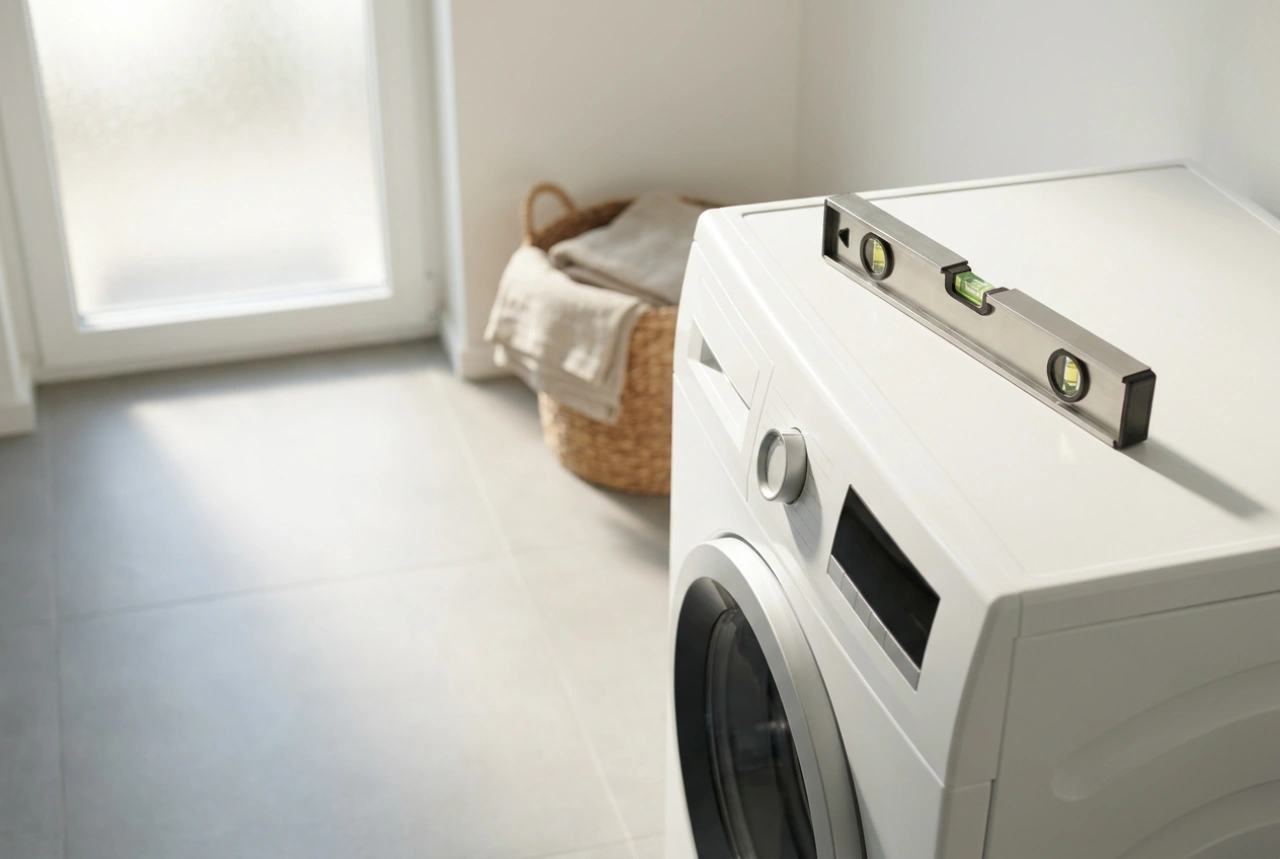
To counteract this, modern slim washer-dryers employ advanced suspension systems consisting of heavy concrete or cast-iron counterweights coupled with hydraulic friction dampers. To ensure optimal performance and prevent the appliance from shifting, precise levelling is mandatory. Using a spirit level, the adjustable feet must be calibrated so that the machine sits perfectly level on a solid, non-yielding floor, such as concrete or reinforced tiling. Placing vibration-dampening rubber pads under the feet can further isolate kinetic energy, preventing the transmission of structural noise through the walls of a compact apartment.
Fibre Protection through Lower Operating Temperatures
Conventional washer-dryers dry garments at temperatures exceeding 75°C, which can cause severe thermal stress to textile fibres. High heat leads to fibre shrinkage, elastic degradation, and weakened structural integrity, particularly in delicate materials like wool, silk, and modern synthetic blends.
A heat pump system operates at a much lower, gentler temperature range, typically between 45°C and 55°C. This lower thermal threshold is highly effective because dry air is continually circulated, relying on efficient moisture evaporation rather than extreme heat. The reduction in thermal stress preserves the natural elasticity of cotton, prevents the warping of synthetic fibres, and reduces static build-up. Consequently, garments maintain their shape, colour vibrancy, and soft texture for significantly longer cycles.
Critical Installation Requirements and Clearance Margins
Successfully integrating a slim heat pump washer-dryer into a compact bathroom requires careful planning of plumbing, electrical, and structural interfaces:
- Drainage Integration: Unlike standalone dryers that use removable water reservoirs, a combined washer-dryer must be plumbed directly into the wastewater system. A dedicated standpipe with a U-bend trap is essential to prevent sewer gases from back-flowing into the drum.
- Electrical Load Management: Heat pump dryers are highly energy-efficient, typically drawing under 1000 watts during the drying phase, compared to over 2500 watts for resistive heaters. This lower electrical draw reduces the risk of overloading standard domestic ring mains.
- Airflow Clearance: Although the drying loop is closed, the compressor and cooling fans still require adequate ventilation. A minimum clearance of 10 to 15 millimetres on the sides and 50 millimetres at the rear is necessary to facilitate convective cooling of the internal components, ensuring long-term mechanical reliability.