

Maintaining a tidy system for hair accessories in a humid bathroom environment requires more than just tossing them into a drawer; it demands an understanding of material friction and spatial organisation. Establishing a methodical structure prevents mechanical damage to delicate clips and keeps elastic bands hygienic and accessible.
The Material Science of Hair Accessory Friction
Hair accessories are composed of diverse materials—elastic rubber, woven polyester, silk, metal, and cellulose acetate (plastic). When stored together loosely, these materials interact based on their coefficients of static and kinetic friction. Smooth silk scrunchies slide easily, whereas textured elastic bands grip other surfaces, leading to tangles and structural stress on delicate joints. To combat this, categorise your accessories by material texture. Group high-friction items, such as silicone elastics and rubberised grip clips, together in isolated compartments. Low-friction items like metal claw clips and silk scrunchies should occupy separate zones where they can slide freely without snagging fabric fibres or bending delicate springs.
Selecting the Right Organiser Material for Humid Environments
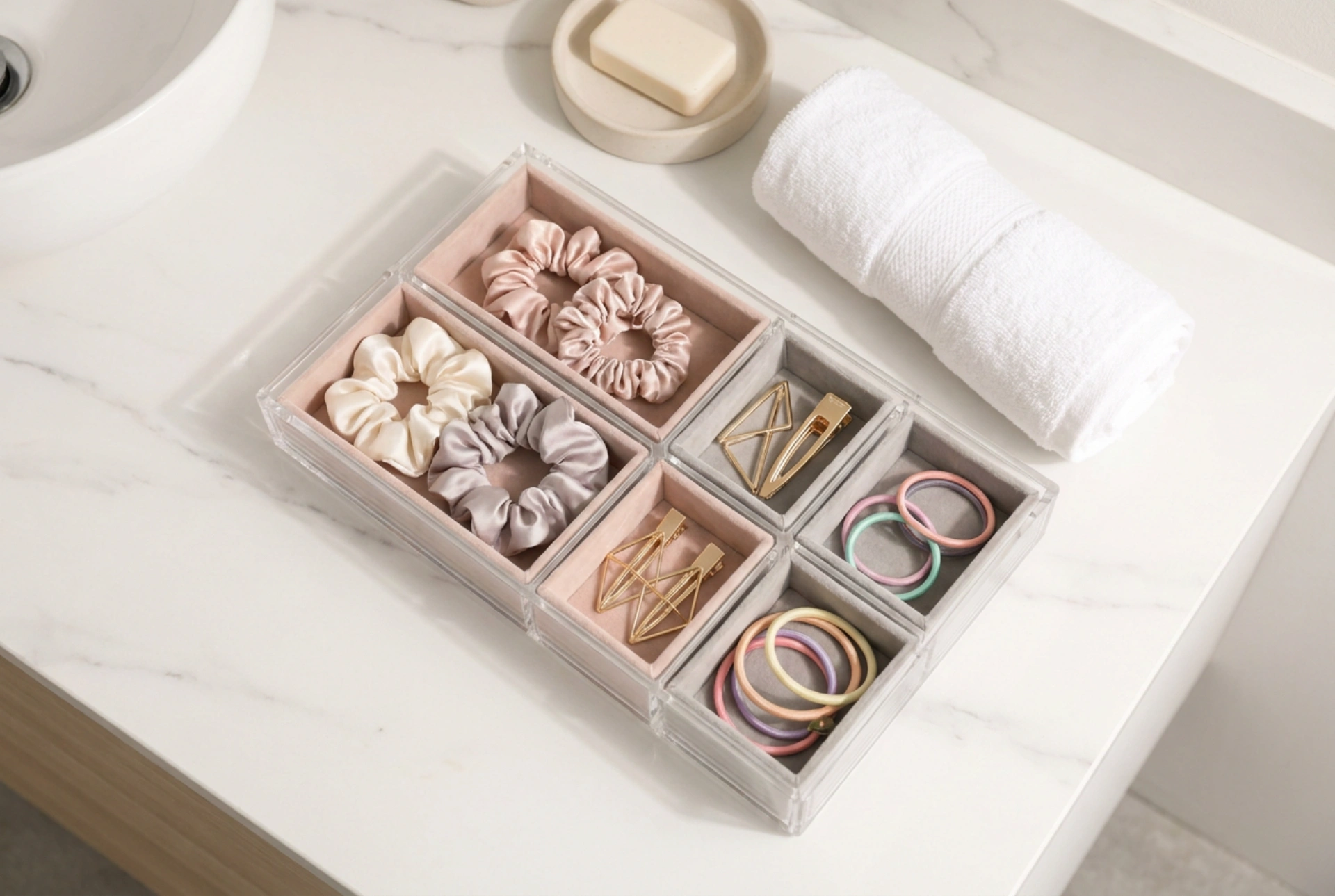
The bathroom is a high-humidity zone, which significantly impacts material longevity and hygiene. Fabric-lined boxes or cardboard dividers absorb airborne moisture, creating a breeding ground for mould, mildew, and bacteria. Instead, opt for non-porous, hydrophobic materials such as acrylic, polystyrene, tempered glass, or food-grade silicone. Acrylic and glass organisers provide optical clarity, allowing you to locate items instantly without rummaging, which mechanically disrupts the sorted system. Silicone dividers offer excellent grip, preventing individual compartments from sliding when drawers are opened and closed. These materials are also chemically inert, meaning they will not degrade when exposed to residues of hairspray, oils, or sanitising agents.
The Order of Operations: Sorting by Geometry and Frequency
To build a sustainable organisational system, arrange items based on their geometry and frequency of use. Begin by emptying all accessories and categorising them into three functional groups: daily essentials, occasional styling tools, and bulk spares. Position daily items in the most accessible, shallow upper trays. Group items by their mechanical closure types: tension-based bobby pins require flat, magnetic strips to hold them in place without stretching the metal; spring-loaded claw clips need deep, vertical compartments to prevent pressure on the internal coil springs; and elastic ties should be looped around vertical cylinders or placed in shallow, open trays. Avoid nesting claw clips inside one another, as the constant tension on the interlocking teeth can cause micro-fractures in the plastic over time.
Hygiene and Pre-Storage Sanitisation
Hair accessories accumulate sebum, dead skin cells, hair styling products, and environmental dust. Storing soiled accessories transfers these contaminants to your clean organiser, accelerating bacterial growth. Before placing any item into its designated compartment, perform a thorough cleaning. Wash plastic clips, acetate combs, and silicone bands in warm water (around 40 degrees Celsius) mixed with a few drops of a mild surfactant, such as a neutral dishwashing liquid or shampoo, which emulsifies lipid-based build-up. For metal hairpins, wipe them down with an isopropyl alcohol solution to sanitise without inducing rust. Ensure all items are completely dry before storage, as trapped moisture inside closed compartments promotes oxidation of metal springs and compromises the elasticity of rubber bands.