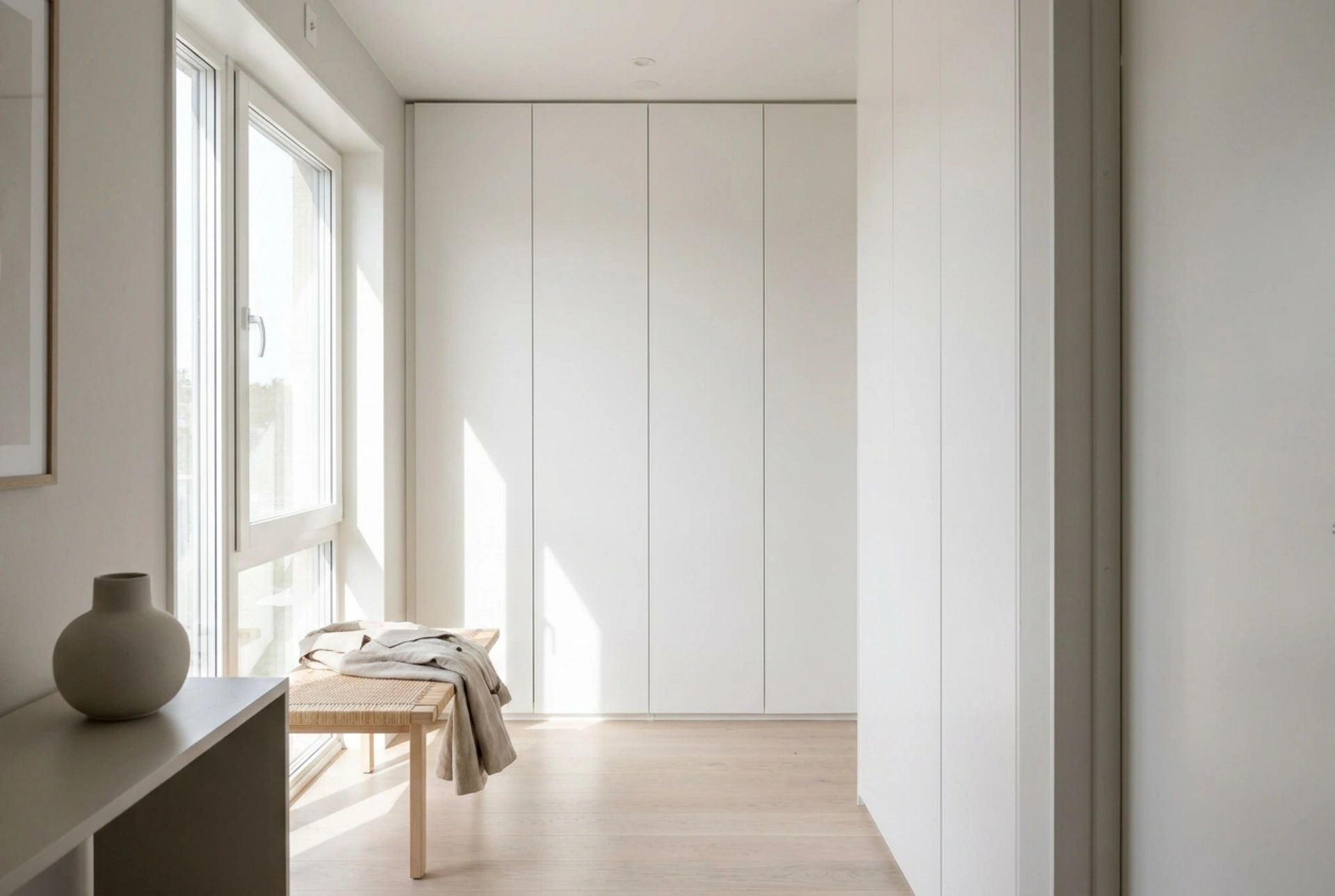


A seamless white wardrobe acts as a functional architectural extension that visually expands narrow entryways while offering high-capacity storage to conceal daily transit items. By utilizing specific principles of light reflection and ergonomic spatial planning, this design choice transforms a chaotic transition zone into a serene, orderly threshold.
The Physics of Light and Visual Space Expansion
The primary benefit of a floor-to-ceiling white wardrobe in a hallway lies in its high albedo—the measure of diffuse reflection of solar radiation. White surfaces reflect up to 80-90% of visible light, whereas dark surfaces absorb most of the spectrum. In narrow, often windowless hallways, this high reflectivity prevents the closed storage unit from feeling like a massive, looming obstacle. Instead, the wardrobe acts as a secondary light source, bouncing ambient light from adjacent rooms deeper into the corridor.
When choosing materials, the finish significantly alters this reflective dynamic. Glossy lacquer or acrylic surfaces create specular reflection, acting almost like mirrors to create depth, but they can highlight minor surface imperfections, dust, and fingerprints. Matte finishes, on the other hand, provide diffuse scattering, which softens the light and creates a velvety, uniform surface that blends effortlessly with standard plasterboard walls. This paint-matching integration tricks the human eye into perceiving the wardrobe as a structural wall rather than a piece of furniture, effectively neutralizing its physical bulk.
Ergonomic Architecture: Eliminating Visual Noise
Visual noise refers to the chaotic accumulation of shapes, colors, and textures that the brain must process upon entering a home. Coats, shoes, bags, and keys left on open hooks create a high density of visual stimuli, which triggers subconscious stress. A closed wardrobe system serves as a physical barrier that intercepts this sensory overload.
To maximize this effect, the wardrobe should feature handleless, push-to-open doors. Eliminating physical hardware removes horizontal and vertical interruptions, allowing the facade to remain entirely flat. Floor-to-ceiling construction eliminates the dead space above the cabinet—a notorious zone for dust accumulation and secondary clutter—while ensuring that the vertical lines guide the eye upward, increasing the perceived height of the ceiling. This structural alignment ensures that the wardrobe integrates perfectly into the hallway's geometry.
Internal Zoning and Micro-Organization Mechanics
Hiding clutter effectively requires an internal structure that mirrors the physics of daily movement. The hallway is a high-velocity transit zone where items are discarded and retrieved in rapid succession. Without an intuitive internal zoning system, the wardrobe interior quickly descends into disarray, spilling back out into the hallway.
- The Active Zone (Eye-Level): This area must contain sturdy, double-prong hooks or heavy-duty hangers suspended from a robust rail. It should be reserved exclusively for coats currently in use.
- The Drop Zone (Mid-Height): Small pull-out drawers or integrated trays should hold keys, mail, and charging devices, keeping these high-rotation items accessible but hidden.
- The Base Zone (Floor-Level): Slanted shoe metal racks or ventilated mesh drawers allow air circulation, facilitating the evaporation of residual moisture from wet footwear.
- The Static Zone (Top Shelves): Out-of-season garments, sports gear, and spare bedding should reside here in sealed, breathable canvas boxes.
Material Science and Maintenance of White Surfaces
To ensure the white facade retains its pristine appearance, understanding the material chemistry is vital. White polymers, melamines, and lacquers are susceptible to photo-degradation, where ultraviolet (UV) light breaks down chemical bonds, leading to yellowing over time. Selecting materials with integrated UV stabilizers is crucial for longevity.
For maintenance, avoid any cleaners containing abrasive particles, chlorine bleach, or strong solvents like acetone, which can micro-scratch the surface or strip the protective topcoat. Instead, use a dilute solution of a non-ionic surfactant (such as standard dishwashing liquid) in lukewarm water. Apply this using a lint-free microfiber cloth. Microfiber contains microscopic fibers that physically lift oils and dust from the microscopic crevices of matte or gloss surfaces without requiring heavy friction, preserving the original refractive index of the white finish.