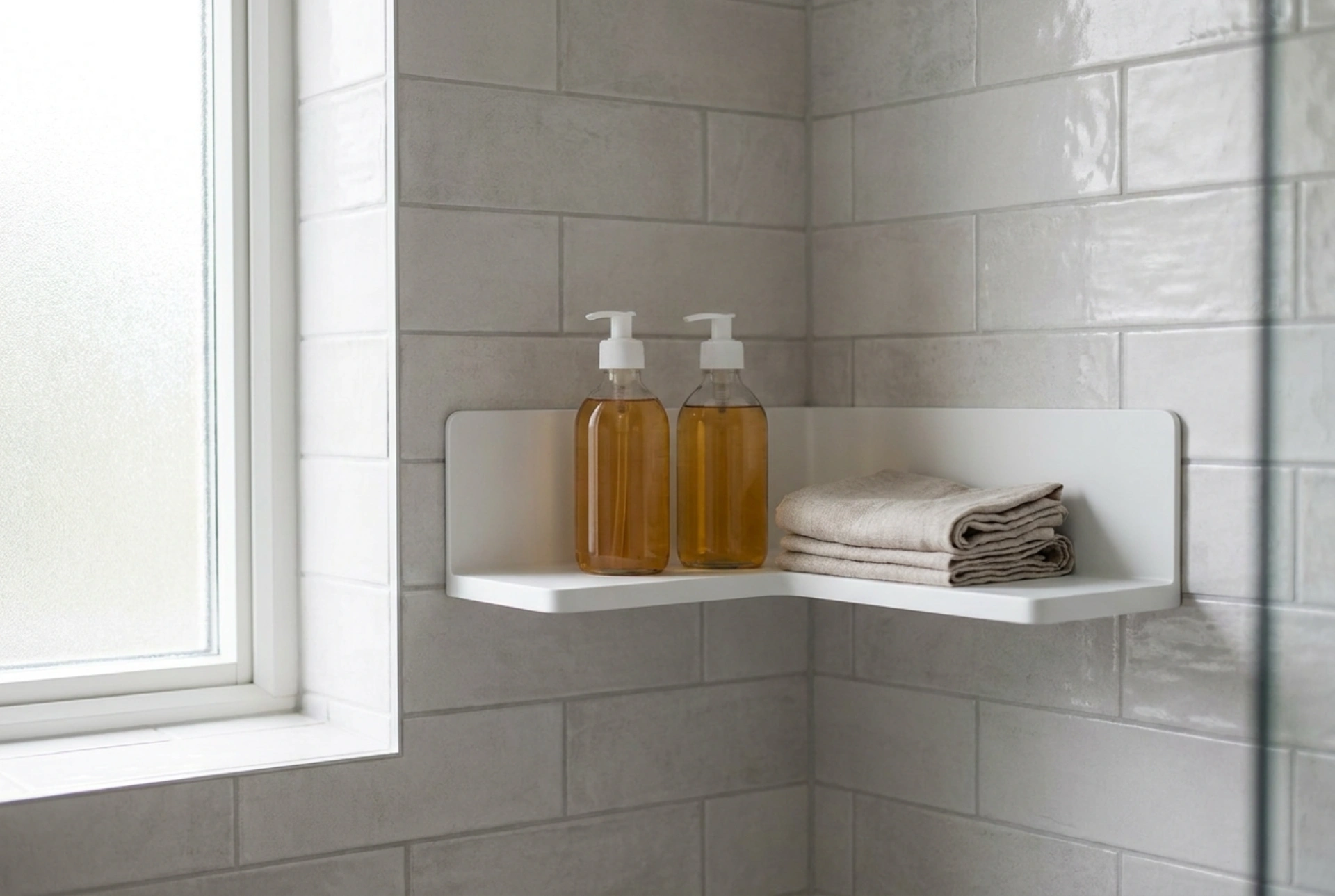


Clearing bottles and toiletries from the edges of your bathroom basin reduces moisture buildup, limescale accumulation, and the growth of biofilm. Transitioning to a hanging corner shelf utilises underused vertical space while exploiting structural physics to create a cleaner, drier, and more hygienic washbasin area.
The Science of Basin Clutter: Why Standing Bottles Breed Grime
When soap dispensers, toothbrushes, and skincare bottles sit directly on the flat edges of a ceramic basin, they trap water underneath them. This is driven by capillary action, where water is drawn into the narrow gap between the bottom of a bottle and the basin surface. Because air circulation is restricted in these micro-spaces, evaporation is extremely slow. This stagnant moisture creates an ideal breeding ground for bacteria and mould, resulting in a slippery biofilm.
Furthermore, mains water contains dissolved minerals such as calcium carbonate and magnesium. When trapped water eventually evaporates around the base of these bottles, it leaves behind solid mineral deposits known as limescale. These deposits chemically bond with the ceramic glaze or stone surface, requiring aggressive descaling agents to remove. Elevating these items onto a suspended corner shelf eliminates this capillary trapping, allowing the basin surface to shed water efficiently into the drain and dry rapidly through natural convection.
Material Science: Selecting a Durable Corner Shelf
The bathroom is a high-humidity environment characterised by frequent temperature fluctuations and exposure to surfactants, acids, and bases from hygiene products. Choosing the right material for your corner shelf is critical for longevity and preventing corrosion.
- Anodised Aluminium: Aluminium naturally forms a protective oxide layer when exposed to oxygen. Anodisation artificially thickens this layer, making the shelf highly resistant to pitting corrosion and scratches. It is lightweight and excellent for adhesive mounting.
- Grade 304 Stainless Steel: This alloy contains chromium and nickel, which form a self-healing passive chromium oxide film on the surface. To maintain this layer, avoid abrasive scouring pads that can mechanically strip the oxide film, exposing the raw iron to oxygen and causing rust.
- Tempered Glass: Tempered glass is thermally treated to increase its mechanical strength. If it breaks, it fractures into small, blunt granules rather than sharp shards. Glass is chemically inert, meaning it will not react with acidic cosmetics or alkaline soaps.
Adhesive Chemistry: Secure Mounting Without Drilling
To avoid damaging waterproofing membranes behind bathroom tiles, high-performance adhesive systems are the preferred mounting method. The key to a successful adhesive bond lies in surface preparation and understanding chemical adhesion.
Before application, the tile surface must be completely free of grease, soap scum, and limescale. A thorough wipe with isopropyl alcohol removes organic contaminants without leaving a residue. Standard household detergents should be avoided as they often contain surfactants that leave a thin film, preventing the adhesive from making direct contact with the tile glaze.
Most modern corner shelves utilise moisture-curing polyurethane or modified silane polymer adhesives. These compounds react with ambient humidity to cross-link into a flexible, highly durable elastomeric solid. During the curing process—which typically takes 24 to 48 hours—the shelf must be held completely static using temporary tension tape. This ensures the polymer chains form strong covalent bonds with the microscopic irregularities of both the tile glaze and the shelf bracket.
Optimising Gravity: Design and Maintenance
The structural geometry of a corner shelf provides inherent mechanical advantages. A triangle anchored at two perpendicular walls distributes load more evenly than a flat, single-wall shelf, reducing the shear stress exerted on the adhesive. To prevent water from pooling on the shelf itself, select designs featuring linear drainage slots. This allows gravity to pull droplets downward, ensuring the undersides of your bottles remain dry and free from mould. Cleaning should be performed bi-weekly using a mild solution of citric acid to dissolve any minor mineral deposits, followed by a rinse and a wipe with a microfibre cloth to restore surface tension.