

Maintaining a tidy drawer for socks and undergarments depends on understanding fabric physics and applying precise folding techniques that prevent unraveling. By utilizing structural compartmentalization and specific folding mechanics, you can keep delicate fabrics organized and easily accessible.
The Material Science of Drawer Chaos
Most drawer clutter stems from a lack of structural friction. When socks and underwear are loosely tossed into a drawer, the smooth surfaces of synthetic fibers like nylon, polyester, and polished cotton allow them to slide past one another. Every time the drawer is opened and closed, kinetic energy transfers to the garments, causing them to shift, overlap, and entangle.
Furthermore, the common practice of rolling socks into a ball damages their material integrity. Socks contain elastane (also known as spandex or Lycra) woven alongside cotton or wool fibers. Stretching the cuff of one sock over the body of the other keeps the elastane fibers under constant tension. Over time, this mechanical stress degrades the polymers, resulting in stretched-out, loose cuffs. Instead, fabrics should be stored in a neutral, relaxed state to preserve elasticity.
The Rectangular Folding Technique for Socks
To eliminate tension and maximize space, socks should be folded into self-contained rectangles that stand vertically. This method relies on the friction of the fabric to keep the fold secure without stretching the fibers.
- Step 1: Lay both socks flat on a clean surface, one directly on top of the other, with the heels pointing upward. Smooth out any wrinkles to ensure even distribution of the fabric.
- Step 2: Fold the heel area inward so that the sock forms a straight, uniform rectangle from toe to cuff.
- Step 3: Divide the length of the sock mentally into thirds. Fold the toe end upward by one-third, then fold the cuff end down over it.
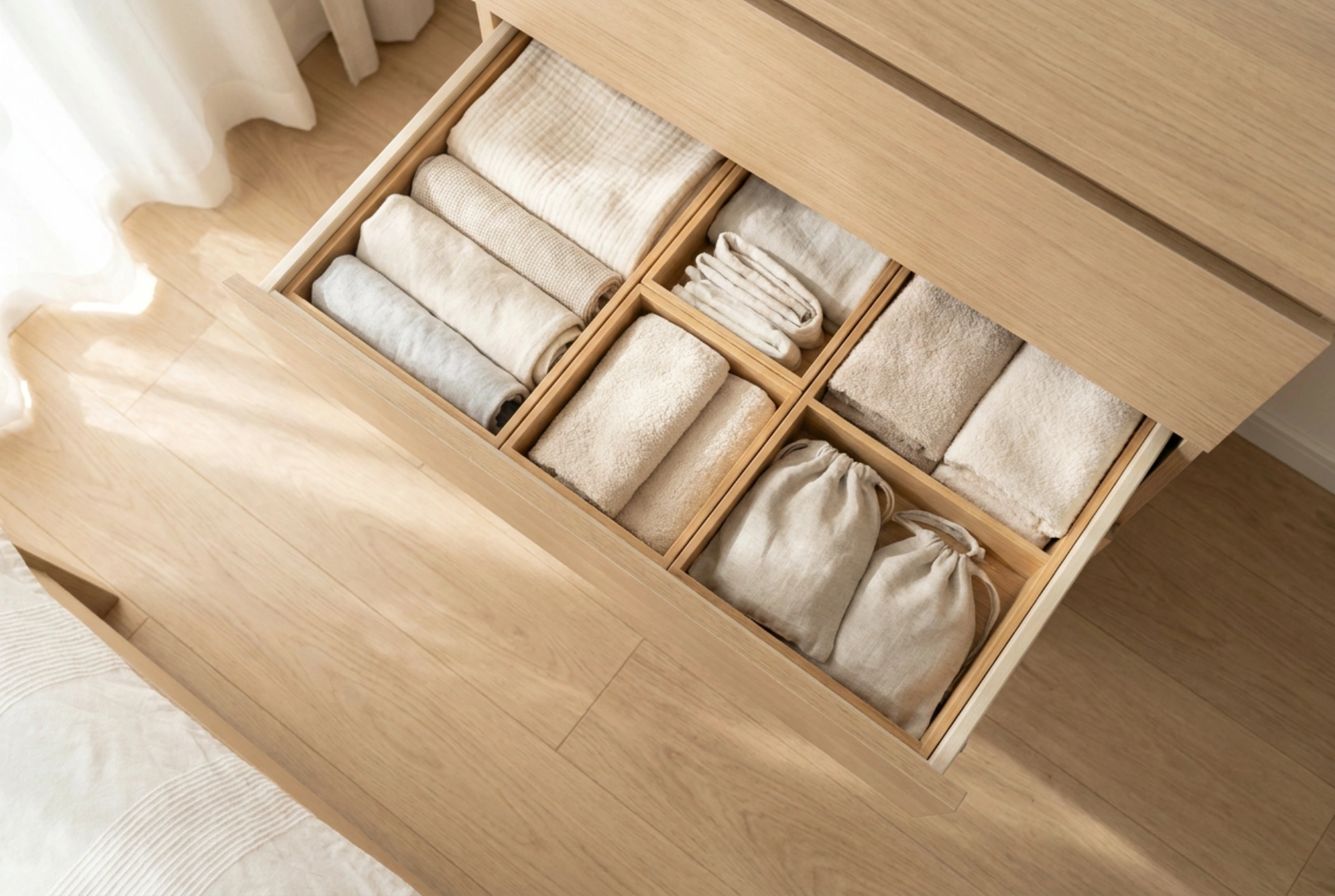
- Step 4: Place the folded sock vertically in your organizer compartment. By standing the socks upright (the "file-folding" method) rather than stacking them horizontally, you distribute weight evenly and prevent the bottom layers from becoming compressed and wrinkled.
Structural Folding for Underwear
Similar to socks, undergarments require a folding technique that creates a self-supporting geometric shape. This prevents the fabric from unravelling when neighboring items are retrieved.
The Tri-Fold Pocket Method
This technique works exceptionally well for briefs, boxers, and synthetic fabrics, creating a secure, locked fold that resists shifting.
- Step 1: Lay the garment flat with the front facing up. Smooth the seams to align the waistband with the leg openings.
- Step 2: Fold the left third of the garment vertically toward the center, then repeat with the right third. You are left with a long, narrow rectangle.
- Step 3: Fold the waistband down approximately one-third of the way. Then, fold the crotch area up and tuck it securely inside the opening of the waistband. This creates a neat, square package that cannot unroll, even if dropped.
Optimizing Drawer Organizers and Friction Zones
An effective organizer acts as an external skeleton for your garments. Compartments should match the volume of the folded items to prevent sliding without causing compression.
When selecting or arranging dividers, opt for breathable, textured materials such as canvas or non-woven polymer fabrics. These materials have a higher coefficient of friction than smooth plastic or polished wood, which helps hold the folded garments in place. Arrange your items by weight and frequency of use: place heavier cotton items toward the back of the drawer to anchor the organizer, and lighter, delicate synthetic or silk items toward the front. This logical hierarchy reduces physical search time and minimizes the disruption of neighboring garments.