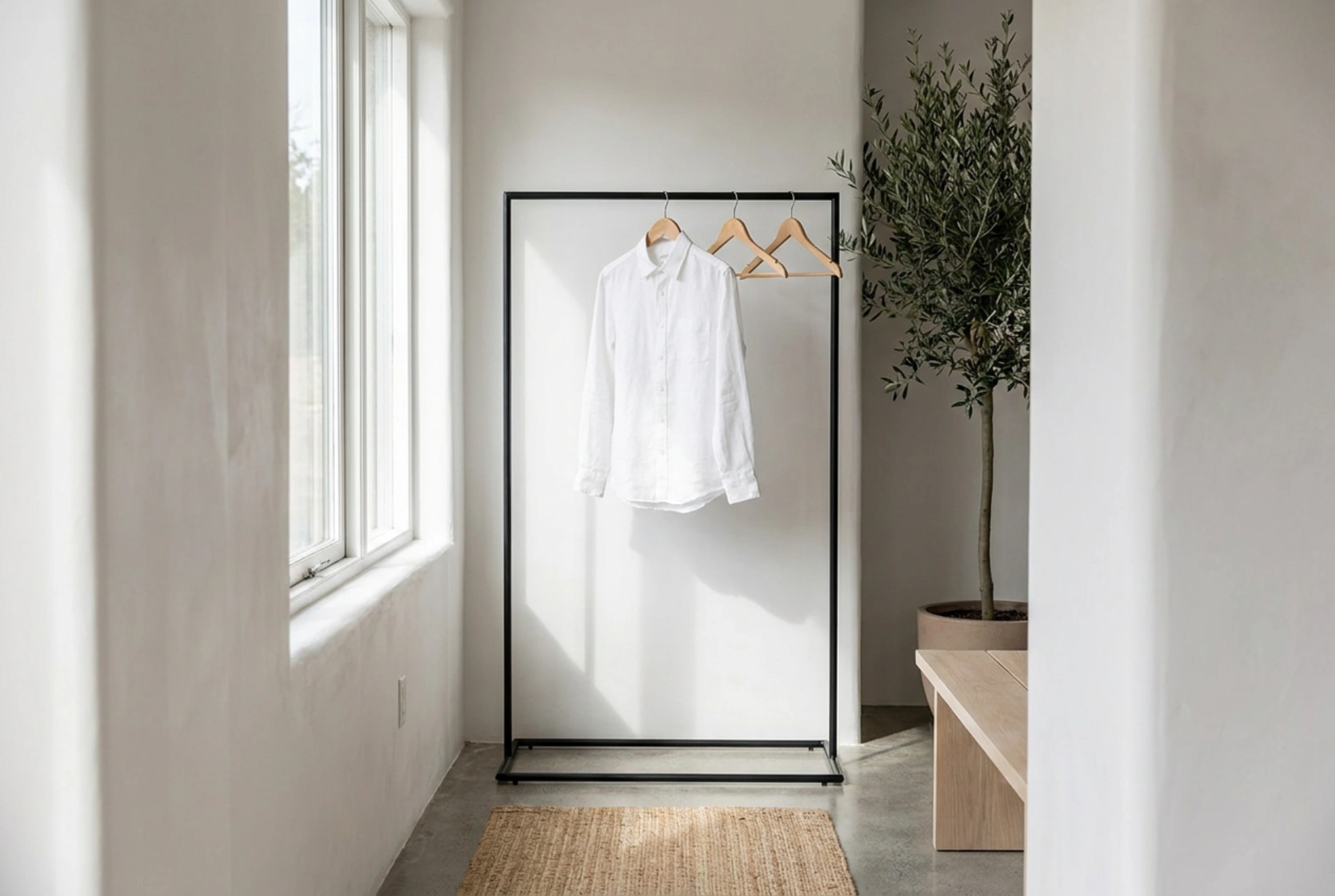


Integrating a freestanding metal garment rack into a confined space requires a careful balance of spatial geometry, structural physics, and ergonomics. When floor space is limited, proper positioning prevents physical bottlenecks while ensuring the rack remains stable and functional under load.
Optimising Visual Lines and Spatial Geometry
In compact rooms or narrow hallways, the visual weight of furniture determines how spacious the area feels. Unlike bulky wooden wardrobes, a minimalist metal garment rack features a slender profile that allows light and sightlines to pass through. To capitalise on this architectural advantage, position the rack parallel to the longest wall or tucked directly into a corner. Aligning the rack with structural lines minimises its projection into the room's main traffic lanes.
When utilising corners, select a 90-degree intersection that does not compete with door frames. Leaving a gap of at least 5 to 10 centimetres between the rack and the wall prevents the metal frame from scuffing the paintwork while allowing hangers to rotate freely. This clearance also ensures that bulky garments do not press directly against the wall, reducing the risk of friction-induced wear on both the plaster and the fabrics.
Understanding Centre of Gravity and Load Dynamics
A freestanding metal rack relies entirely on its base footprint for stability. In small spaces, there is a temptation to overload the rack or compress garments to save room, which alters the unit's centre of gravity. To prevent tipping accidents, heavier items such as wool coats, trench coats, and boots must be distributed evenly across the lower plane or centred directly over the vertical support bars.
The physics of torque dictate that hanging heavy loads at the extreme outer edges of a top rail creates rotational force, increasing the risk of structural failure or tipping. Distribute weight symmetrically, placing lighter shirts and jackets toward the centre and heavier items closer to the vertical uprights. If the rack features a lower shelf, use it to store heavier storage boxes or shoes; this acts as a ballast, lowering the overall centre of gravity and significantly increasing lateral stability.
Ergonomics and Clearance Zones
For a small entryway or bedroom to remain functional, you must account for the human clearance zones required to interact with the garment rack. An average hanger requires a depth of 45 to 50 centimetres. Therefore, the rack will occupy a total functional depth of approximately 55 centimetres once garments are hung. Ensure this envelope does not encroach on primary walking paths, which require a minimum clear width of 70 to 90 centimetres for comfortable movement.
Pay close attention to door swings and cupboard door arcs. A metal rack placed too close to a doorway can block the opening radius, causing repetitive impacts that damage both the door finish and the rack's metal frame. Map out the trajectory of all moving doors and drawers, ensuring a buffer zone of at least 15 centimetres beyond the maximum swing arc to allow occupants to pass safely even when carrying bags or groceries.
Floor Protection and Material Care
The interface between the metal base of the rack and your flooring material is a critical point of friction. Heavy metal frames can scratch hardwood, dent vinyl, or snag carpet fibres when moved. To mitigate this risk, apply heavy-duty adhesive felt pads to the contact points of flat-bottomed bases. If the rack is equipped with castors, ensure they are constructed from polyurethane or soft rubber rather than hard plastic, which can crack tiles or leave permanent grooves in wooden floorboards.
Additionally, small spaces often suffer from restricted airflow, which can exacerbate moisture issues. When hanging damp outerwear, ensure garments are spaced at least 3 centimetres apart. This spacing facilitates convection currents, allowing air to circulate freely around the fibres. Adequate ventilation accelerates drying times and prevents the accumulation of stagnant moisture, which can degrade delicate fabrics and, over time, compromise the protective powder coating of the metal frame.