

A cooker hood’s efficiency depends entirely on the state of its filtration system, which captures airborne grease particles and neutralises volatile cooking odours before they can settle on kitchen surfaces.
The Mechanics of Cooker Hood Filtration
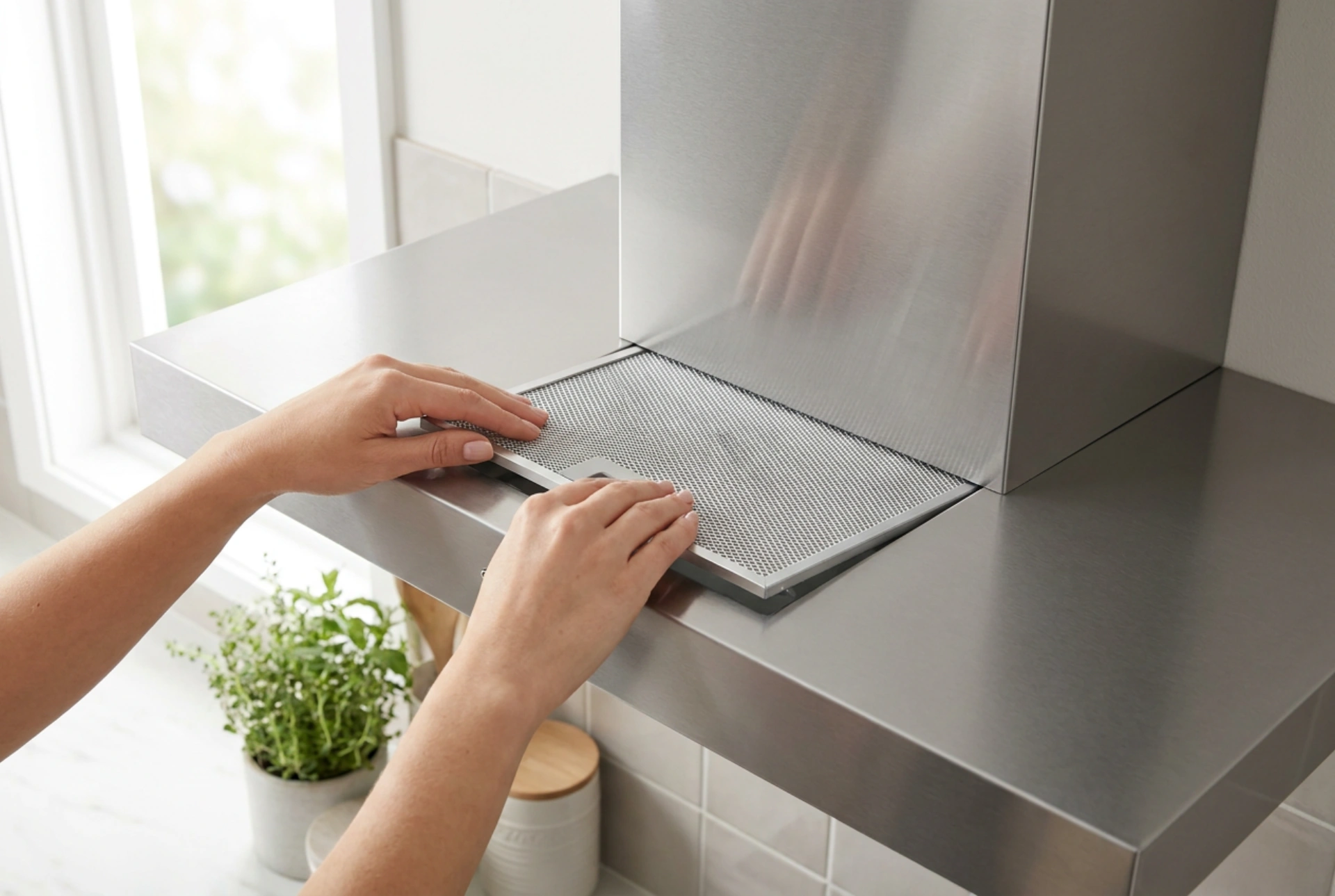
To maintain peak performance, it is essential to understand that most cooker hoods operate using a two-stage filtration system: mechanical and chemical. The first line of defence is the metal grease filter. Typically made from multiple layers of aluminium or stainless steel mesh, this filter works on the principle of inertial impaction. As heavy, grease-laden steam is drawn through the narrow pathways of the cold metal mesh, the sudden changes in airflow direction force the suspended grease droplets to collide with the metal surfaces. Because grease has a high surface tension, it clings to the metal rather than passing through. Over time, these captured lipids polymerise under the heat of the hob, turning into a sticky, stubborn varnish that restricts airflow.
The second stage, found primarily in recirculating hoods, is the activated carbon filter. Unlike the mechanical grease filter, the carbon filter relies on chemical adsorption. Activated carbon is processed to have an incredibly high surface area-to-mass ratio, packed with microscopic pores. Odour molecules—specifically volatile organic compounds (VOCs) released during cooking—are pulled into these pores and bound to the carbon surface by weak intermolecular forces. Once these pores are completely filled, the filter is saturated and can no longer capture odours, allowing them to recirculate back into the kitchen.
How to Clean Metal Grease Filters
Cleaning metal grease filters regularly is vital to prevent motor strain and fire hazards. The key to removing polymerised grease is utilising heat and alkaline chemistry to break down the hydrophobic lipid chains. Follow this systematic process every four to six weeks:
- Prepare the soaking bath: Fill a deep heat-resistant basin with water heated to at least 60°C. High temperatures are necessary to soften the solidified fats, reducing their viscosity.
- Introduce the degreasing agent: Add a generous amount of sodium bicarbonate (baking soda) and a concentrated, neutral dishwashing liquid. The sodium bicarbonate acts as a mild alkali, initiating a saponification reaction that converts sticky fats into water-soluble soaps.
- Soak and agitate: Submerge the filters completely for 15 to 20 minutes. Avoid using harsh steel wool or abrasive brushes, as these create microscopic scratches on the metal wires. These micro-grooves will capture grease even faster in the future. Use a soft-bristled nylon brush to gently dislodge the residue.
- Rinse and dry: Rinse thoroughly with hot water to wash away all emulsified grease. Shake off excess water and allow the filters to dry completely before reinstalling them.
When and How to Manage Activated Carbon Filters
Unlike metal filters, standard activated carbon filters cannot be washed. Exposing raw activated carbon to water collapses its porous structure, rendering it completely useless. Consequently, these inserts must be replaced or regenerated periodically.
The lifespan of a carbon filter depends on your cooking habits. As a rule, standard disposable carbon filters should be replaced every three to six months. Signs that a replacement is due include persistent cooking odours remaining in the air long after cooking, or a noticeable decrease in suction power, which occurs when the tightly packed carbon granules become clogged with fine dust and grease that bypassed the primary filter.
Some modern appliances utilise regenerable carbon filters. These specialised units can be reactivated using thermal desorption. To regenerate these filters, wash them in a dishwasher at a high temperature (without detergent to avoid chemical contamination) and then dry them in an oven at 150°C to 200°C for approximately two hours. The high heat breaks the weak chemical bonds holding the adsorbed VOCs to the carbon pores, vapourising them and restoring the carbon's adsorption capacity.