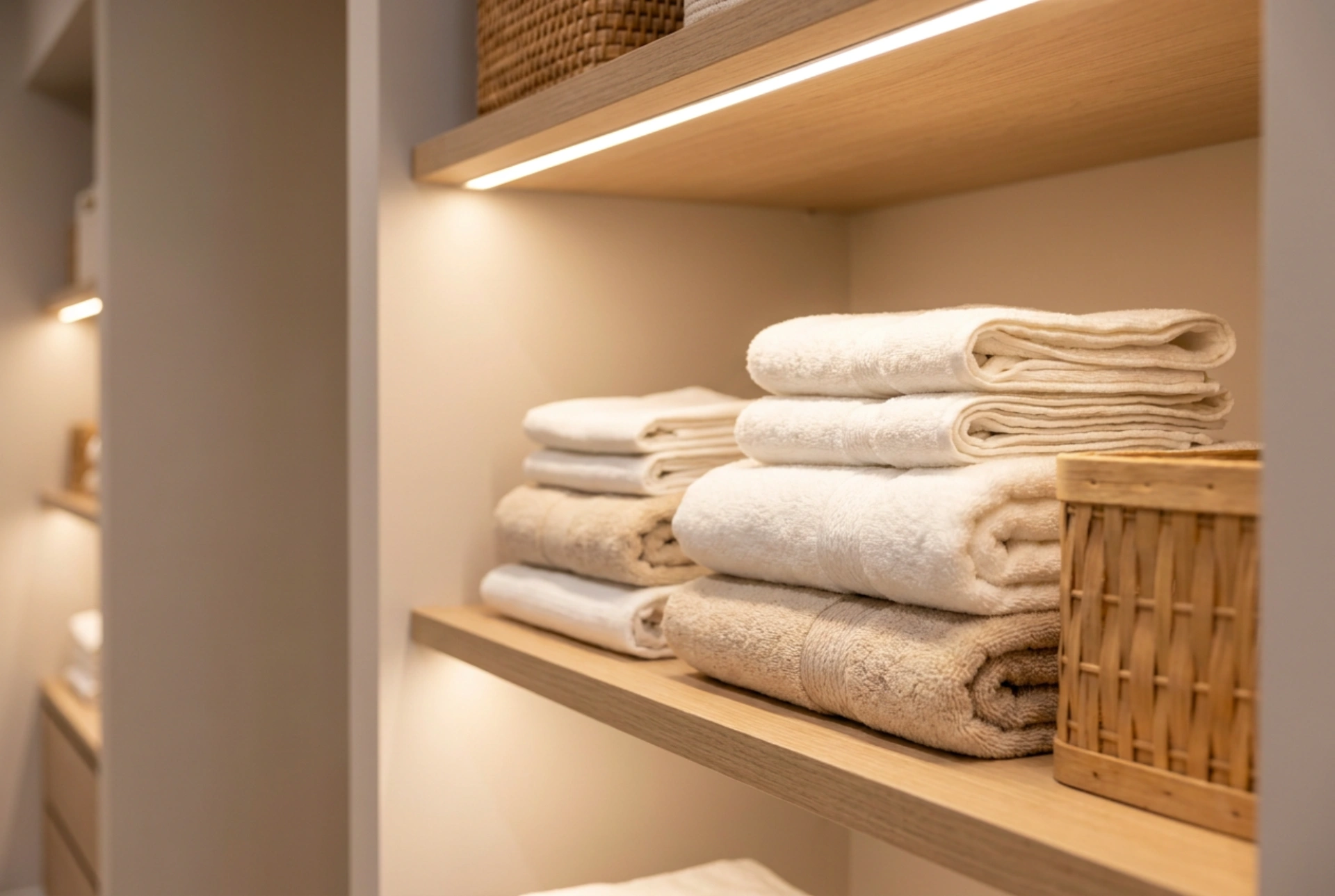


Inadequate illumination in wardrobes and closets leads to wasted time and mismatched outfits. Integrating low-voltage LED lighting into shelving units solves this issue by delivering targeted illumination directly where fabrics and items are stored, without requiring complex electrical overhauls.
The Physics of Wardrobe Lighting: CRI and Color Temperature
When selecting LEDs for closets, two physical metrics dictate the accuracy of what you see: the Color Rendering Index (CRI) and the color temperature measured in Kelvins (K). Standard residential lighting often has a CRI of around 80, which can distort colors, making dark blue and black garments indistinguishable. For wardrobes, a CRI of 90 or higher is essential. This high index ensures that the light spectrum emitted closely mimics natural daylight, allowing for accurate color perception.
Color temperature alters both the mood and the functional clarity of the space. Warm white light (2700K to 3000K) matches traditional home aesthetics but can soften contrasts. Neutral white light (4000K) offers the highest functional clarity, highlighting textures and colors accurately without introducing a sterile, blue cast. Utilizing neutral white LEDs ensures that fabric weave and genuine dye shades are immediately recognizable.
Thermal Management and Lifespan: The Role of Aluminum Profiles
Although LEDs emit significantly less heat than incandescent bulbs, they still produce thermal energy at the semiconductor diode level. If this heat is not dissipated, it degrades the phosphor coating of the LED, leading to color shifting and premature failure. Mounting flexible LED strips directly onto wooden or melamine shelves is a common mistake; wood is an insulator and traps heat.
To prevent thermal degradation, LED strips should always be installed inside anodized aluminum profiles. Aluminum has high thermal conductivity, drawing heat away from the diodes and dissipating it into the surrounding air. Additionally, the profile’s diffuser (matte or opal cover) scatters the individual point-sources of light into a continuous, glare-free beam, protecting the eyes from harsh reflections on polished surfaces.
Surface Preparation and Mechanical Adhesion
Most modern closet systems are constructed from laminated particle board or sealed wood. Securing LED profiles or battery-operated fixtures requires durable adhesion. Standard pressure-sensitive adhesives (PSA) often fail due to temperature fluctuations or micro-dust on the mounting surface. To ensure a permanent bond, the surface must undergo thorough preparation:
- Remove all dust and structural residues using a microfiber cloth.
- Degrease the area using isopropyl alcohol (minimum 90% concentration). Avoid household glass cleaners, as they leave behind silicone films that prevent adhesion.
- Apply a high-quality acrylic foam tape to the aluminum profile, applying firm pressure across the entire length for at least 30 seconds to activate the pressure-sensitive polymer chains.
Power Distribution and Automation Sensors
For wardrobe retrofits, low-voltage systems (12V or 24V DC) are the safest and most efficient choice, requiring only a compact driver plugged into an existing wall outlet. Alternatively, rechargeable lithium-ion battery packs offer wire-free convenience for isolated cabinets. To make the system practical, automation is key. Two primary sensor types are used to control wardrobe lights:
- Passive Infrared (PIR) Sensors: These detect changes in infrared radiation (heat signatures) when a hand or body enters the sensor's field of view. They are ideal for walk-in closets.
- Magnetic Reed Switches: Installed on the door frame, these sensors detect the proximity of a small magnet attached to the door. When the door opens, the magnetic field is broken, completing the electrical circuit and turning on the lights instantly.
Strategic Placement: Avoiding Glare and Shadows
Where you position the light source determines its effectiveness. Placing LED strips at the very back of a shelf causes the items in front to cast deep shadows over themselves. For optimal visibility, mount the lighting profiles horizontally along the front edge of the shelf ceiling, facing downward and slightly angled inward. This ensures the front faces of folded clothes or storage boxes are fully illuminated. For tall cabinet sections, running LED profiles vertically down the inner side panels provides uniform light distribution from top to bottom, eliminating dark zones under individual shelves.