

Storing coats and shoes in a single hallway closet often leads to cross-contamination, where road dirt, moisture, and odours from footwear affect hanging outerwear. Achieving a hygienic and organised shared space requires understanding physical barriers, moisture control, and the science of air circulation inside enclosed areas.
The Physics of Closet Contamination: Why Separation Matters
When shoes and coats share an unventilated volume of air, several physical and chemical processes occur. Footwear collects organic matter, street grime, road salt, and moisture from both the external environment and perspiration. If placed directly beneath hanging coats without a barrier, gravitational shedding and evaporation take place.
As damp shoes dry, water molecules evaporate and rise, carrying volatile organic compounds (VOCs) that cause unpleasant odours. Hanging jackets, especially those made of porous natural fibres like wool or synthetic waterproof membranes, readily absorb these vaporised compounds and moisture. Furthermore, gravity causes dried dirt, dust, and micro-particles from the soles of shoes to migrate downward, which can soil any long coats or trousers hanging nearby. Preventing this requires a systematic approach to zoning and material barriers.
Implementing Physical Barriers and Zoning
The most effective way to isolate footwear from outerwear is to establish absolute physical boundaries. Installing a solid mid-level shelf or a vertical divider acts as a shield against both falling debris and rising vapours.
- Solid Horizontal Shelving: Instead of wire racks, which allow dirt and dust to fall through onto items below, use solid wood, laminate, or acrylic shelving. A solid barrier completely stops gravitational debris transfer.
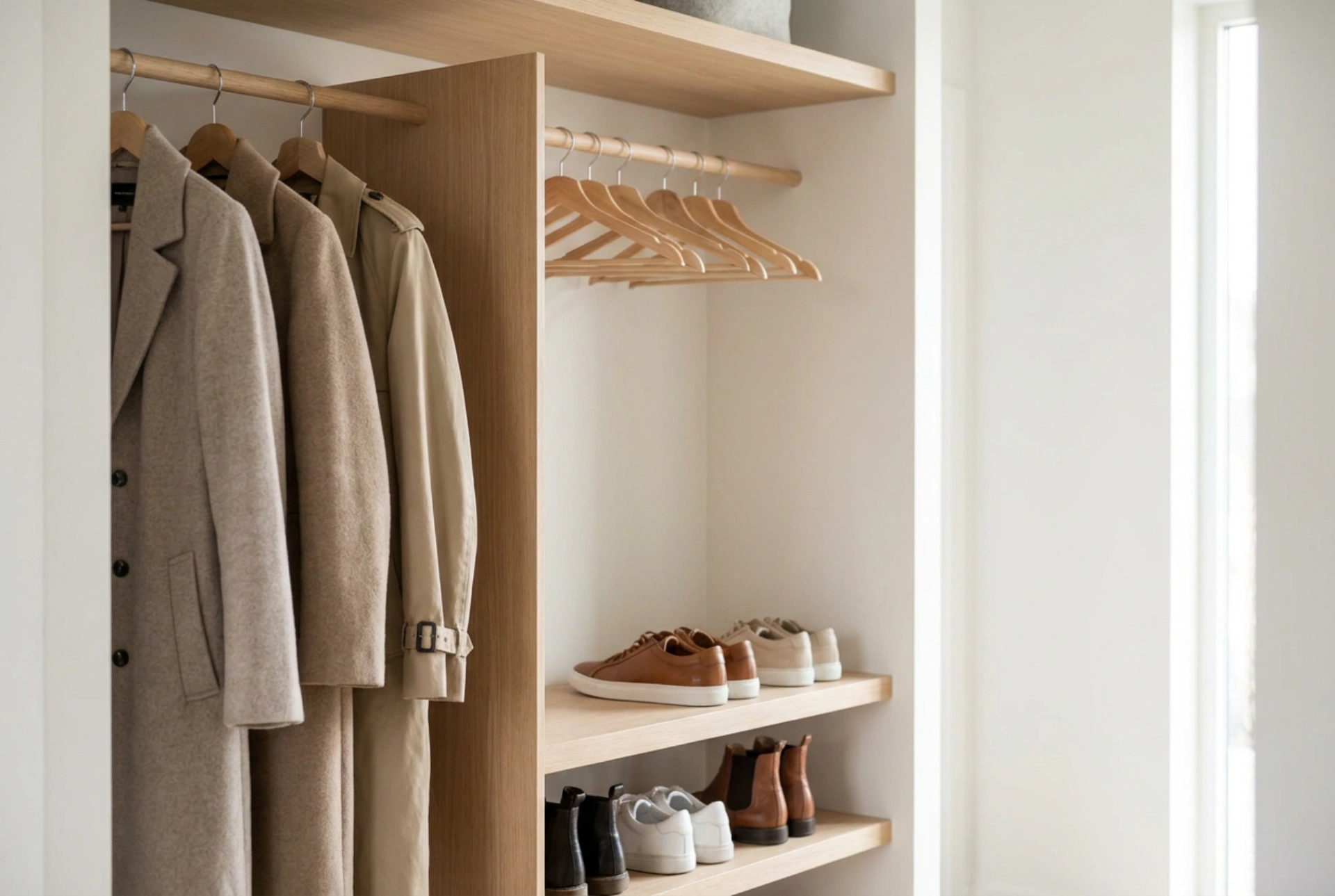
- Vertical Partitioning: If space permits, dividing a closet vertically creates two separate microclimates. One side can be dedicated entirely to full-length hanging items, while the other side features stacked shoe cubbies. This completely eliminates the issue of coats hanging directly over footwear.
- Enclosed Shoe Chambers: Utilising pull-out drawers, drop-down shoe cabinets, or breathable storage boxes at the base of the closet adds an extra layer of containment. Acrylic or wooden boxes with ventilation holes facing away from the coats ensure that shoes can dry without venting directly into the hanging garments.
Managing the Microclimate: Moisture and Odour Control
Even with physical barriers, air inside a closet can stagnate. To maintain a fresh environment, you must control the humidity and neutralise odour-causing bacteria at the molecular level.
Airborne moisture is the primary catalyst for mould and musty smells. Placing natural desiccants, such as packets of silica gel or activated charcoal bags, in the shoe compartment is highly effective. Activated charcoal operates via adsorption; its highly porous structure traps gas molecules and moisture within its microscopic pores, preventing them from circulating upward to the coats. Baking soda (sodium bicarbonate) can also be used in open containers near footwear to neutralise acidic odour molecules chemically.
Furthermore, ensure your hanging coats are spaced at least two fingers apart. Packed closets prevent air currents, which traps damp air in the fabric folds and encourages mould growth.
The Correct Order of Operations for Daily Storage
Maintaining a clean, divided closet depends on establishing a strict routine for how items enter the space. Storing wet or heavily soiled items immediately will defeat any physical separation system.
First, always allow wet jackets and damp shoes to dry completely in an open, well-ventilated area before placing them inside the closet. Placing wet items in a closed wardrobe spikes the relative humidity, creating an ideal breeding ground for fungal spores. Second, implement a quick sole-cleaning routine. Use an external doormat to remove loose mud and moisture before shoes cross the threshold of the closet. Finally, rotate seasonal gear. Store off-season footwear in sealed containers on the highest shelves, and keep current-season coats on the hanging rail, ensuring that long winter coats are folded or placed in garment bags to prevent them from dragging on the lower shoe decks.