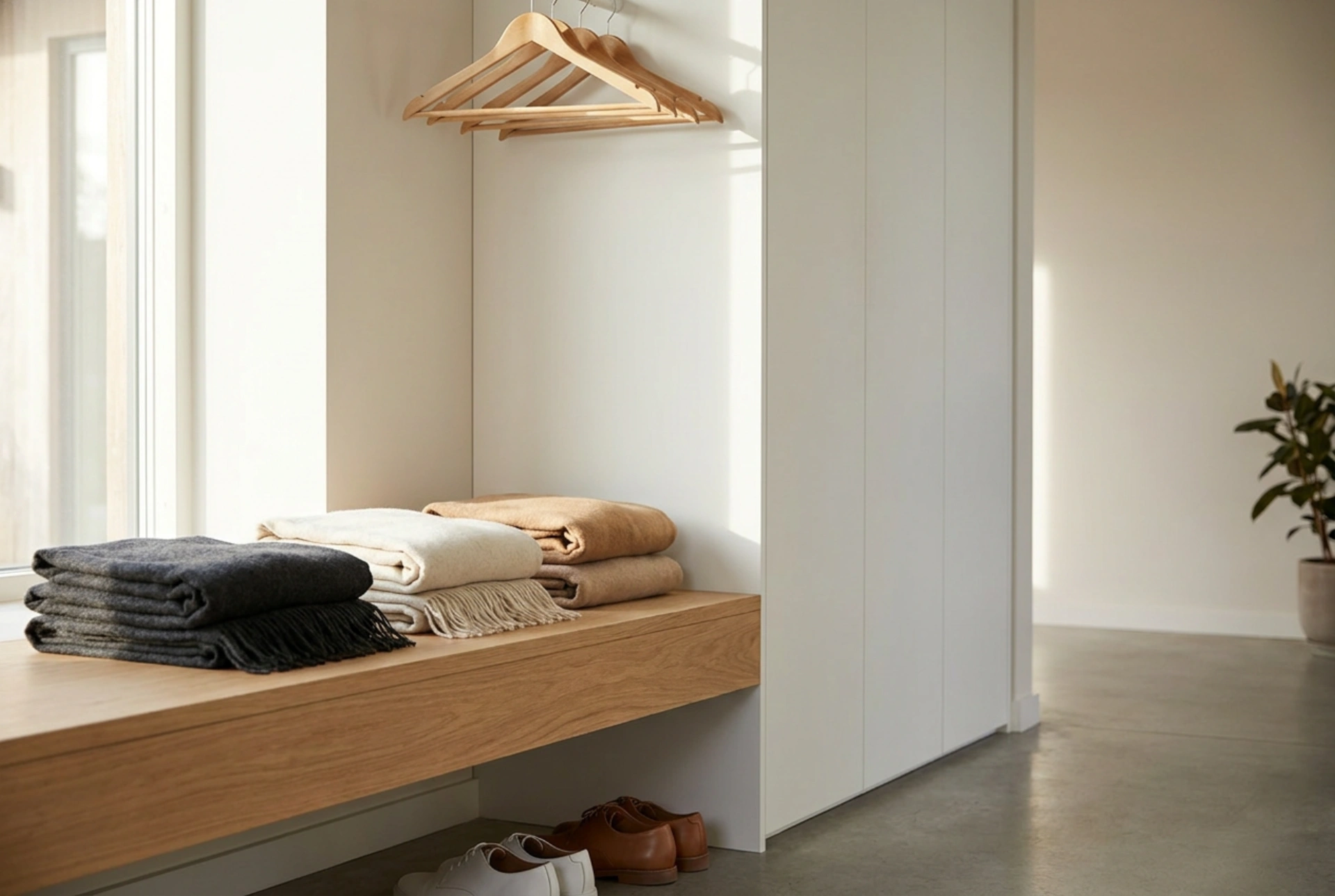


Managing an entryway requires balancing ergonomics with efficient spatial zoning to prevent dirt, moisture, and outdoor debris from migrating further into the living space. An integrated wardrobe featuring a built-in bench serves as a functional transition zone, dividing high-rotation outerwear from long-term storage while providing a stable physical platform for daily routines.
The Physics of the Entry Zone: Controlling Moisture and Airflow
The primary challenge in any entryway is managing the moisture, salt, and dirt carried in on shoes and jackets. When wet outerwear is placed directly into a sealed wardrobe, the relative humidity inside rises rapidly, creating an ideal microclimate for mold growth and fabric degradation. An open, integrated bench section mitigates this risk by utilizing ambient room airflow to dry damp textiles.
By separating the entryway storage into an open zone (the bench, open hooks, and lower shoe shelves) and a closed zone (the main wardrobe cabinet), you establish a thermal and moisture boundary. Wet coats hang in the open draft, allowing water to evaporate freely into the room's ventilation system, while dry, off-season garments remain sealed behind doors, protected from airborne dust and moisture fluctuations.
Material Science for Entryway Benches and Cabinetry
An entryway bench must withstand significant mechanical load, friction, and moisture exposure. Solid hardwoods like oak or beech are excellent choices due to their high fiber density and natural resistance to impact. However, untreated wood absorbs water and skin oils, leading to staining and rot over time. To prevent this, wood surfaces should be sealed with a high-quality polyurethane lacquer or a hardwax oil that penetrates deep into the pores, creating a hydrophobic barrier.
For the internal cabinet structures, high-density fiberboards or melamine-faced chipboards are highly stable, but their edges must be sealed with polyurethane (PUR) adhesive rather than standard EVA glue. PUR bonding provides superior resistance to moisture infiltration, preventing the boards from swelling when exposed to wet umbrellas or dripping jackets. Metal components, such as shoe racks and shelf supports, should feature powder-coated finishes to resist the corrosive effects of road salt carried in on winter footwear.
Ergonomics and Structural Dimensions of the Integrated Bench
For an entryway bench to be genuinely comfortable and functional, its dimensions must align with human anthropometry. The optimal sitting height for an adult to comfortably tie shoes ranges between 400 and 450 millimetres from the finished floor level. The seat depth should be at least 350 to 400 millimetres to provide adequate support without protruding too far into the hallway clearance.
Positioning shoe storage directly underneath the bench maximizes vertical efficiency. Utilizing open-grid steel shelves or suspended metal rods below the seat allows dirt and dried mud to fall onto a removable, easy-to-clean drip tray rather than settling on the floor or the shoes below. Furthermore, leaving a gap of at least 150 millimetres between the bottom shelf and the floor facilitates easy cleaning and accommodates bulkier winter footwear.
Systematic Storage Allocation: Active Rotation vs. Seasonal Archiving
Efficient entryway organization relies on strict categorization based on frequency of use. Grouping items logically prevents clutter and shortens the time required to leave or enter the house:
- Active Zone (Open Bench & Hooks): Reserved strictly for items currently in daily use. Limit hooks to one or two per family member to prevent overloading, which restricts airflow and hides items at the bottom of the pile.
- Transition Zone (Upper Cabinets & Drawers): Dedicated to smaller accessories like gloves, hats, and scarves. Organizing these items in shallow pull-out drawers or breathable wire baskets prevents them from becoming lost in deep shelves.
- Archive Zone (Closed Wardrobe): Houses off-season coats, formal wear, and spare shoes. These items should be stored on sturdy wooden hangers that preserve the shoulder structure of heavy coats, preventing fabric stretching and seam strain.