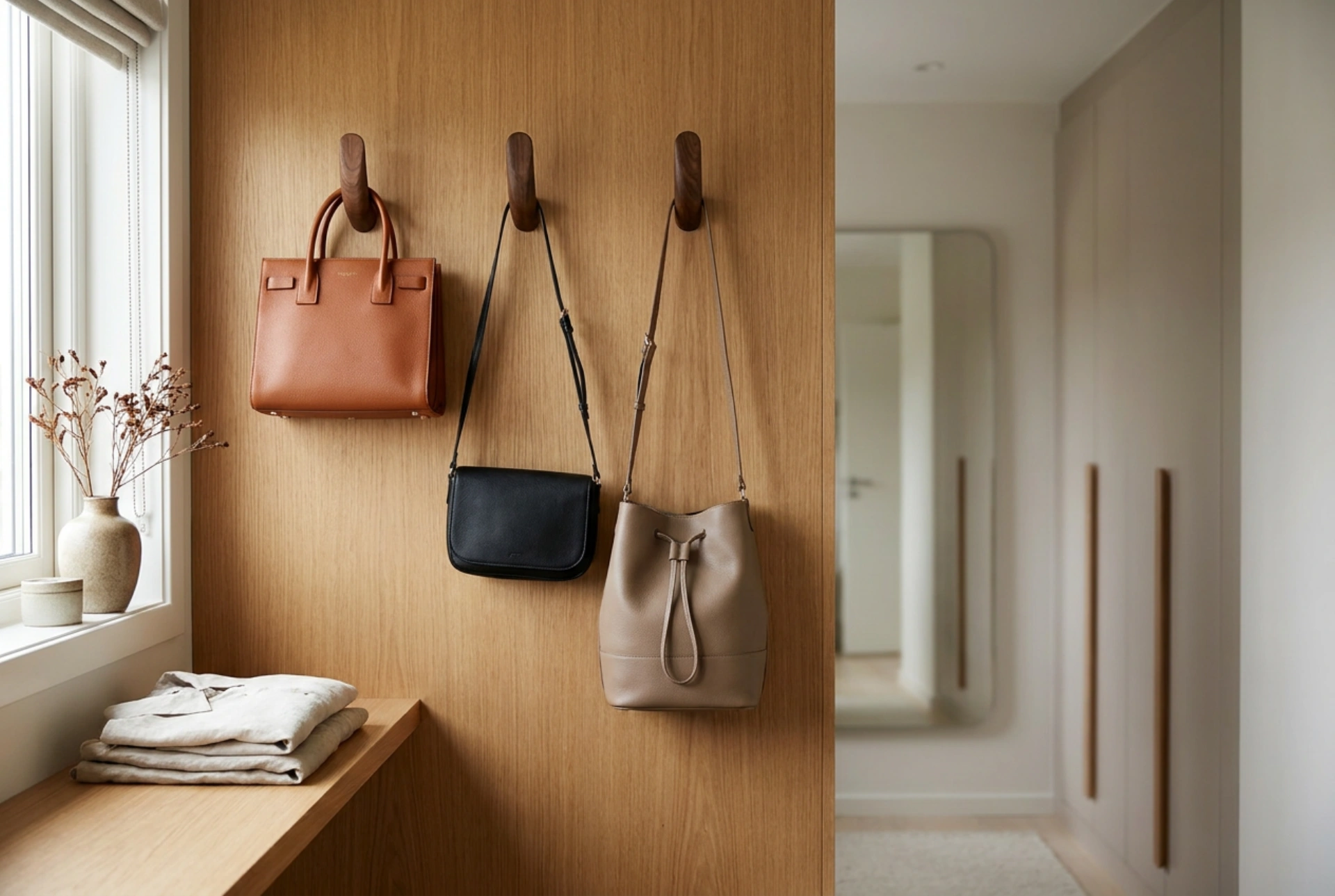


Hanging handbags on a wall is an excellent way to save space and display your collection, but improper suspension can cause permanent structural damage. To preserve the shape of your bags, you must understand the mechanical forces at play and how materials like leather, canvas, and synthetic polymers react to prolonged tension. When a handbag is suspended by its straps, gravity pulls the entire mass of the bag downward. This creates a highly concentrated stress point where the strap meets the hook. According to basic physics, pressure is force divided by area. A thin, narrow hook concentrates all the weight onto a tiny surface area of the strap. Over time, this intense pressure stretches the leather fibers, breaks down synthetic adhesives, and deforms the internal fillers—such as cotton cords or cardboard stiffeners—used to keep handles rigid.
The Geometry of Wall Hooks: Distributing the Load
To prevent localized stretching, the contact point between the hook and the strap must be as wide as possible. Standard thin metal nails or sharp-angled hooks are highly damaging. Instead, opt for wide, curved fixtures. Ideally, the curvature of the wall hook should match the natural arch of a human shoulder. A hook with a broad, semi-circular surface profile distributes the downward force across a larger section of the strap, drastically reducing the localized pressure. Furthermore, material choice for the hooks is crucial. Natural hardwood, polished resin, or wide silicone-coated hooks are ideal. These materials offer a smooth finish that prevents friction damage to the delicate undersides of bag handles, particularly those made of lambskin or soft suede. Avoid unsealed metals that can oxidize and leave chemical stains on the straps, or rough wood that can snag fabric fibers.
Internal Support: Maintaining Structural Integrity
A bag's shape is not just threatened by the suspension of its handles; the body of the bag is also subject to gravity. When hung empty, soft-sided bags collapse inward, causing permanent creases and folds in the leather or canvas. Once these creases set, the fibers are structurally weakened, and the bag may never stand upright again. Before hanging any handbag, you must replicate its internal volume. Use clean, acid-free tissue paper or custom-shaped cotton inserts to pack the interior. Avoid using newspaper, as the ink can easily transfer to the lining, and do not use heavy plastics, which can trap moisture and encourage mould growth. The stuffing should fill the void spaces entirely, supporting the front, back, and side gussets, without overstretching the seams. This internal structural support ensures that the tension is held outward, counteracting the downward pull of gravity on the empty shell.
Environmental Factors: Heat, Humidity, and Material Science
The room environment plays a silent but significant role in how hung materials deform over time. Leather is an organic, hygroscopic material, meaning it constantly absorbs and releases moisture from the surrounding air. In highly humid environments, leather fibers absorb water molecules, making the collagen structure softer and far more prone to stretching under tension. Conversely, in overly dry rooms, or when hung near radiators, leather loses its natural moisture, becomes brittle, and is highly susceptible to cracking at stress points. Keep your display wall away from direct heat sources and out of direct sunlight. Ultraviolet radiation breaks down chemical bonds in both natural dyes and synthetic polymers, leading to severe fading and material degradation. Maintain a stable relative humidity of around 45% to 55% in your dressing space.
A Practical Protocol for Wall-Hanging Storage
To transition your collection to a safe wall display, adhere to the following systematic approach:
- Empty the contents: Remove coins, keys, makeup, and heavy electronics to minimise the total suspended mass.
- Analyze strap tension: For bags with long chain straps, loop the chain so the weight is shared across multiple points rather than a single long link.
- Insert inert packing: Fill the body of the bag with acid-free tissue to preserve its volumetric shape.
- Position on wide mounts: Place the straps carefully over broad, curved wooden or plastic pegs, ensuring the strap sits flat without twisting.
- Rotate periodically: Give your bags a rest. Periodically remove them from the wall and store them flat on a shelf to allow the fibers to relax and recover their natural state.