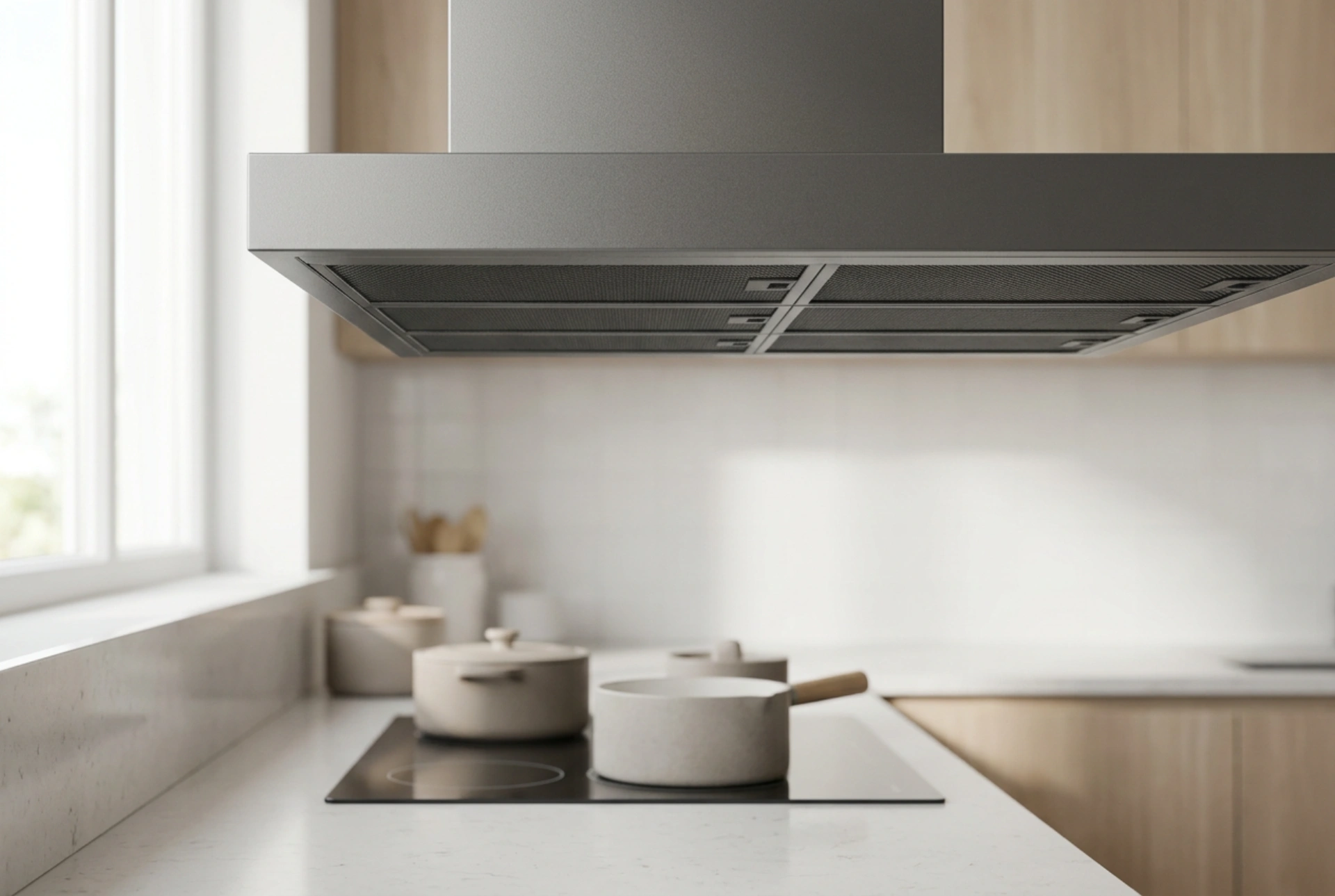


Recirculating kitchen hoods provide a highly efficient solution for homes lacking external venting, cleaning and returning air directly to the room. Unlike ducted systems that expel air outside, these closed-loop devices rely on multi-stage filtration to eliminate airborne grease, moisture, and cooking odors.
The Two-Stage Filtration Process: Mechanics and Chemistry
A recirculating cooker hood operates through a systematic, two-step filtration process. Each stage targets a different physical state of kitchen emissions, ensuring that both suspended particulates and gaseous molecules are removed before the air is recirculated. Understanding this division of labor is essential for maintaining optimal indoor air quality.
First Stage: Mechanical Grease Capture
The journey begins with the mechanical grease filter, typically made of multi-layered aluminum or stainless steel mesh. When you cook, heat vaporizes lipids and moisture, sending them upward in a thermal plume. As this warm, grease-laden air is drawn into the hood by the motorized fan, it collides with the cool metal mesh. This temperature differential triggers condensation. The microscopic droplets of liquid grease coalesce on the metallic fibers, adhering to them due to surface tension. This stage is crucial because it protects the interior fan mechanism and prevents the secondary charcoal filter from becoming clogged with sticky oils, which would instantly destroy its efficiency.
Second Stage: Molecular Adsorption via Activated Carbon
Once freed from heavy grease particles, the air passes into the charcoal filter. This is where physical chemistry takes over. Unlike absorption, where a substance is drawn into the bulk of a liquid or solid, the carbon filter works through a process called adsorption. Activated carbon is treated with oxygen to open up millions of microscopic pores between the carbon atoms. This structure gives it an astonishingly high surface area—just one gram of activated carbon can have a surface area exceeding 1,000 square meters.
As gaseous odor molecules (such as volatile organic compounds, sulfur compounds from onions, or fatty acids from frying) pass through this intricate carbon matrix, they are pulled toward the pore walls by weak intermolecular attractions known as van der Waals forces. The odor molecules stick to the carbon surface, effectively trapping them while allowing clean air molecules to pass through undisturbed.
Airflow Dynamics and the Importance of Contact Time
For chemical adsorption to occur effectively, the air must remain in contact with the activated carbon for a specific, albeit brief, duration. This is known as dwell time. If the fan speed is too high, the air velocity forces odor molecules through the carbon bed too quickly, preventing the van der Waals forces from binding them. Running the hood at a moderate, steady speed often yields far better odor elimination than running it on maximum boost, as it optimizes the ratio of volume flow to contact time.
Maximizing Hood Efficiency: Best Operational Practices
Operating a recirculating hood successfully requires a specific order of operations. You should activate the hood approximately five minutes before you begin cooking. This establishes a stable negative pressure zone and directional airflow in the kitchen area, ensuring that rising steam and vapors are immediately captured rather than dispersing into the wider room.
Equally important is the post-cooking phase. After turning off the heat source, leave the hood running on a low setting for 10 to 15 minutes. This continued airflow serves two purposes: it captures residual vapors and, crucially, dries out any moisture that has accumulated within the carbon filter. Moisture can temporarily block the microscopic pores of the carbon, reducing its ability to adsorb odors during your next cooking session. Regularly cleaning the primary metal grease filters—either by hand with warm water and a degreasing detergent or in a dishwasher—ensures that airflow remains unimpeded, preserving the delicate balance of the closed-loop system.