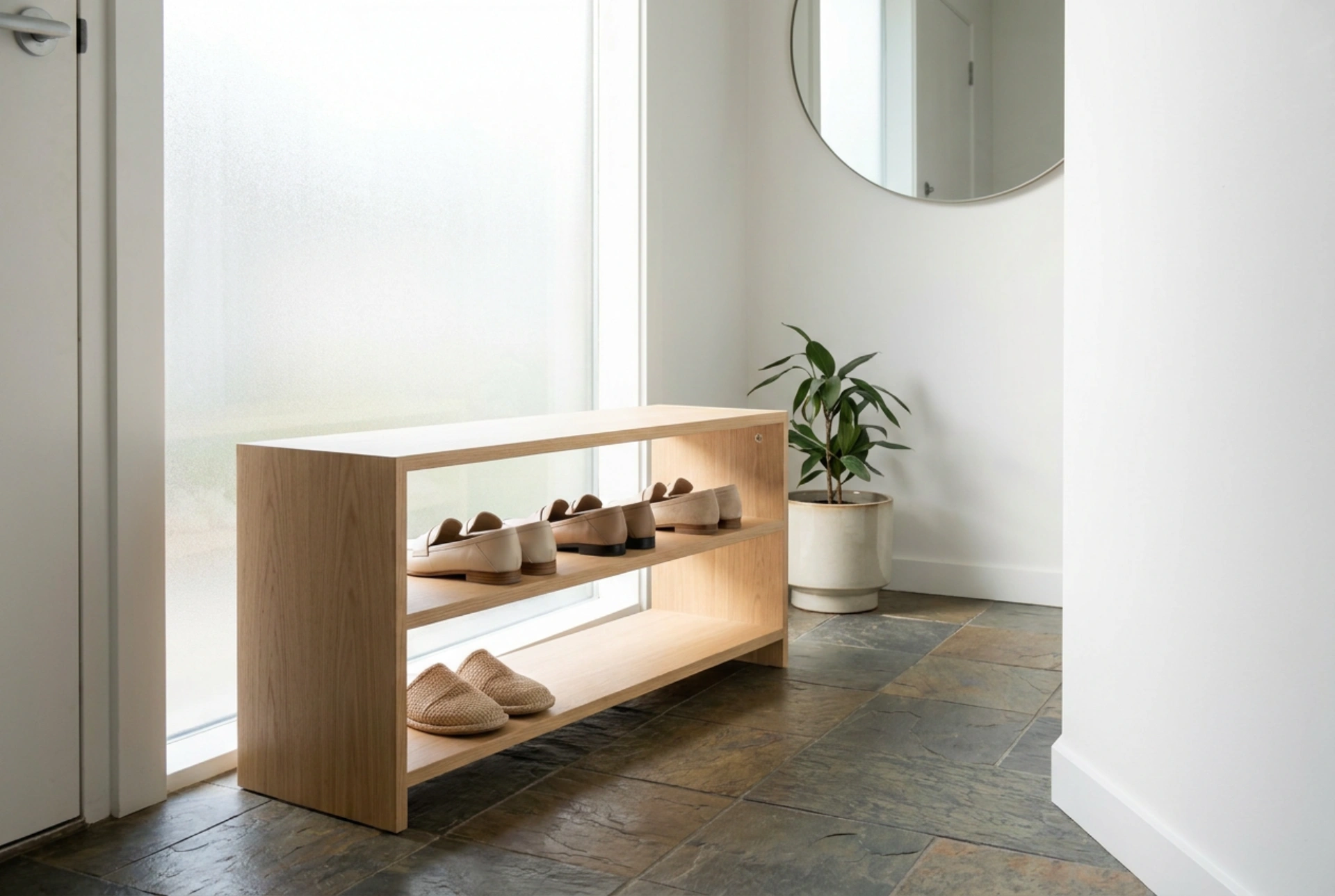


A narrow hallway often suffers from physical bottlenecks caused by poorly stored footwear, reducing the usable floor area and creating visual clutter. Implementing a slim, vertical shoe storage solution utilises underused wall space to restore structural flow and improve daily transition efficiency.
The Physics of Hallway Bottlenecks and Spatial Dynamics
In residential architecture, the entryway or hallway acts as a high-traffic transition zone. When shoes are left scattered on the floor, they present physical obstructions that disrupt the natural walking path. The average adult shoe measures between 25 and 30 centimetres in length. When placed perpendicular to a wall in a corridor that is only 100 centimetres wide, a single pair of shoes reduces the walking clearance by nearly a third.
To overcome this spatial limitation, home organisation must shift from a horizontal paradigm to a vertical one. A narrow shoe rack, particularly one featuring a tilting or radial hinge mechanism, exploits the vertical plane. By storing shoes at an angle—often near-vertical—the depth profile of the storage unit can be reduced from the standard 35 centimetres down to a mere 15 to 20 centimetres. This reclaiming of floor space significantly increases the ease of movement through the hallway.
Selecting Materials for Longevity and Hygiene
Hallway furniture is subjected to challenging environmental factors, including dirt, grit, and moisture transported from outdoors. Choosing the correct material is vital for structural longevity and hygiene:
- Powder-Coated Steel: Offering exceptional durability, metal racks are highly resistant to impact and moisture. The powder coating prevents oxidation (rust) and is easy to sanitise, making it ideal for wet climates.
- Sealed Solid Timber: Hardwoods treated with polyurethane or natural oils offer robust structural integrity. The protective coating prevents water from penetrating the wood grain, which could otherwise lead to warping, swelling, and fungal growth.
- Engineered Wood: While cost-effective, standard particleboard or MDF must be thoroughly sealed with water-resistant laminates. Unsealed edges absorb ambient humidity and liquid run-off, causing the material to delaminate and degrade over time.
Optimising Ventilation and Evaporation
Storing damp footwear in enclosed, unventilated spaces creates a high-humidity microclimate conducive to the proliferation of bacteria and mould. When wet shoes are placed in a rack, the water must evaporate. Without adequate airflow, this moisture remains trapped, leading to unpleasant odours and material degradation of both the footwear and the cabinet.
To facilitate efficient evaporation, look for shoe racks with slatted doors, open backs, or integrated ventilation grilles. If using a closed tilting cabinet, establish a routine of leaving the compartments slightly ajar after storing damp shoes. This encourages convective airflow, allowing warmer, drier room air to circulate through the unit, carrying away moisture. Additionally, placing bags of activated charcoal or sodium bicarbonate inside the compartments will actively adsorb volatile organic compounds and excess water vapour from the air.
Installation Mechanics and Safety
Because narrow shoe racks feature a high aspect ratio—meaning they are tall and shallow—their centre of gravity is inherently unstable. When doors are opened or when heavy winter boots are placed in the upper compartments, the unit can easily tip forward. Securing the rack directly to the wall is an absolute structural necessity.
To ensure a stable installation, identify the wall composition. For solid masonry walls, expansion wall plugs made of nylon paired with heavy-duty screws provide high shear resistance. For plasterboard partition walls, locating the underlying timber studs is recommended; alternatively, toggle bolts or metal self-drilling plasterboard anchors should be used. The mounting points should be located near the top of the cabinet to maximise the lever arm resistance against tipping forces.
Practical Routine for Hallway Efficiency
Maximising the utility of a compact shoe rack requires a disciplined order of operations. Dedicate the lowest compartments to daily footwear, which is more prone to collecting heavy dirt and moisture, to prevent grit from falling onto clean shoes below. Seasonal or infrequently worn shoes should be thoroughly dried, cleaned, and stored in higher compartments or transferred to long-term storage elsewhere. By maintaining a strict limit on the number of shoes kept in the active entryway zone, you ensure the narrow rack performs its primary function: keeping the floor clear, clean, and safe for passage.