

Optimising kitchen drawer space requires a systematic approach based on volumetric efficiency, geometry, and daily ergonomics. By understanding the physical dimensions and movement dynamics of your utensils, you can eliminate dead zones and create a highly functional storage system without relying on rigid, pre-made inserts that leave gaps.
Volumetric Planning and Dimensional Constraints
Before selecting or constructing dividers, you must calculate the true usable volume of the drawer. Many homeowners measure only the top opening, neglecting the draft angle of the drawer sides, protruding screw heads, or the clearance height required for low-hanging cabinet frames. To establish a precise baseline, measure the internal depth, width, and clear height—the distance from the drawer bottom to the lowest point of the counter frame above it.
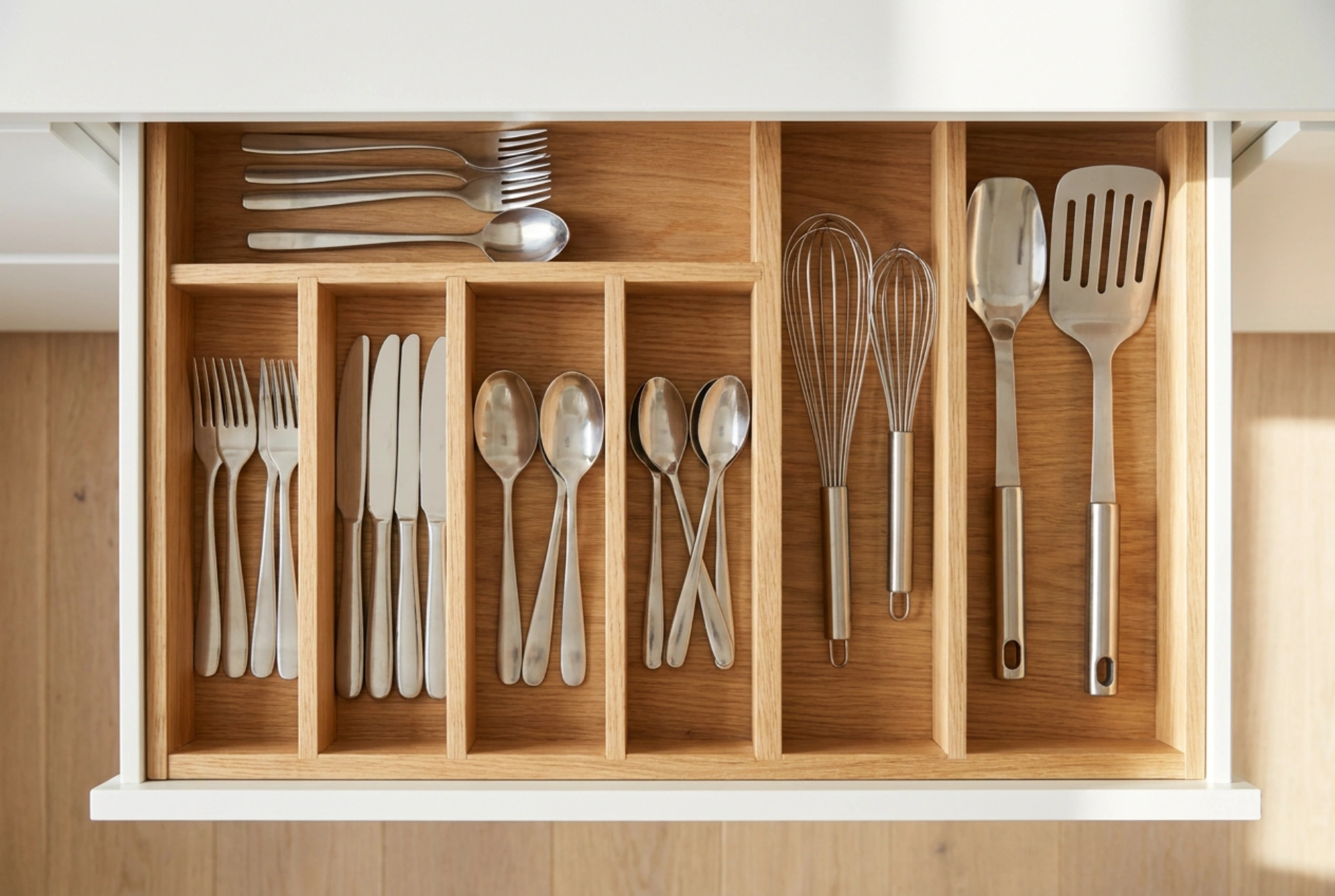
A common spatial pitfall is the "buffer gap"—the unused 2 to 5 centimetres at the back or sides of generic organisers. To mitigate this, modular systems should be calculated down to the millimetre. Plan your layout using a grid system based on the dimensions of your largest items, such as rolling pins or ladles, and build smaller cells around them. This geometric hierarchy ensures that every cubic centimetre is active storage space.
Managing Inertia and the Physics of Friction
Every time a drawer is opened or closed, its contents are subjected to acceleration and deceleration. Without proper physical restraint, items slide, collide, and reorganise themselves into chaotic piles. To prevent this kinetic energy from disrupting your layout, you must address the coefficient of friction on the drawer base.
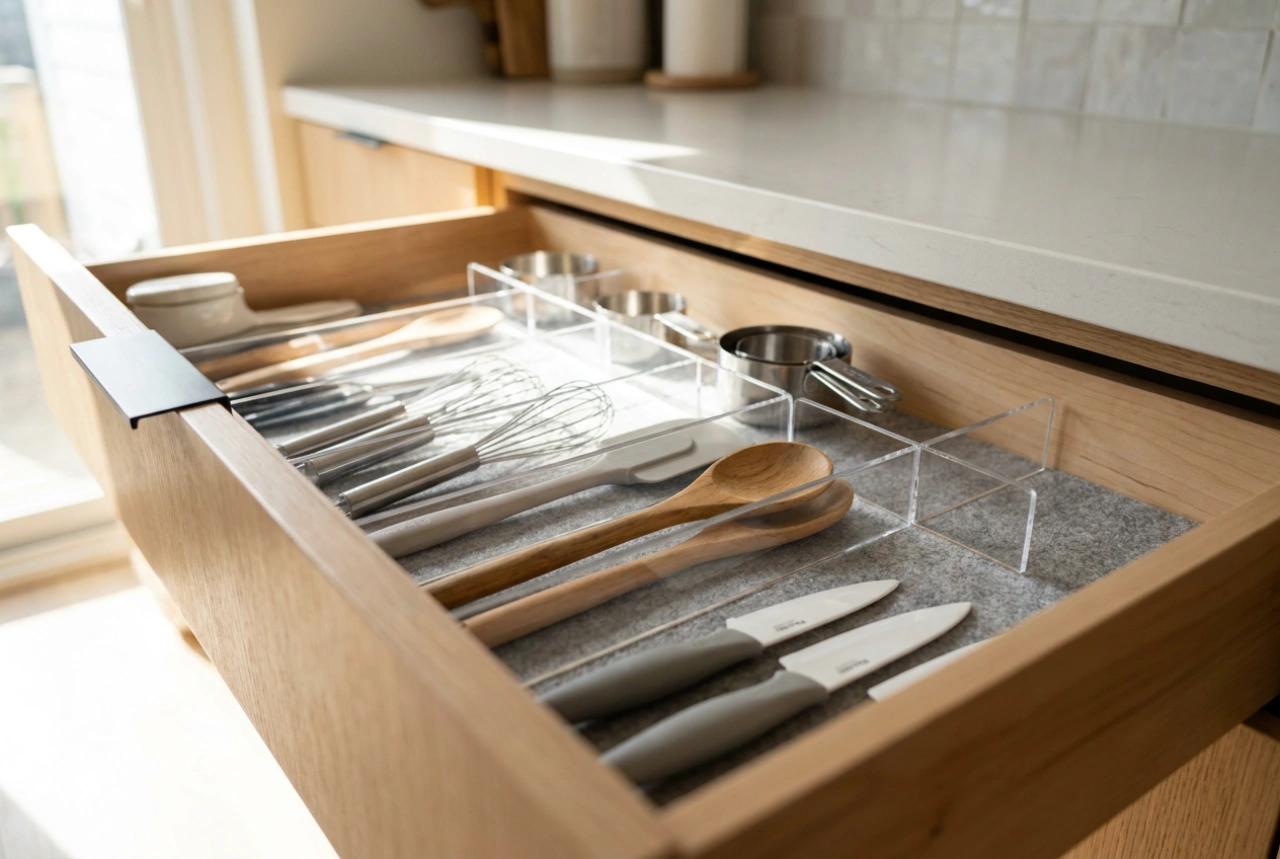
Installing a high-grip, food-grade elastomer or silicone liner provides the necessary resistance to counteract inertia. For heavier implements like metal whisks or meat tenderisers, structural barriers are essential. Use adjustable wooden or composite dividers that wedge tightly against the drawer walls. The tension of these dividers should rely on friction fits or micro-adjustable compression mechanisms, ensuring they remain stationary under the force of daily drawer operations.
Zoning by Frequency of Interaction
Ergonomics dictates that the most frequently used tools should reside in the primary zone of interaction—the front third of the drawer. When you open a drawer, your hand naturally drops to this forward area first. Storing everyday cutlery or preparation knives here minimises the distance the drawer needs to travel for standard tasks, reducing wear on the mechanical runners.
Conversely, secondary items like bottle openers, silicone spatulas, or measuring spoons belong in the middle zone. The rear third, which requires the drawer to be fully extended, should host tertiary items—those used occasionally, such as seasonal tools or structural baking accessories. Grouping items by shape and nesting identical objects (like stacking measuring cups) further maximises vertical clearance.
Material Science: Selecting the Right Dividers
The materials you choose for your drawer organisers affect both hygiene and long-term durability. Solid hardwoods like oak or maple offer excellent structural rigidity and natural aesthetic appeal. However, they must be treated with food-safe oils to prevent moisture absorption and subsequent warping in high-humidity kitchen environments.
For high-moisture zones or drawers housing wet prep tools, non-porous materials like anodised aluminium or high-density polymers are superior. These materials resist organic growth, do not absorb odours, and can be easily sanitised with standard chemical detergents without degrading. When mixing materials, ensure that metal edges are deburred or capped with silicone to prevent scratching the drawer interior.