

Storing delicate necklaces in a drawer often leads to frustrating knots due to kinetic friction and physical movement during drawer operation. By understanding the physics of chain movement and selecting materials that reduce slippage, you can keep your jewelry pristine, organized, and ready to wear without the risk of tangling.
The Mechanics of Chain Tangling: Why Knots Form
Chains knot because of three main factors: flexibility, friction, and kinetic energy. When a drawer is opened or closed, it imparts kinetic energy to the objects inside. This acceleration and deceleration cause unsecured items to slide due to inertia. Highly flexible chain weaves, such as cable, anchor, or curb chains, have multiple tiny articulation points that allow them to loop over themselves easily. On the other hand, snake and omega chains are semi-rigid, possessing a larger minimum bending radius that naturally makes them more resistant to sharp folds and knots. Additionally, smooth metal surfaces sliding against each other have a low coefficient of static friction, meaning they require very little force to slide into tight knots once they overlap.
Selecting the Right Drawer Lining Materials
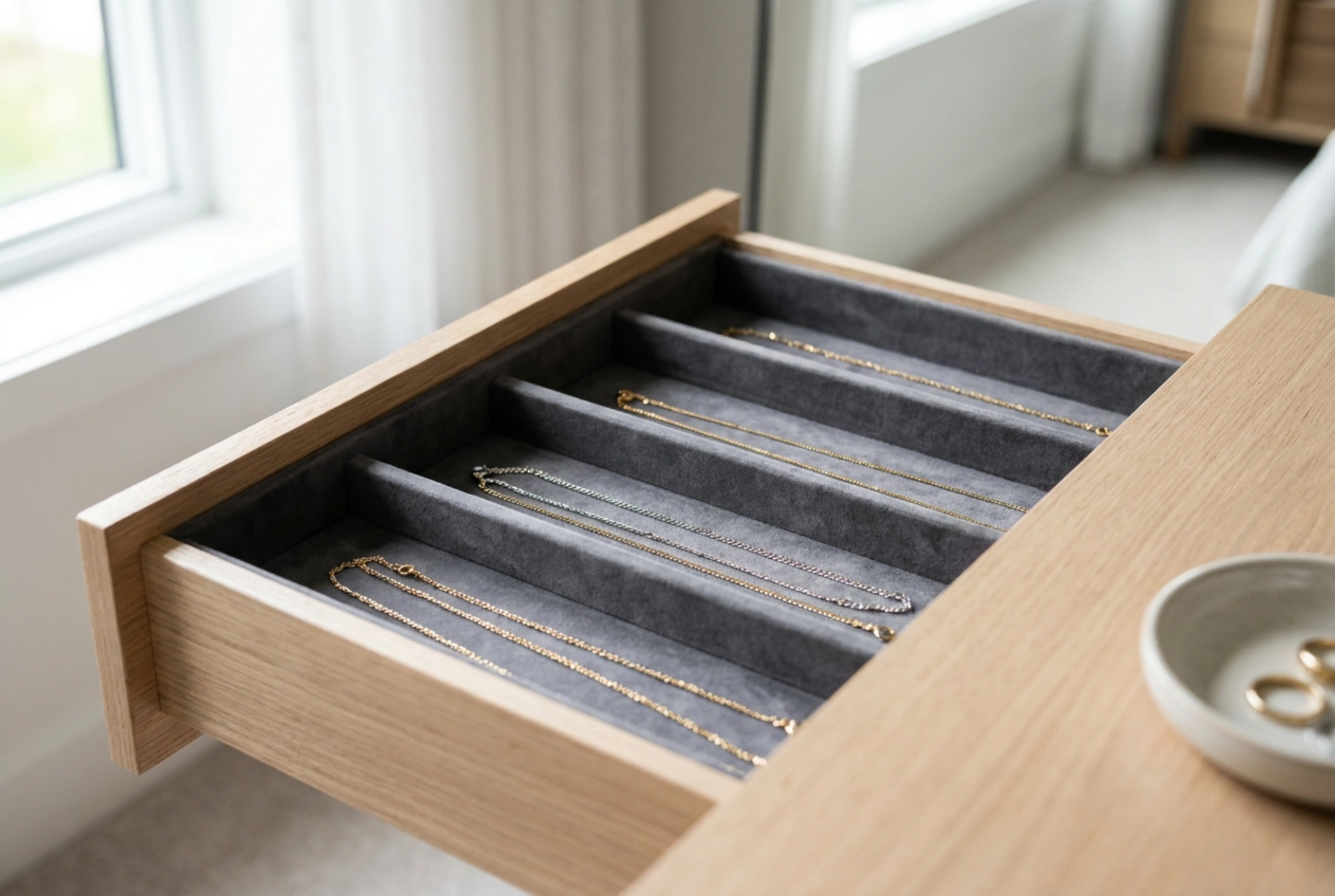
The base material of your drawer organizer dictates how much your chains will shift when the drawer glides open and shut. High-friction fabrics like velvet, microfiber, or flocked silicone are ideal because they physically grip the metal links, absorbing the kinetic energy of the drawer's movement and preventing lateral sliding. However, material chemistry is equally important. Silver jewelry reacts with atmospheric hydrogen sulfide to form silver sulfide, which causes black tarnish. Many wooden drawers release volatile organic compounds and organic acids, such as acetic acid, which accelerate metal corrosion and tarnishing. To protect your collection, opt for acid-free, felt-lined trays, and consider placing anti-tarnish strips containing activated carbon or zinc oxide inside the drawer to chemically scavenge reactive gases before they reach the metal.
Practical Physics: Separation and Tensioning Techniques
To guarantee zero tangles, you must eliminate the physical possibility of chains overlapping. This can be achieved through clever structural barriers and tension:
- Individual Compartments: Use shallow, rectangular dividers where each compartment holds only one necklace. The length of the slot should ideally accommodate the laid-out chain to prevent the ends from coiling together.
- The Straw Method (Rigid Barriers): For ultra-delicate chains, threading one side of the necklace through a sterile, food-grade silicone or paper tube keeps the chain rigid. This physically prevents the chain from looping back on itself, eliminating the geometry required to form a knot.
- Hook and Loop Tensioning: If your organizer features small hooks or a padded bar, drape the chains over them and secure the clasps. Securing the clasp changes the chain from an open, highly chaotic strand to a stable, closed loop, drastically reducing the chance of free ends intertwining.
Preventing Environmental Degradation in Drawers
Humidity acts as a catalyst for chemical reactions on metal surfaces, particularly for gold-plated items where the base metal, often copper or brass, can migrate to the surface and oxidize. Placing a small packet of silica gel in the corner of your jewelry drawer maintains a low relative humidity, preserving the outer layers of your pieces. Furthermore, avoid placing jewelry drawers near heating vents, radiators, or in bathrooms, where rapid temperature fluctuations and steam accelerate tarnish. By combining physical separation with proper chemical and environmental controls, your jewelry drawer will remain both functional and highly protective.