

Selecting between a traditional cutlery basket and a dedicated top cutlery drawer significantly impacts dishwasher capacity, water spray mechanics, and daily ergonomic efficiency. Understanding the physics of water circulation and the metallurgy of silverware helps optimize how these design choices perform in daily use.
Water Circulation and the Prevention of Shielding
The primary mechanism of cleaning in a dishwasher relies on pressurized water jets dissolving soil through mechanical force and chemical action. In traditional cutlery baskets, utensils frequently nest together—particularly spoons and forks of similar sizes. This nesting creates a physical barrier, known as shielding, where water and detergent cannot penetrate the overlapping surfaces. The result is incomplete soil removal and localized film buildup.
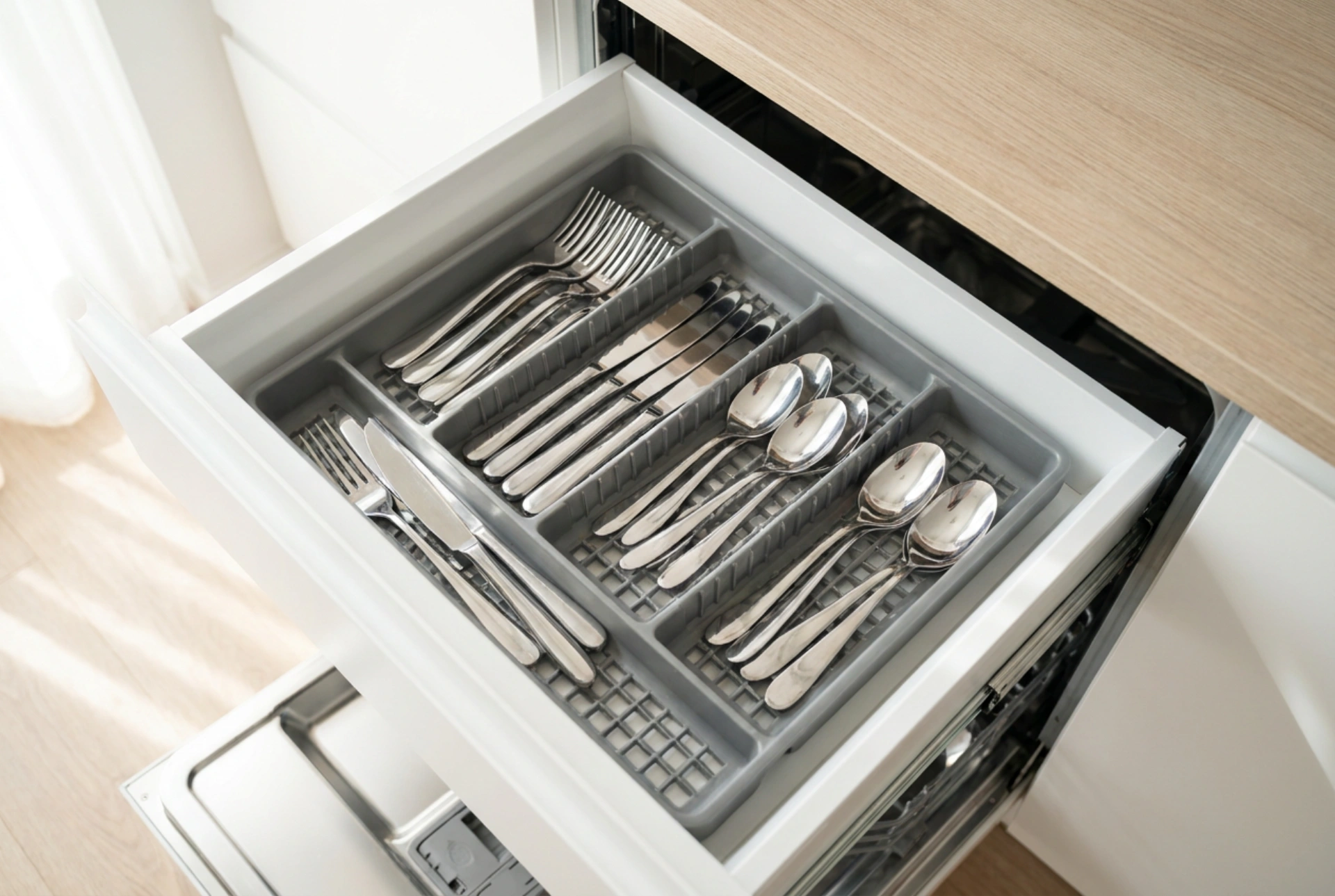
A dedicated cutlery drawer solves this issue by isolating each utensil in its own slot. By keeping items separated, water from the top spray arm can access all faces of the cutlery. This spatial separation ensures that the chemical surfactants in your detergent can wet, emulsify, and lift grease uniformly from every surface without obstruction.
Galvanic Corrosion and Material Preservation
Cutlery is made from various metals, most commonly stainless steel alloys (such as 18/10 or 18/0), silver, or silver-plated metals. When different metals touch in a hot, humid environment containing electrolyte-rich dishwashing water, galvanic corrosion can occur. This electrochemical reaction leads to pitting, tarnishing, and permanent surface damage.
In a standard cutlery basket, metals frequently come into direct contact. A top cutlery drawer mitigates this risk entirely. The plastic-coated tines keep each piece of cutlery insulated from its neighbors. Furthermore, avoiding physical contact prevents mechanical scratching during the high-vibration wash cycle, preserving the passive chromium oxide layer that protects stainless steel from rusting.
Optimizing Appliance Capacity and Ergonomics
Removing the bulky cutlery basket from the bottom rack fundamentally alters the spatial dynamics of the dishwasher. The lower basket is designed to accommodate the heaviest, most heavily soiled items, such as pots, pans, and large dinner plates. By eliminating the basket, you gain up to fifteen percent more usable area on the bottom rack, allowing for better spacing between large dishes and improving the overall path of the lower spray arm.
From an ergonomic perspective, a cutlery drawer shifts the loading process. Instead of dropping items into a basket, you place them individually into designated slots. While this requires slightly more precision during loading, it significantly accelerates the unloading process. By sorting forks, knives, and spoons into dedicated zones within the drawer during loading, you can grab entire sorted batches at once when unloading, reducing physical strain and saving time.
Techniques for Perfect Drying and Loading
To maximize the efficiency of a cutlery drawer, specific loading techniques must be applied. Always place knives with the blades facing downward or secured flat to prevent accidental cuts during unloading. Spoons should be loaded with their concave surfaces facing slightly downward or at an angle; this prevents water from pooling in the bowl of the spoon, ensuring complete drying through thermal evaporation during the final rinse-and-dry phase.
Additionally, ensure that extremely long utensils do not block the rotation of the upper spray arm directly beneath the cutlery drawer. A simple manual spin of the spray arm before starting the cycle confirms that the physical clearance is sufficient for unhindered water distribution.