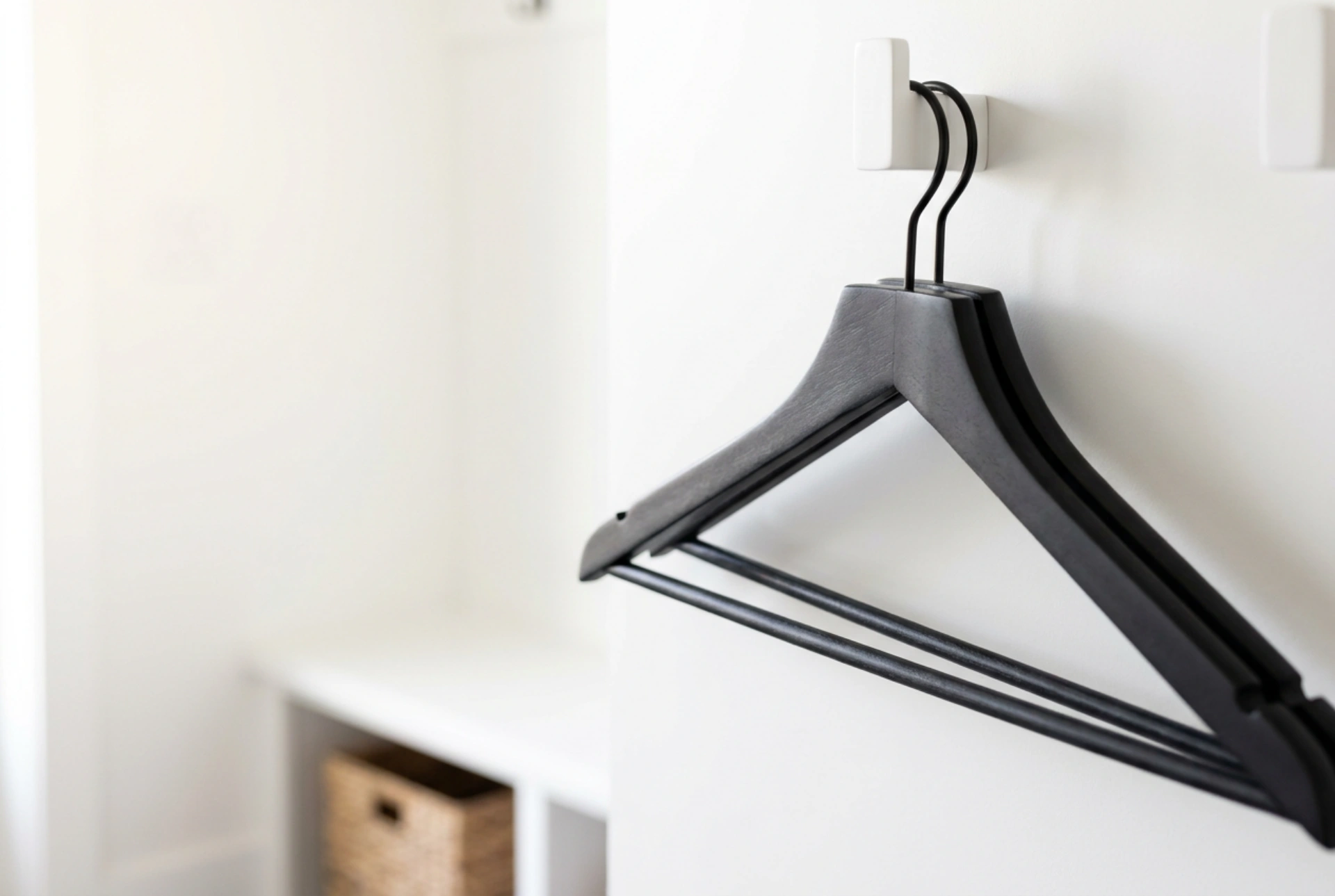


Hanging heavy winter coats on standard hangers causes irreversible structural damage to both the garment's shoulder seams and the hanger itself. Selecting the right support requires understanding the physics of weight distribution, material tensile strength, and ergonomic geometry to preserve your outerwear investment.
The Physics of Garment Distortion under Gravity
When a heavy wool coat or leather jacket—often weighing between two and five kilograms—is placed on a hanger, gravity exerts a continuous downward force. According to basic physics, pressure is calculated as force divided by area. A standard wire or thin plastic hanger concentrates this substantial force onto a very narrow strip of fabric across the shoulders. This high point-load pressure stretches the textile fibers beyond their elastic limit, leading to permanent deformation commonly known as "shoulder bumps" or dimples.
Over time, this localized stress weakens the stitching of the shoulder seams and causes the armholes to warp. To prevent this, the load must be distributed over a larger surface area. By expanding the contact zone between the hanger and the garment, the pressure is significantly reduced, keeping the structural integrity of the fabric and seams intact.
Material Mechanics: Selecting the Strongest Core
The choice of hanger material directly dictates its load capacity and resistance to bending under static weight. Understanding how different materials respond to stress is essential for choosing the right support.
- Hardwoods: Dense woods such as beech, maple, and lotus wood offer superior tensile and bending strength. Their internal cellular structure naturally resists warping. A high-quality wooden hanger is carved along the grain to ensure maximum structural integrity and prevent splitting under heavy loads.
- High-Gauge Metals: Standard thin wire hangers undergo plastic deformation—meaning they bend permanently—under minimal weight. Heavy-duty metal hangers made of solid, chrome-plated steel or thick aluminum (with a diameter of at least 4 millimeters) offer excellent resistance to bending forces and take up minimal horizontal space in closets.
- Dense Polymers: While lightweight molded plastic hangers are prone to snapping, hangers engineered from high-density ABS plastic provide exceptional impact and bending resistance. These often feature reinforced internal ribbing along the curves to withstand high vertical forces.
Key Anatomical Features of a Heavy-Duty Hanger
A hanger designed for heavy outerwear must feature specific structural adaptations to handle heavy weight and preserve the garment's natural shape.
Shoulder Flare Width
The most critical dimension of an outerwear hanger is the width of the shoulder ends. While standard shirt hangers are less than one centimeter wide at the tips, a proper coat hanger should feature a flare measuring between 3 and 6 centimeters. This broad profile mimics the natural shape of the human clavicle and shoulder joint, providing a wide platform that supports the heavy shoulder pads and thick fabrics of overcoats.
The Contour Angle
Human shoulders do not lie in a perfectly flat plane; they curve slightly forward. A high-performance hanger features a gentle forward contour. This forward curve allows the jacket to drape naturally, reducing tension on the collar and the upper back panel, which prevents puckering of the lining.
The Hook Attachment
The point where the metal hook connects to the hanger body is the primary point of failure. Under a heavy load, the hook can pull directly out of the frame. Heavy-duty wooden hangers address this by using threaded metal hooks that screw deep into the wood block, often secured with a metal collar or an internal anchor bolt to resist vertical pull-out forces.
Tailoring the Hanger to Specific Outerwear Materials
Different outerwear materials require specific physical properties from a hanger to maintain their shape and condition over time.
Wool and Cashmere Overcoats: These heavy garments are highly susceptible to stretching. They require wide, contoured wooden hangers with a flared shoulder width of at least 5 centimeters to support their substantial weight without distorting the natural drape of the wool fiber.
Leather Jackets: Leather is a natural skin that stretches under tension but does not shrink back. It also has a low friction coefficient on smooth polished wood, which can cause the jacket to slide off-center, creating asymmetric load. Leather jackets require broad hangers with textured, non-slip shoulder grips or a matte finish to keep the garment perfectly centered.
Down and Synthetic Parkas: While relatively light, parkas are highly voluminous. To prevent the down filling from compressing, use thick, wide hangers that keep the front and back panels separated. This maintains air circulation and preserves the loft of the insulation.