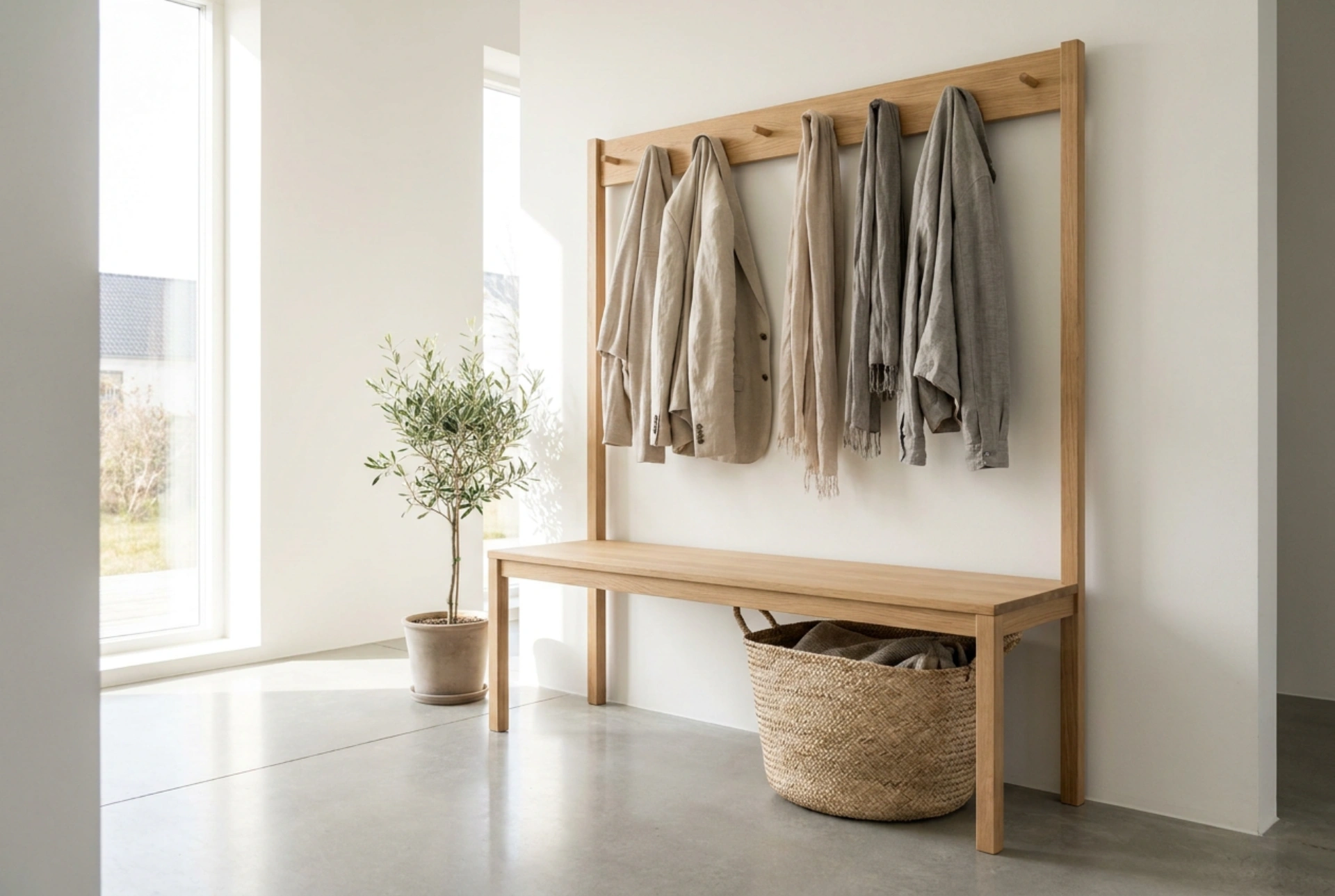


Streamlining morning departures relies on minimising physical friction and decision fatigue at the threshold of the home. Integrating an entryway bench with a coat rack creates a dedicated transition zone that physically coordinates the sequence of donning footwear and retrieving outerwear.
The Ergonomics of Entryway Transition
The entryway of a home functions as a high-traffic kinetic bottleneck. When exiting, an individual must transition from a resting state to a walking state while performing complex motor tasks: selecting outerwear, sitting to tie footwear, and gathering personal items. This process can be optimised through ergonomic design. A standard seating height of 40 to 45 centimetres aligns precisely with the average adult femur length. This height allows the knees to bend at a comfortable 90-degree angle, reducing physical strain on the lumbar spine when leaning forward to fasten shoes.
By pairing this seating surface directly with vertical storage, the kinetic path of a departing person is compressed. Instead of traversing multiple rooms to retrieve a coat, shoes, and keys, all physical steps occur within a single square metre. This spatial compression minimises cognitive load during time-sensitive departures, establishing a predictable physical routine that reduces stress.
Structural Physics and Weight Distribution
An integrated bench and coat rack is subject to complex mechanical forces, particularly rotational torque and shifting centres of gravity. When multiple heavy winter coats are suspended from the top hooks, the overall centre of gravity of the unit rises. If an individual pulls a garment forward with force, this kinetic energy creates a lever arm effect, risking structural tipping.
- Counterweight Mechanics: The bench section serves as a structural stabiliser. Placing heavy items, such as boots or storage baskets, on the lower shelves lowers the centre of mass, increasing static stability.
- Wall Anchoring: To ensure complete physical safety, the vertical frame must be anchored to the wall substrate. Heavy-duty toggle bolts should be used for plasterboard, while expansion plugs are necessary for solid masonry walls to resist shear forces.
- Load-Bearing Capacity: Fasteners must be selected based on shear and tensile strength. Standard double hooks should be secured with deep-threaded wood screws directly into the structural timber studs or metal frame to prevent the hooks from tearing loose under the weight of wet garments.
Moisture Control and Material Science
Outerwear and footwear frequently introduce moisture, salt, and dirt into the entryway, making material selection a matter of chemistry and physics. When wet garments hang against the unit, water droplets transfer to the back panel, while damp footwear pools moisture on the lower shelves. Left unmanaged, this moisture leads to wood swelling, mould proliferation, and structural degradation.
To combat this, the materials must be treated to resist water absorption. Untreated timber possesses a high capillary action, drawing moisture deep into its cellulose fibres. Applying a hydrophobic coating, such as a polyurethane varnish or a hardwax oil, seals these microscopic pores. Water is forced to remain on the surface, where it can evaporate safely. Furthermore, shoe shelves beneath the bench should feature a slatted design rather than a solid surface. Slats facilitate natural convective airflow, allowing ambient air to circulate around damp soles, which significantly accelerates drying times and prevents anaerobic bacterial growth.
Optimising Spatial Layout and Daily Flow
Maximising the efficiency of an entryway unit requires precise positioning relative to the architectural features of the hallway. The unit must sit outside the sweep radius of the main entrance door to prevent physical collisions. An ideal clearance of at least 80 centimetres should be maintained in front of the bench to allow an adult to sit, stretch their legs, and bend forward comfortably without blocking the primary exit path.
Organising the unit itself should follow a strict hierarchy based on usage frequency. Daily-use items occupy the primary zone (hooks at shoulder height and the top shelf of the shoe rack), while seasonal or secondary gear is relegated to the lower shelves or high overhead baskets. By maintaining a clean physical boundary between active daily items and long-term storage, the cognitive friction of searching for lost items is entirely eliminated.