

Selecting the right refrigerator-freezer combination requires understanding how thermal insulation, airflow, and freezing mechanisms impact long-term food preservation.
Thermodynamics of Food Preservation: Choosing the Right Cooling System
When selecting an appliance with a large freezer capacity, the primary decision lies between static cooling and forced-air (No-Frost) systems. Static freezers rely on natural convection; cold air sinks while warmer air rises, creating distinct temperature zones. While this maintains a higher relative humidity, it leads to rapid frost build-up on the evaporator coils. This ice layer acts as an insulator, reducing thermal transfer efficiency and forcing the compressor to work harder to maintain target temperatures.
Forced-air or No-Frost systems use a fan to distribute dry, cold air evenly throughout the compartment, extracting moisture to an external evaporator where it is periodically melted. While this prevents frost accumulation, the continuous airflow accelerates sublimation—the transition of ice directly into water vapour. This process causes freezer burn. To counteract this, food must be stored in airtight, vapour-impermeable barriers to prevent cellular dehydration.
Evaluating Capacity, Thermal Mass, and Air Distribution
Calculating the ideal freezer volume depends on your storage habits and the physics of thermal mass. A larger freezer operates most efficiently when loaded to approximately 70% to 80% of its total capacity. When the freezer door is opened, cold air escapes instantly and is replaced by warm, humid ambient air. Solid frozen items possess a much higher thermal mass than air, meaning they retain cold and help the compartment return to its target temperature of -18 degrees Celsius rapidly, reducing load on the compressor.
- Daily Fresh Freezing: If you freeze large batches of fresh food at once, look for appliances with a fast-freeze function. This temporarily lowers the temperature to -24 degrees Celsius, accelerating the freezing process to prevent the formation of large ice crystals that rupture food cell walls.
- Drawer Configuration: Deep drawers isolate distinct food groups and prevent massive air exchange. When a single drawer is pulled out, the cold air trapped around other drawers remains undisturbed, preserving the microclimate.
Material Science of Freezer Storage
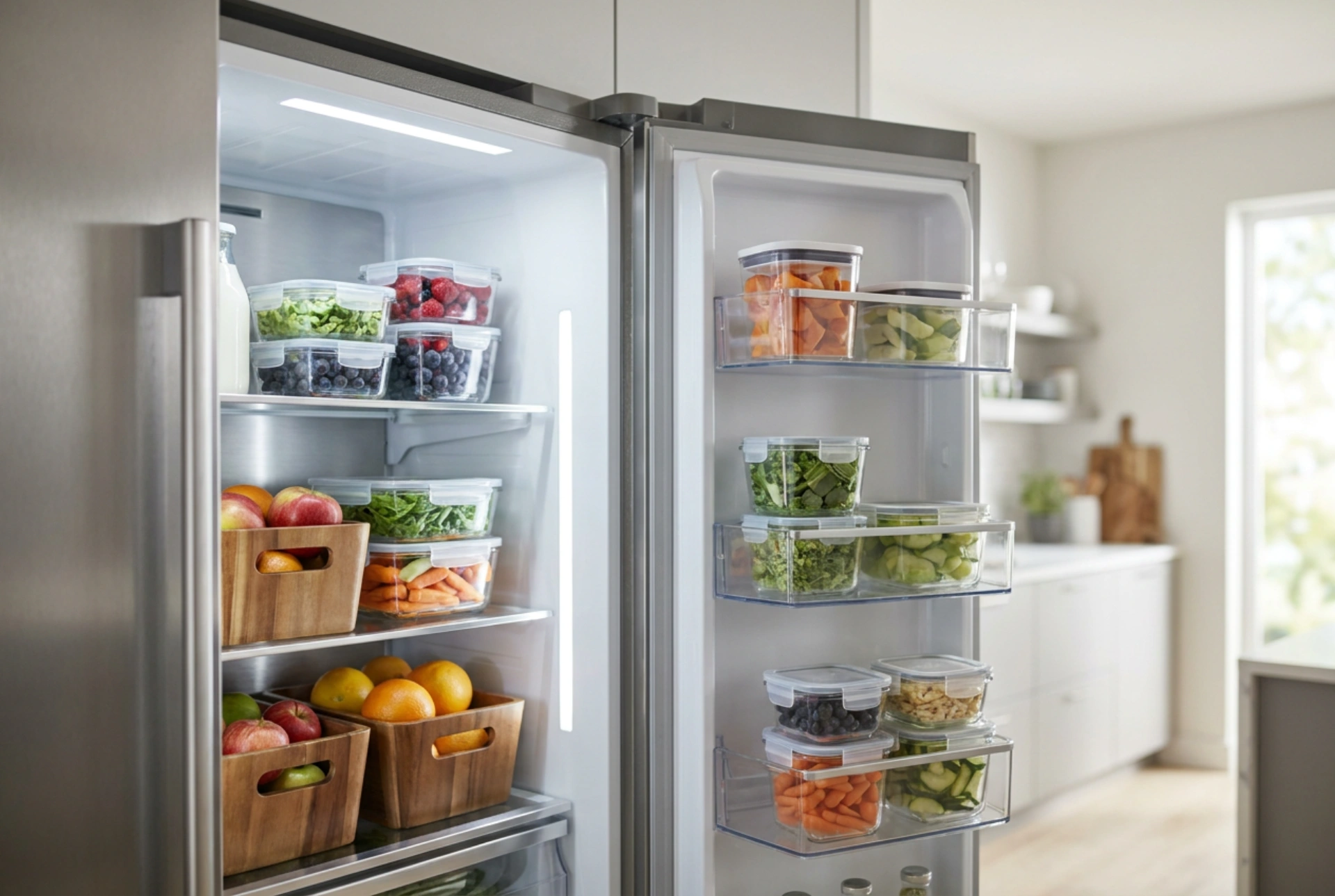
Maximising a large freezer requires choosing the right storage vessels to prevent chemical degradation. Standard plastics become brittle at low temperatures because their polymer chains lose flexibility. Look for containers rated specifically for freezing, usually made from high-density polyethylene (HDPE) or thick borosilicate glass capable of withstanding rapid thermal expansion and contraction.
To prevent oxidation, which degrades lipids and pigments in frozen food, air must be eliminated. Vacuum-sealing bags are highly effective because they remove the atmospheric oxygen that drives chemical spoilage. For liquid storage, leave a 10% headspace to accommodate the volumetric expansion of water as it transitions from liquid to solid phase, preventing container rupture.
Structural Considerations: Compressor Types and Insulation
The efficiency of a large freezer is deeply tied to its insulation thickness and compressor technology. Traditional single-speed compressors operate on an all-or-nothing cycle, starting up at maximum power and shutting down once the target temperature is reached. This creates temperature fluctuations. Inverter compressors adjust their speed continuously to match the actual cooling demand, maintaining a highly stable thermal environment which is crucial for preventing the recrystallisation of ice inside frozen foods.
Additionally, check the insulation thickness of the appliance walls. Thicker polyurethane foam insulation provides a superior thermal barrier, which not only lowers electricity consumption but also extends the safe storage time during power outages by slowing down the rate of ambient heat transfer into the freezer cavity.