

Maximising wardrobe efficiency requires aligning physical clothing dimensions with the spatial geometry of your cabinet to eliminate unused air gaps and prevent fabric degradation.
The Physics of Hanging: Gravity, Friction, and Tension
When garments are hung, gravity acts as a continuous pulling force on the textile structure. Woven fabrics, such as those found in tailored jackets, cotton shirts, and linen trousers, benefit from this vertical tension as it naturally relaxes minor creases. However, the weight of the garment must be distributed evenly across its structural anchor points—specifically, the yoke and shoulders. Using hangers that do not match the natural 15-to-20-degree shoulder slope of human anatomy leads to localised pressure points, resulting in fabric puckering and irreversible stretching of the shoulder seams.
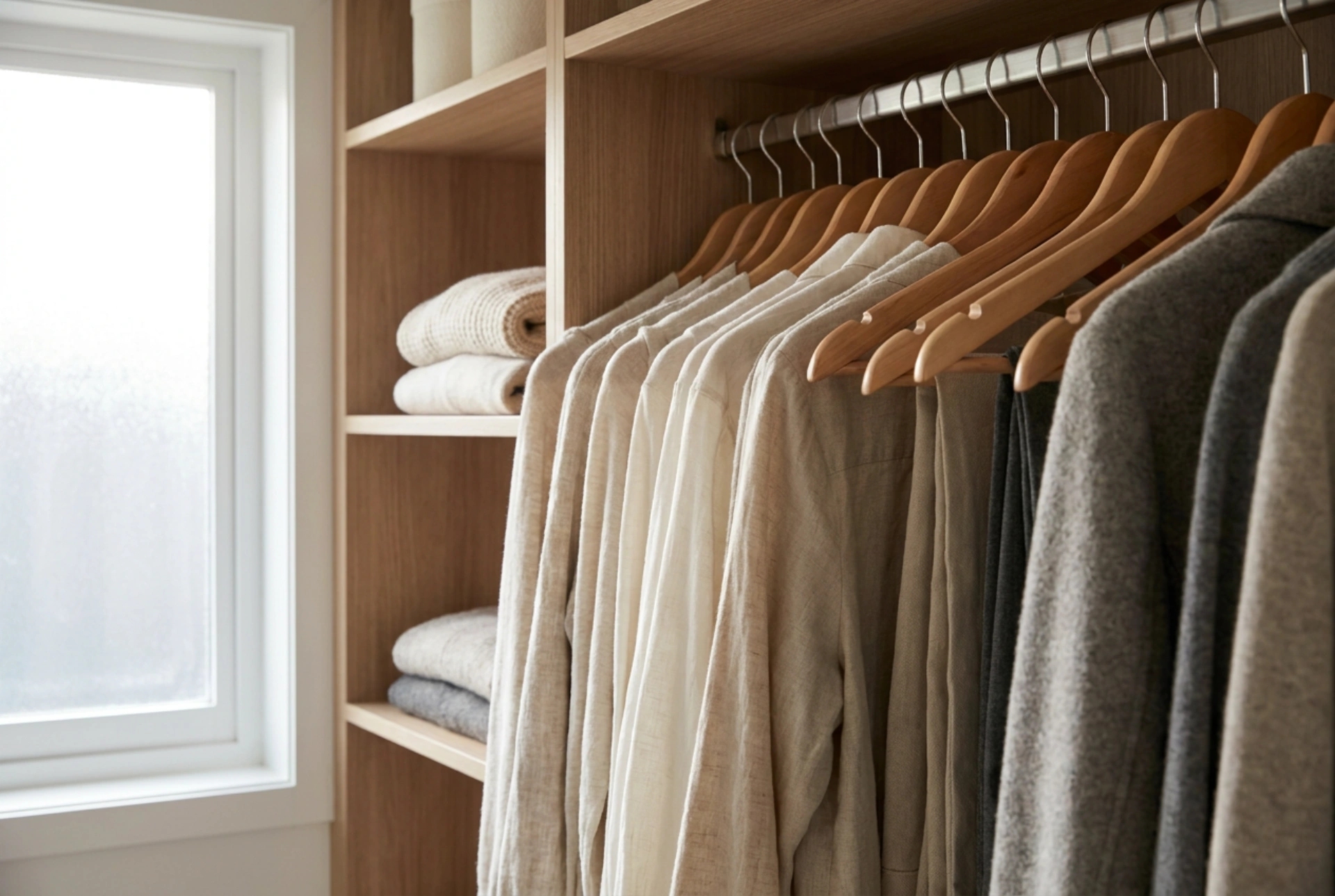
Material friction also plays a vital role. High-friction hanger coatings, like flocked velvet or untreated wood, prevent silky synthetic or natural silk garments from sliding off. Conversely, heavy woollen coats require wide, contoured wooden hangers that mimic human shoulder thickness (approximately 4 to 5 cm wide at the tips) to distribute the load and preserve the garment's three-dimensional shape. Understanding these physical dynamics ensures that clothes remain pristine while suspended.
Vertical Zoning: Calculating Precise Clearances
To eliminate wasted vertical space, wardrobes must be segmented based on the exact lengths of specific clothing categories. A one-size-fits-all hanging section inevitably creates large pockets of empty space at the bottom, which quickly become cluttered or remain underutilised. Dividing the wardrobe into distinct zones is the mathematically optimal solution.
- Short Hang (90 to 110 cm): This zone is engineered for shirts, blouses, skirts, and folded trousers. By installing two rods vertically stacked above each other in a standard 220 cm high carcass, you double the usable hanging capacity.
- Medium Hang (120 to 130 cm): Ideal for knee-length dresses, light trench coats, and men's suits hung with trousers extended.
- Long Hang (150 to 170 cm): Reserved for full-length evening dresses, maxi skirts, and heavy overcoats. Keeping these garments suspended without touching the floor prevents the hem from creasing and accumulating dust.
By measuring your longest garments before planning, you can position the support rails at precise heights, leaving exactly 5 to 10 cm of clearance beneath the hems for airflow and easy cleaning.
Horizontal Density and Depth Calculations
The depth of a wardrobe dictates how freely garments can hang without experiencing lateral compression. Standard human shoulder width ranges from 40 to 50 cm. Therefore, an internal wardrobe depth of 58 to 60 cm is the scientific baseline. If the cabinet is shallower, sleeves will rub against the back wall and the front doors every time they are operated. This continuous mechanical friction damages delicate fibres and causes unsightly creasing along the outer sleeve lines.
For narrow spaces where a 60 cm depth is impossible, transverse (pull-out) rails must be utilised. Unlike longitudinal rods, transverse rails orient the clothes parallel to the door, relying on a forward-pulling mechanism to access items. When calculating horizontal capacity on a standard rod, apply the rule of 3 cm per garment. This spacing ensures enough air gap to prevent the stagnation of humid air, which can lead to musty odours and mould growth, while still maintaining high storage density.
Structural Integrity of Wardrobe Rails
The mechanical load of clothing can be deceptively heavy; a linear metre of hanging shirts weighs approximately 5 to 7 kg, while a metre of winter coats can exceed 15 kg. Standard hollow aluminium or steel rods will sag over time if they span more than 90 cm without middle support. Choosing oval-profile rails instead of circular ones increases resistance to vertical bending forces, ensuring long-term structural integrity and a smooth sliding motion for hangers.