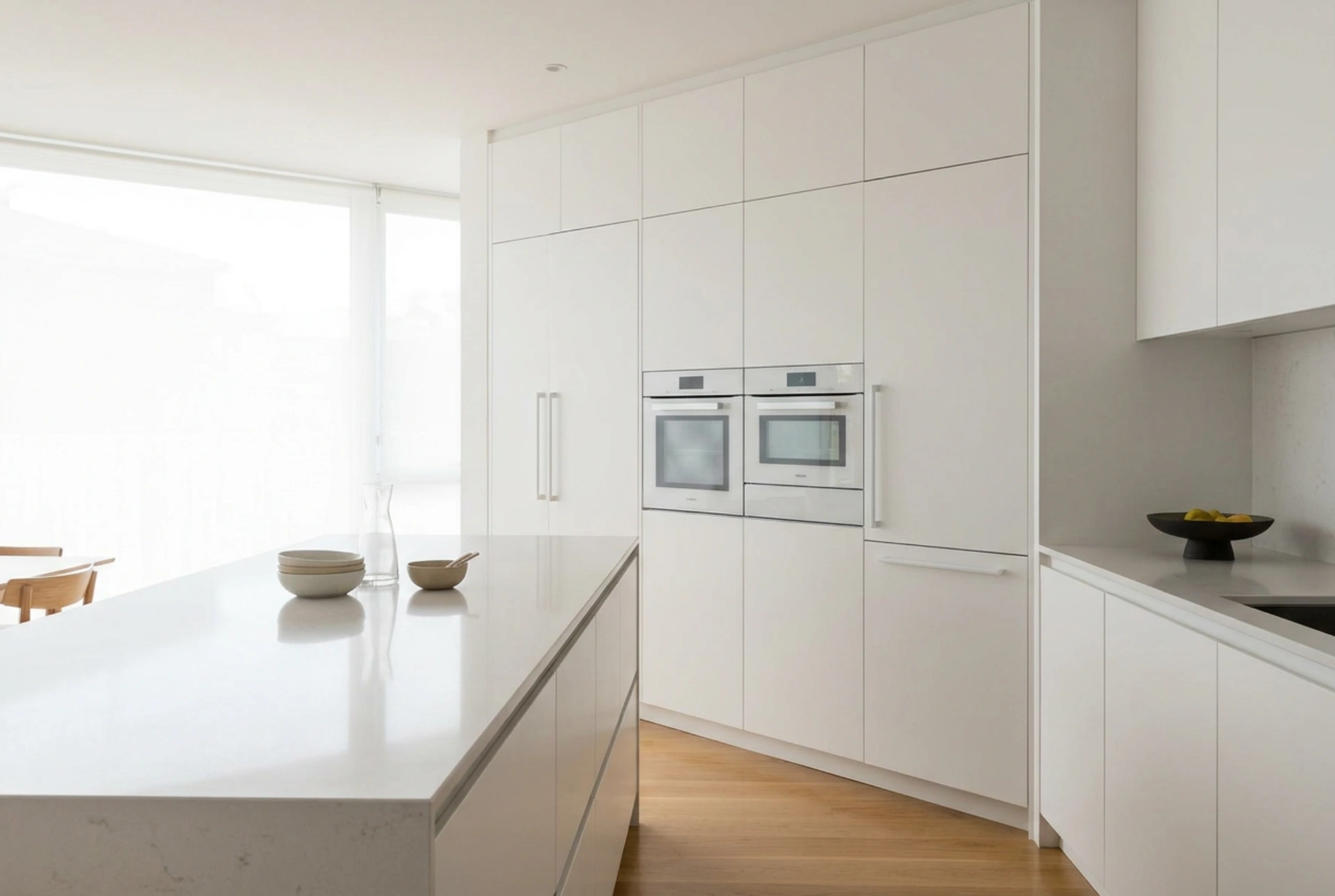


Integrating a double-door refrigerator into modern kitchen cabinetry requires precise spatial planning, mathematical tolerance checks, and an understanding of thermodynamics to prevent premature appliance failure and cabinet warping.
The Physics of Heat Dissipation: Why Ventilation Matters
To maintain cold internal temperatures, a refrigerator must efficiently expel heat from its condenser coil. An integrated appliance operates within a confined wooden carcass, making proper airflow paths vital. Without adequate ventilation, heat accumulates around the compressor, forcing the motor to run continuously to achieve the set temperature. This dramatically increases energy consumption and drastically reduces the operational lifespan of the appliance. To prevent thermal build-up, you must ensure a minimum ventilation gap of 200 square centimetres at both the base of the cabinet for air intake and at the top for air exhaust. The air must flow freely behind the appliance in a chimney-like channel. This channel requires a minimum clearance depth of 50 millimetres between the back wall of the refrigerator and the structural wall of the room.
Hinge Kinematics: Sliding vs. Fixed Door-on-Door Systems
The choice of hinge mechanism dictates how the decorative kitchen furniture panel connects to the appliance doors, which directly affects both durability and ease of use. There are two primary mechanical systems to consider:
- Fixed Hinge (Door-on-Door): In this configuration, the kitchen unit front is mounted directly onto the appliance door. The weight of the wooden panel is borne entirely by the heavy-duty hinges of the refrigerator itself. This system allows for a wider opening angle (often up to 115 degrees) and provides a tighter acoustic and thermal seal, but it requires highly precise calculations regarding the maximum allowable weight of the decorative panel.
- Sliding Hinge: The kitchen front is attached directly to the cabinet carcass using standard kitchen hinges, and a sliding guide rail links it to the appliance door. When the door is opened, the kitchen panel glides across the appliance door. While this system offers easier installation adjustment, it limits the opening angle and contains more moving parts prone to wear over time.
For double-door models, which naturally feature wider and heavier front panels, fixed hinges are highly recommended to ensure long-term stability and prevent door sagging.
Dimensional Tolerances and Door Clearance Sweeps
Achieving a seamless, flush look with surrounding cabinetry requires meticulous tolerance management. A common error is neglecting the door sweep radius. When a thick cabinet front opens, its outer edge swings slightly outward beyond the cabinet width. Without an adequate shadow gap (typically 3 to 4 millimetres between cabinet fronts), the door will scrape against adjacent cabinetry when opened. For side-by-side or French-door configurations, a precise central vertical gap must be maintained so that both doors can swing open simultaneously without physical interference.
Structural Weight Distribution and Base Support
An integrated double-door refrigerator is heavy, often weighing upwards of 120 kilograms when empty, and potentially exceeding 200 kilograms when fully loaded with food and beverages. Standard kitchen cabinet plinths and bases are not designed to support this concentrated load without bowing. The base platform of the housing unit must be constructed from high-density, moisture-resistant material and supported by heavy-duty adjustable legs positioned directly beneath the load-bearing corners of the appliance. Failure to reinforce this base will lead to structural sagging, which throws the door hinges out of alignment and breaks the airtight seal of the magnetic door gaskets.