

Sliding wardrobe doors that rub against their track are not just annoying; the resulting friction can permanently damage the aluminium rails and wear down the roller bearings. Correcting this issue requires understanding how gravity, track cleanliness, and roller calibration work together to keep the door suspended at the correct height.
The Mechanical Causes of Door Rubbing
Sliding doors operate on a simple suspended or bottom-running roller system. Over time, the constant kinetic energy of opening and closing, combined with the downward pull of gravity, causes the adjustment screws on the roller carriages to loosen. This slight mechanical shift drops the door panel, leading to direct contact between the bottom of the door frame and the metal track. This friction not only generates noise but also creates resistance that strains the roller bearings, eventually leading to flat spots on the wheels.
Another common culprit is structural settling or uneven flooring, which shifts the parallel alignment of the top and bottom tracks. When the tracks are no longer perfectly parallel, the door tilts, causing the outer edges of the frame to scrape against the track walls.
Locating and Accessing the Adjustment Screws
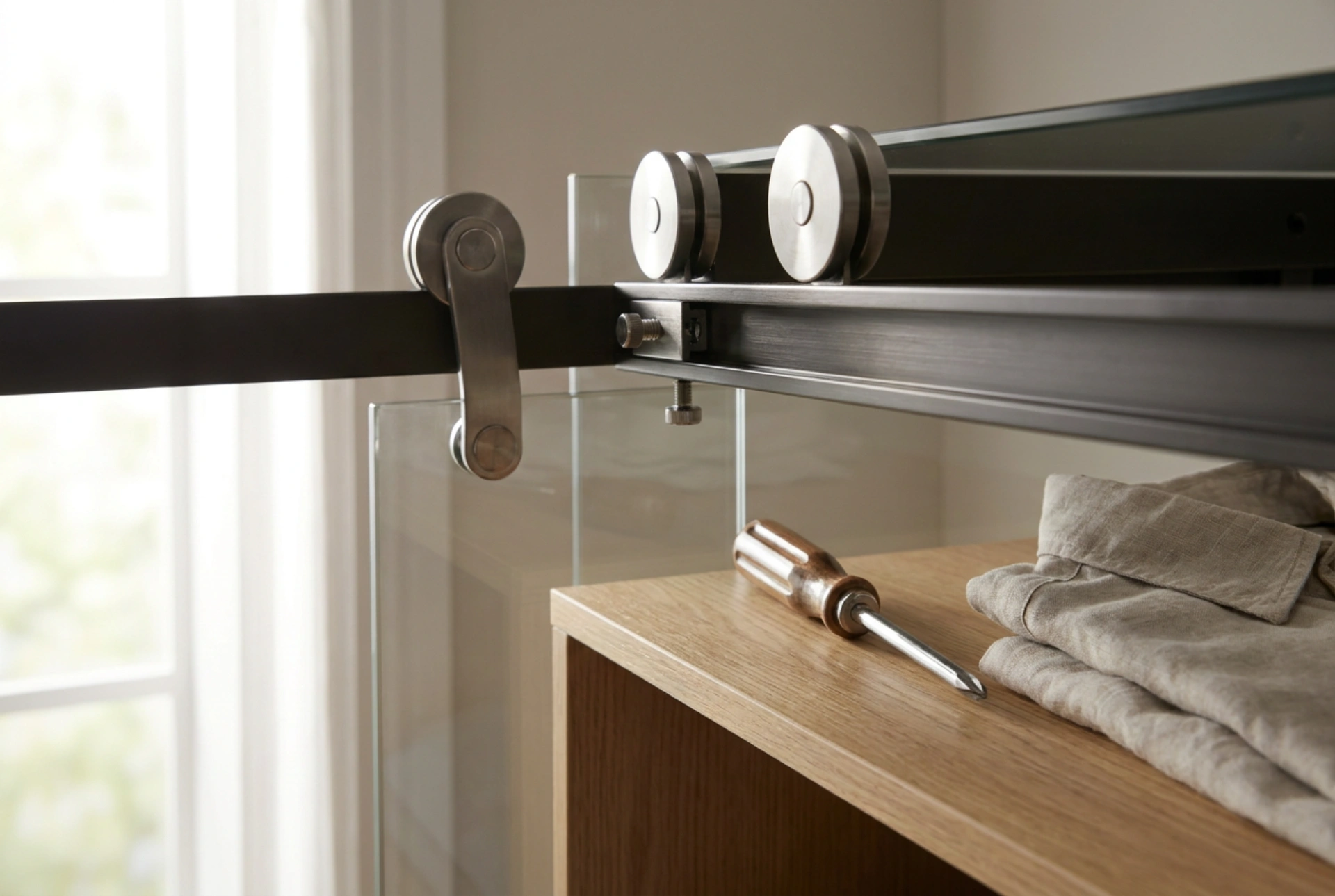
Most sliding wardrobe systems feature height-adjustment screws located at the bottom corners of the door panels. These are often hidden behind protective plastic caps or felt dust-strips to maintain a clean aesthetic. Depending on the design of your wardrobe, you will find one of two mechanisms:
- Threaded Bolt Systems: Direct vertical bolts where turning clockwise raises the roller housing relative to the door, effectively lifting the door panel off the track.
- Eccentric Cam Systems: Rotating cams that adjust the height of the wheel relative to the bracket through an offset axis. These require precise, incremental turns.
Before making any mechanical adjustments, always clear any debris from the track using a stiff brush and a vacuum. Accumulated dust and fibres compress into hard obstacles that mimic a misaligned door, forcing the rollers to jump or drag.
Step-by-Step Calibration and Height Adjustment
To eliminate rubbing, you must recalibrate the tension and height of the rollers on both sides of the door to ensure equal load distribution.
Step 1: Check the Current Level
Slide the door close to the side wardrobe panel. Examine the vertical gap. If the gap is wider at the top than the bottom, the roller on the opposite side is set too low, tilting the door. Use a spirit level against the door edge to confirm the angle of inclination.
Step 2: Adjust the Height
Insert a manual screwdriver (flathead or hex key, depending on the system) into the adjustment hole. Avoid power drivers, as they can easily strip the soft metal of the adjustment screws. Turn the screw clockwise to raise the door and counter-clockwise to lower it. Work in small, half-turn increments. Raising the door by just 1 to 2 millimetres is usually sufficient to clear the bottom track lip.
Step 3: Equalise the Load
Adjust both the left and right rollers so that the door sits perfectly horizontal and level. If only one side is raised, the door will slide unevenly, causing uneven wear on one roller and causing the other to slide or drag along the track without rotating.
Preventative Track and Roller Maintenance
To ensure long-term smooth operation, the mechanics of the track must be kept free of friction-increasing elements. Do not use heavy oils or wet grease on the tracks or rollers; these substances act as magnets for dust, hair, and clothing fibres, creating an abrasive paste that quickly destroys roller bearings. Instead, use a dry silicone spray or a specialised PTFE lubricant on the roller axles. Wipe away any excess to keep the running surfaces clean and dry.