

Designing a wardrobe under a slanted roof requires a precise understanding of geometry and ergonomics to transform awkward angles into highly functional storage. By mapping your daily routines to the physical constraints of the slope, you can maximise every cubic centimetre without compromising on accessibility.
The Physics of Sloping Space: Mapping the Zones
Every attic slope introduces a gradient of usability determined by vertical clearance. To design an efficient layout, the space must be divided into three distinct ergonomic zones based on human reach and gravity. The lowest section, where the roof meets the knee wall, typically falls below 90 centimetres. This area is highly inefficient for standing access but ideal for deep, low-profile storage such as heavy-duty pull-out drawers. Placing items here on telescopic runners allows you to retrieve belongings without bending at awkward, spine-straining angles.
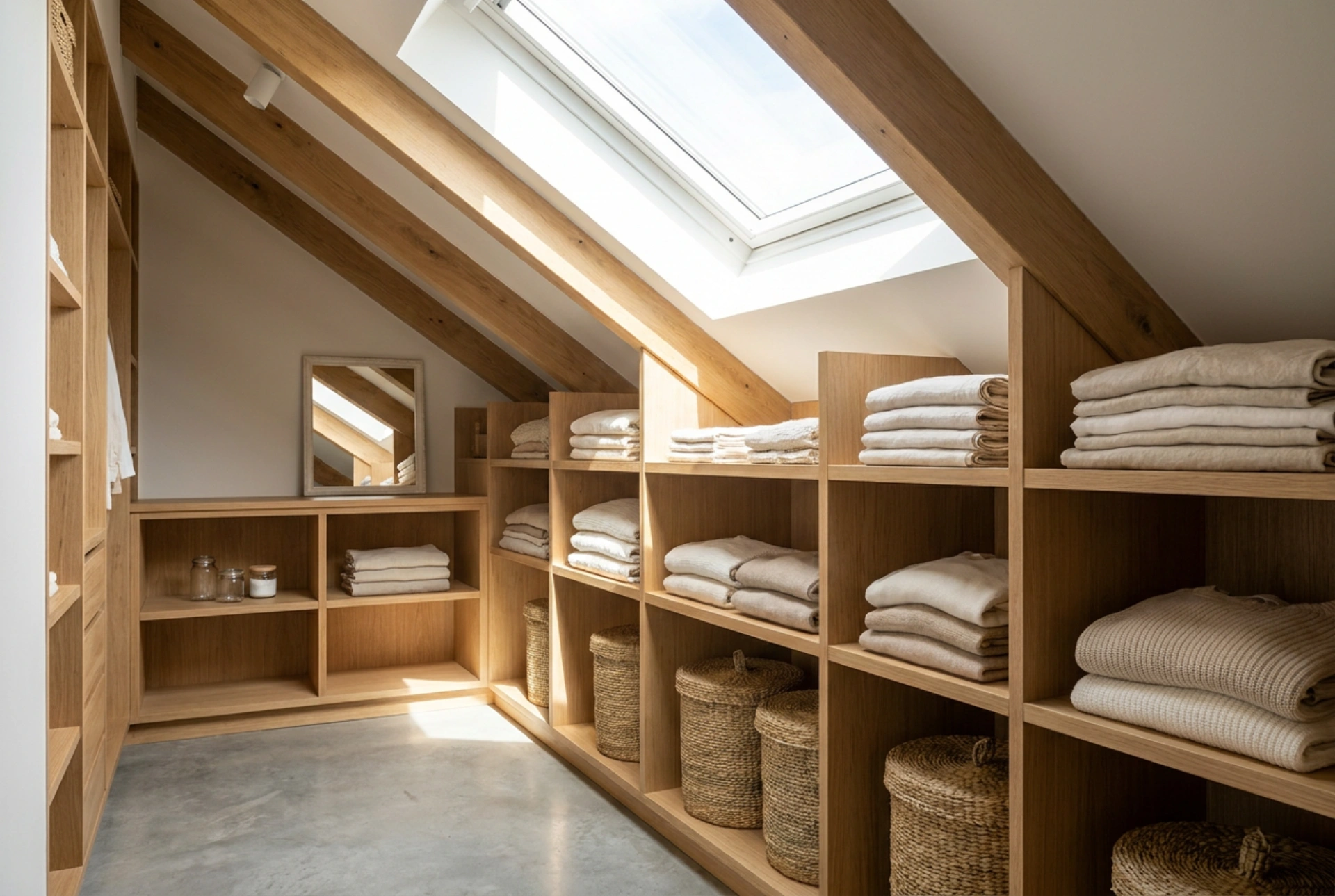
The mid-zone, ranging from 90 to 140 centimetres, represents the optimal height for active reach. This is where shelving units and pull-out trays should reside. Because the depth of the wardrobe increases as it nears the floor, standard shelves can lead to lost items at the back. Implementing shallow shelves or sliding trays ensures that physics works in your favour, keeping objects visible and within the natural sweep of your arm.
The high-zone, exceeding 140 centimetres, is the only area capable of accommodating hanging rails. A standard clothes hanger requires a minimum depth of 55 to 60 centimetres and a vertical clearance of 100 centimetres for shirts or 160 centimetres for long coats. Positioning the hanging rail perpendicular to the slope using pull-out wardrobe rails is an excellent mechanical solution when the parallel run lacks the necessary depth.
Managing Microclimates: Ventilation and Fabric Protection
Attics are uniquely susceptible to temperature fluctuations and moisture accumulation due to their proximity to the roof. When warm, humid air inside the home rises and meets the colder outer walls of the attic, condensation can form behind built-in furniture. This creates a risk of mould and musty odours on textiles.
To mitigate this, never press back panels directly against the roof structure or external walls. Leave a ventilation gap of at least 3 to 5 centimetres to facilitate natural convection. Air must flow freely from the floor level up through the top of the wardrobe. Selecting open wire baskets or slatted shelving over solid timber can significantly improve airflow around fabrics. Furthermore, choosing materials that do not absorb moisture, such as powder-coated steel or high-density melamine-faced panels, prevents structural warping and odour absorption common with untreated solid wood in humid environments.
Ergonomic Mechanics: Choosing the Right Fittings
Standard hinged doors require significant clearance to open, which is often unavailable in tight attic walkways. Sliding doors are the mechanically superior choice, but they require a dual-track system that must be perfectly level to prevent the doors from drifting under the influence of gravity. If the ceiling slope prevents a full-height sliding door, a combination of open shelving and low-level drawers is often the most practical solution.
For deep cavities, hardware selection is critical. Drawers should feature full-extension runners with a high load capacity (minimum 30 kg) to handle the weight of stacked textiles. This allows you to pull the entire volume of the drawer out into the light, eliminating the need to search blindly in dark corners. To store shoes or bulky seasonal items in the deepest recesses, install rolling carts on heavy-duty castors that can be wheeled out entirely for sorting and cleaning.
Light and Visibility in Deep Recesses
Slanted wardrobes often suffer from poor natural light penetration, as standard ceiling fixtures rarely cast light into deep, angled recesses. While skylights provide excellent illumination during the day, direct sunlight can degrade fabric fibres and cause dyes to fade due to UV exposure. To protect your wardrobe, position the storage units so they are shielded from direct midday sun, or use UV-filtering window films on skylights.
Inside the wardrobe, neutral, light-coloured interior finishes—such as white, light grey, or pale birch—are highly effective at reflecting ambient light. This visual trick increases contrast, making it significantly easier to identify dark clothing items without relying on high-wattage artificial lighting.