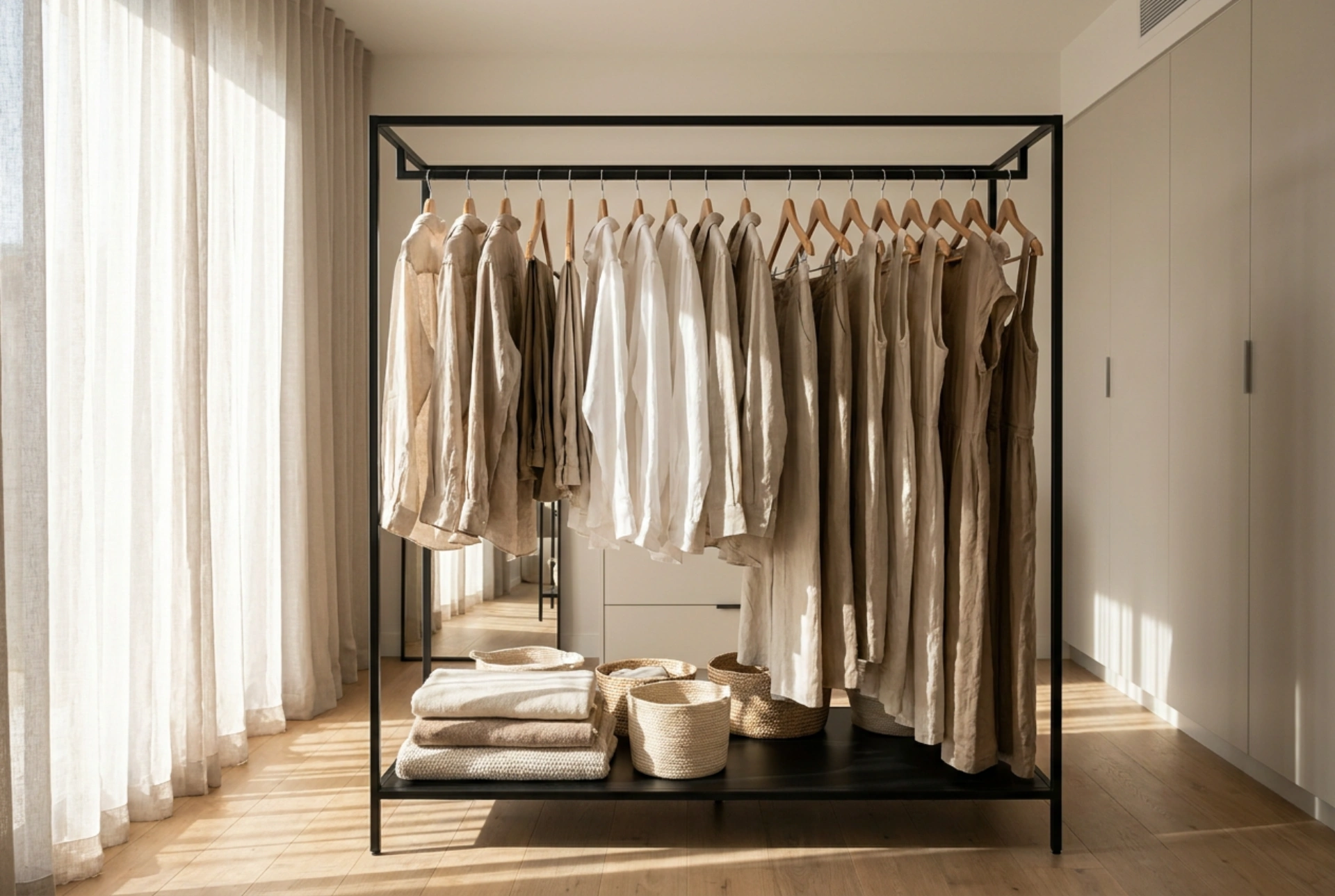


Static built-in closets often fail to adapt to changing seasonal wardrobe volumes, leading to cluttered spaces and poor air circulation. Utilizing freestanding, open-frame garment racks provides a dynamic, non-permanent zoning solution that optimises spatial flow and structural utility in any dressing room.
The Physics of Spatial Partitioning and Microclimate Control
Traditional solid wardrobes act as thermal and physical barriers, creating stagnant air pockets where relative humidity can rise, encouraging mould growth and dust mite proliferation. Open-frame garment racks, conversely, partition space without restricting airflow. By placing these racks strategically, you create a physical boundary that defines different functional areas while allowing natural air currents to circulate freely. This constant air exchange assists in keeping textiles dry and prevents the accumulation of musty odours.
Furthermore, open frames do not block natural light. In dressing areas, light penetration is crucial for accurate colour perception and material inspection. Placing a minimalist metal rack perpendicular to a window allows light to filter through the garments, illuminating the space while serving as a translucent room divider that maintains an open, airy aesthetic.
Structural Integrity and Mechanical Stability
When selecting and positioning a garment rack for zoning, understanding its mechanical limits is vital. A fully loaded rack holding heavy winter coats or wool suits carries significant mass, which raises its centre of gravity. To ensure safety and prevent tipping, the rack must have a wide, stable base, ideally constructed from heavy-gauge powder-coated steel or solid iron tubes.
- Weight distribution: Place heavier items, such as boots, storage boxes, or heavy outerwear, on the bottom shelf or lower tier to lower the overall centre of gravity.
- Caster functionality: If the rack is mobile, select high-grade industrial casters with reliable locking mechanisms. Lock at least two opposing wheels to prevent accidental movement when retrieving items.
- Load capacity: Always calculate the combined weight of your garments. Standard light-duty racks bend under continuous stress, leading to structural fatigue at the joint connections. Opt for threaded metal joints rather than push-pin connectors for permanent stability.
Designing Functional Zones for Operational Flow
Effective wardrobe management relies on clear operational zones based on daily habits and clothing lifecycle. A freestanding rack can act as a physical transition point between different storage states:
The Active Zone
Position a central rack to hold current-season garments that you wear weekly. This should be easily accessible from the dressing area's main entry point, minimising unnecessary movement and keeping high-traffic items separate from long-term storage.
The Transition and Airing-Out Zone
Textiles should not be returned to a closed closet immediately after wear, as they retain body heat and moisture. Use a designated portion of your garment rack as an airing-out zone. Allowing fabrics like wool, silk, and linen to breathe for 12 to 24 hours before storage preserves their fibre structure and reduces the frequency of chemical dry cleaning.
The Seasonal Barrier
Use a rack as a divider to separate active summer wear from stored winter garments. By placing the offseason rack further back in the room, you mentally and physically declutter your daily routine, focusing your attention only on what is immediately relevant.
Preventing Fibre Degradation through Strategic Placement
While natural light is beneficial for visibility, direct ultraviolet (UV) radiation breaks down chemical bonds in textile dyes and synthetic fibres, leading to fading and material degradation. When positioning your zoning rack, ensure it sits outside the direct path of intense sunlight. If the rack must be placed near a window, utilise sheer curtains to diffuse the UV rays or apply a UV-filtering film to the glass. Additionally, keep racks away from direct heat sources such as radiators, as localised heat dries out natural fibres like wool and leather, causing them to become brittle and crack over time.