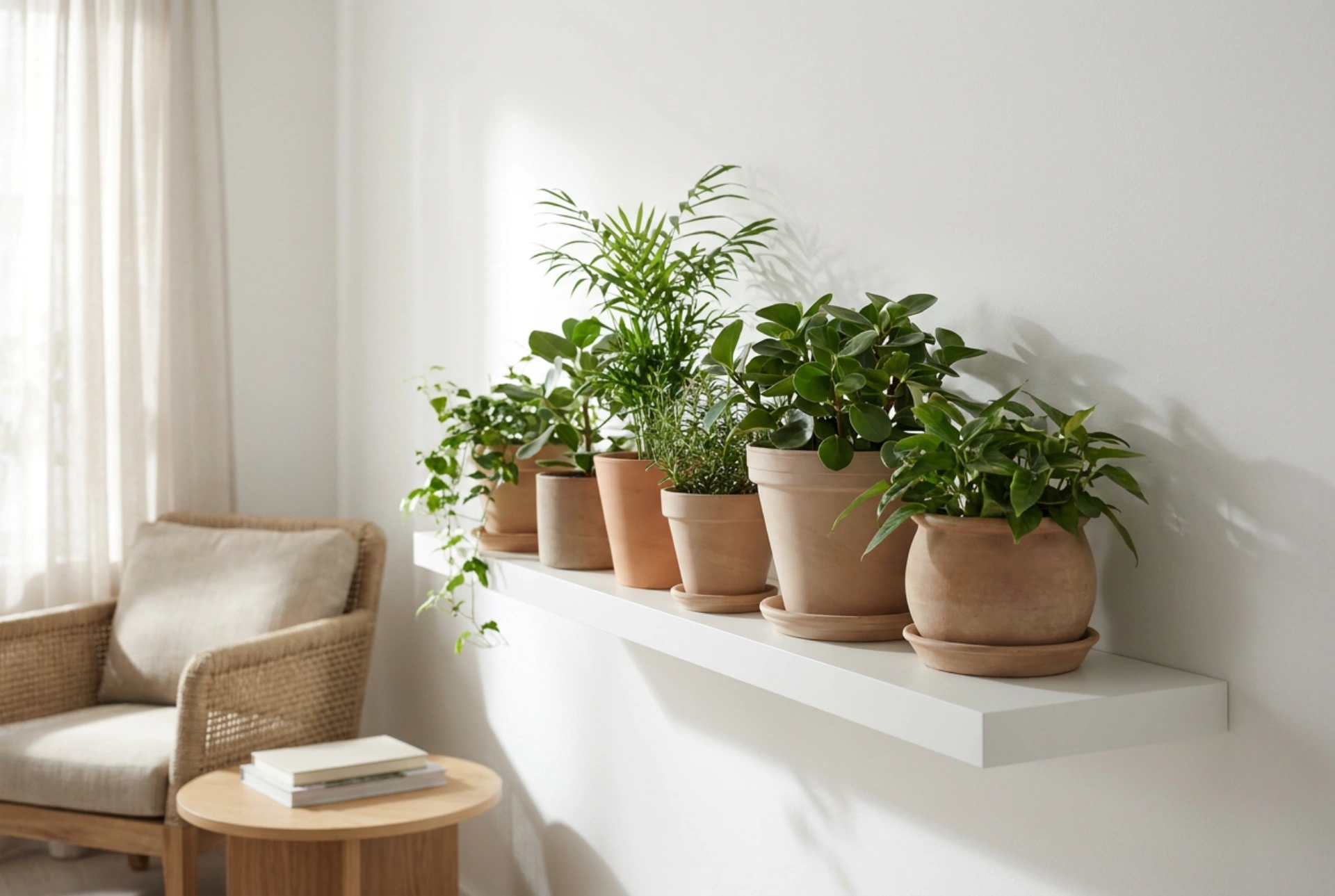


Moving houseplants from crowded windowsills to a dedicated wall shelf optimises natural light exposure and air circulation while reclaiming valuable functional surfaces. Transitioning to vertical plant organisation requires careful consideration of structural load limits, moisture control, and microclimates to ensure both safety and plant health.
Calculating Structural Load and Wall Anchoring
The primary risk when shifting plants to a wall shelf is underestimated weight. A potted plant's mass changes dynamically; dry soil is light, but after deep watering, the weight can triple. To prevent structural failure, you must calculate the wet weight of your plants. A standard 15 cm terracotta pot filled with wet organic soil and a medium-sized houseplant can easily weigh between 2 and 3 kilograms.
To support this load, the physical forces of leverage must be managed. When a shelf projects outward, the weight of the pots creates a bending moment (torque) that pulls the top of the shelf bracket away from the wall. Simple plastic expansion plugs are insufficient for drywall. Instead, utilise heavy-duty toggle bolts or threaded dry-wall anchors that expand behind the plasterboard, distributing the pulling force over a larger surface area. For solid masonry or concrete walls, nylon wall plugs with deep-thread screws provide the necessary friction grip to counteract gravitational shear forces. Always secure at least one shelf bracket directly into a wooden wall stud if installing on a stud partition wall.
Managing Moisture and Drainage Mechanics
Unlike windowsills, which are often made of moisture-resistant stone, tile, or treated PVCu, wall shelves are typically constructed of wood, veneered particleboard, or metal. Standing water will rapidly warp wood fibres, dissolve glues in engineered boards, or initiate oxidation (rust) on ferrous metals. To maintain a clean, damage-free system, you must control capillary action and evaporation.
Direct watering on a high shelf frequently leads to overflow spills. To prevent this, employ the double-potting technique. Plant your specimen in a plastic nursery liner with drainage holes, and place this liner inside a slightly larger, sealed decorative vessel (cachepot). To prevent the roots from sitting in stagnant, anaerobic water at the bottom of the cachepot, place a 2 cm layer of expanded clay pebbles (hydroton) at the base. These clay pebbles act as a reservoir, holding excess runoff water away from the roots while slowly releasing it back as humidity through evaporation, establishing a self-regulating microclimate.
Matching Plant Biology to Vertical Light Gradients
Light levels decrease exponentially as you move away from a window, and they also change vertically. When arranging a wall shelf, you must position plants according to their specific photosynthetic requirements. The highest shelf, closest to the ceiling, often experiences warmer temperatures due to rising heat, but may receive less direct light if it sits above the window frame.
- Upper Shelves: Position trailing species such as Epipremnum aureum (Devil's Ivy) or Philodendron hederaceum. These plants are adapted to forest understories where they climb or cascade, managing well in indirect light while benefiting from the rising warm air.
- Middle Shelves: Ideal for foliage plants like Calathea or Asplenium nidus (Bird's Nest Fern) which require moderate, filtered light. The foliage here is protected from the direct, scorching ultraviolet rays that hit the windowsill.
- Lower Shelves: Often receive the least light unless positioned directly opposite a window. Use this space for low-light tolerant species like Sansevieria or Aglaonema, which have low metabolic rates and require infrequent watering.
Weight Distribution and Maintenance Protocols
To minimise physical stress on the shelving unit, place the heaviest, largest pots directly over or as close as possible to the wall brackets. This placement minimises the bending moment on the shelf board, preventing sagging over time. Lighter, trailing plants can be placed in the centre of the span.
Establish a strict maintenance protocol: never water plants while they are sitting on the shelf. Instead, remove each pot, carry it to a sink or tray, apply water thoroughly until it drains through, and allow the excess moisture to escape completely before returning the plant to its shelf position. This practice completely eliminates water marks on your walls and shelves while preventing the buildup of dissolved mineral salts in the potting medium.