

Pilling transforms smooth, soft knitwear into a worn-out texture, but this deterioration is entirely reversible when you understand the mechanics of fibre friction. By utilising a fabric shaver correctly and applying precise tension control, you can safely shear away tangled microfibres without damaging the base weave of your garments.
The Science of Pilling: Why Knits Tangle
Pilling is the result of mechanical friction on the surface of spun yarns. When fibres are subjected to abrasion during wear or washing, individual loose fibre ends slip out of the yarn core. These loose ends entangle with one another under kinetic movement, forming small, spherical knots known as pills. This phenomenon is particularly prevalent in short-staple fibres, such as low-grade cashmere, wool blends, and synthetic polymers like acrylic or polyester. While natural wool pills tend to fall off over time due to the fibre's inherent weakness under tension, synthetic pills remain anchored firmly because of the high tensile strength of polymer chains. Understanding this distinction is vital: synthetic pills require physical shearing, whereas natural fibres can sometimes be managed with gentler abrasion techniques.
Anatomy of a Fabric Shaver: How It Works
A rotary fabric shaver operates on a simple mechanical principle akin to an electric razor. A perforated metal guard acts as a protective barrier between the delicate fabric and a set of rapidly spinning, spring-loaded blades behind it. The guard features holes of varying diameters designed to capture different sizes of pills. When you glide the shaver over the surface, the pills pass through the perforations, where the spinning blades instantly shear them off at the base. To prevent the blades from snagging the structural threads of the garment, high-quality fabric shavers utilise adjustable distance caps. These spacers lift the guard slightly, ensuring that only the protruding pills are cut, leaving the underlying knitted grid completely intact.
The Step-by-Step Restoration Protocol
Restoring a sweater is a systematic process that requires physical preparation and a controlled touch. Follow these sequential steps to ensure safety and efficiency:
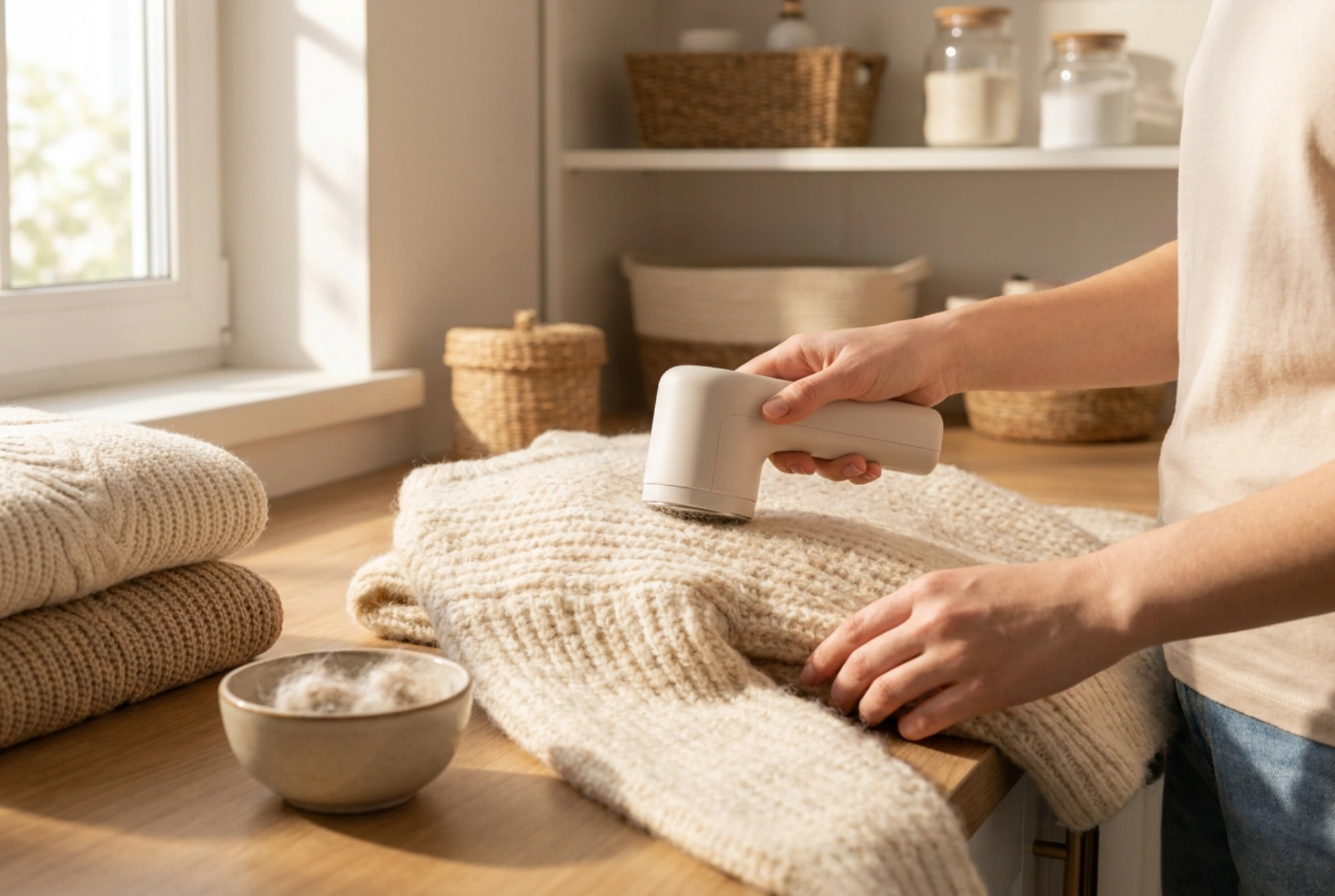
- Surface Preparation: Lay the garment completely flat on a hard, unyielding surface, such as a clean wooden table or ironing board. Never attempt to shave a sweater while wearing it or when it is draped over a soft cushion, as uneven pressure will cause the fabric to bunch up and enter the cutting chamber.
- Tensioning the Fabric: Use your non-dominant hand to pull the section of the fabric you are working on taut. Creating a flat, tensioned plane is the single most important step in preventing the shaver from catching and cutting a hole in your knitwear.
- Technique and Movement: Place the shaver gently on the fabric. Do not press down; let the weight of the device do the work. Move the shaver in small, light, circular motions, gradually progressing across the garment. For rib-knit areas or raised patterns, shift to linear movements parallel to the knit direction to avoid shearing the raised decorative stitches.
- Device Maintenance: Empty the lint collector frequently. A packed lint chamber slows down the motor, reducing blade speed, which can lead to tearing rather than clean cutting of the fibres.
Post-Restoration Care: Minimising Friction
Once the pills are removed, you must protect the freshly sheared fibres from immediate re-pilling. Always wash restored garments inside out to shield the exterior surface from direct abrasion against the washing machine drum. Opt for a gentle cycle with a low spin speed (no higher than 800 RPM) and cold water. Use a liquid detergent, as undissolved powder particles can act as an abrasive agent inside the fibres. Additionally, using a specialised fabric conditioner can lubricate the fibres, reducing the kinetic friction that causes them to slip out and entangle in the first place.