

Achieving perfectly clean laundry does not require overflowing caps of washing detergent. In fact, consistently overusing cleaning agents damages fabric fibres, leaves dulling residues, and creates a breeding ground for bacteria inside your washing machine.
The Anatomy of the Dispenser Drawer
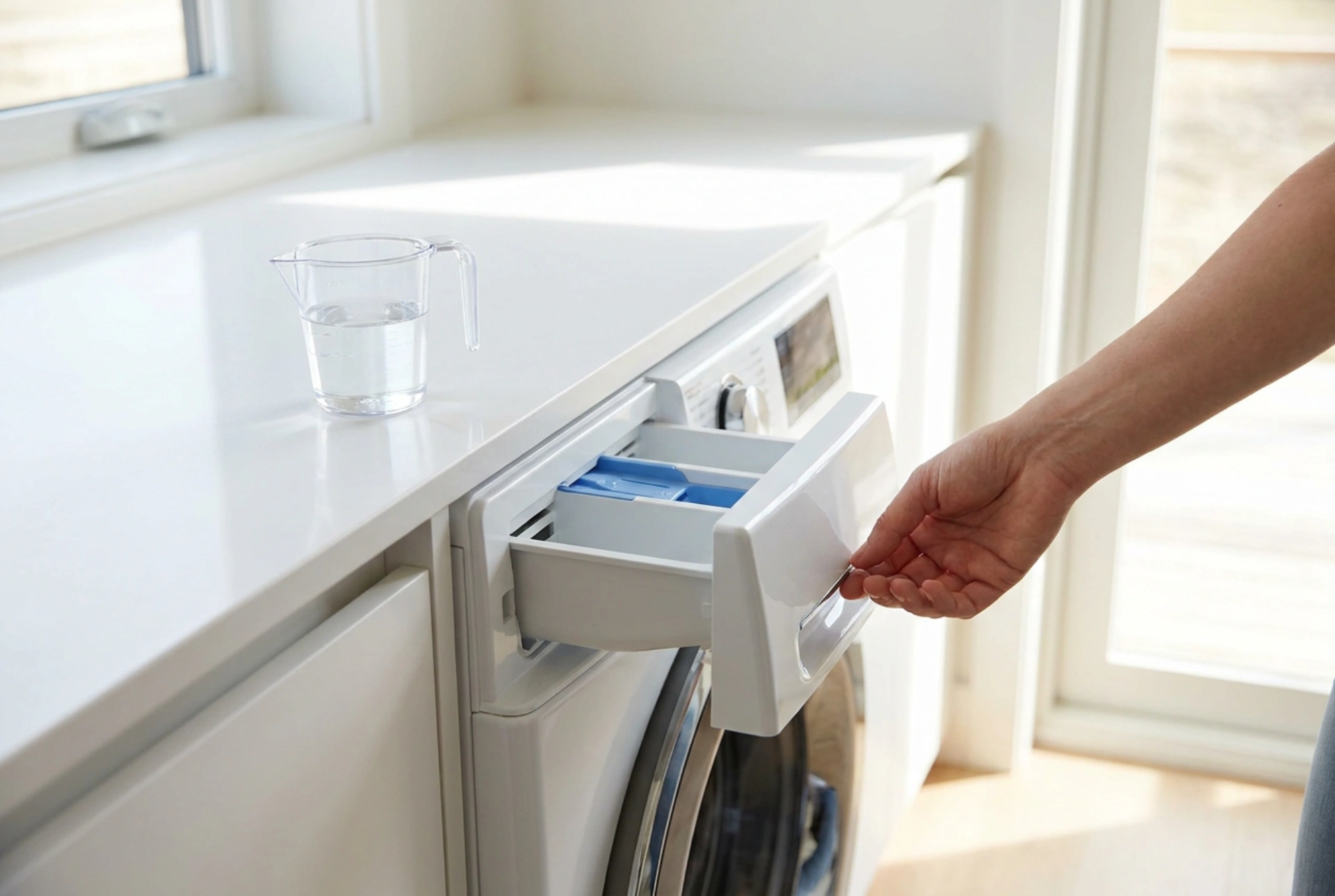
To control detergent usage, you must first understand where each substance goes. Most standard drawers have three distinct compartments, usually marked with symbols or Roman numerals. Understanding these is vital for the correct sequence of chemical release during the wash cycle.
- Compartment I (Pre-wash): This chamber is designed for heavily soiled clothes. Water flushes through here first, removing loose dirt before the main cycle. Only use this if you have selected a specific pre-wash programme.
- Compartment II (Main Wash): This is the primary chamber where you place your main powder or liquid detergent. It is flushed with water during the main wash cycle, dispersing surfactants to break down oil and dirt.
- The Flower Symbol (Fabric Softener): This compartment holds liquid softeners or conditioners. Unlike the other chambers, it operates on a physical siphon system. Water is injected here during the final rinse cycle, raising the liquid level past the siphon cap and drawing the softener down into the drum.
The Chemistry of Overdosing: What Happens to Your Laundry
Detergents work through surfactants—molecules with a hydrophilic (water-attracting) head and a hydrophobic (water-repelling) tail. The hydrophobic tails attach to grease and grime, lifting them into the water where they form tiny spheres called micelles. These micelles are then rinsed away.
When you use too much detergent, the water becomes saturated with excess surfactants. Instead of lifting dirt, these molecules bond with each other and redeposit onto the fabrics. This results in stiff, scratchy clothes that attract dust and dirt more quickly. Furthermore, the excess suds cushion the friction between garments in the drum, reducing the mechanical action necessary to scrub clothes clean.
The Mechanical Threat: Biofilm and "Scrud"
Excess detergent that does not rinse away accumulates in the hidden parts of your appliance, such as the outer drum, pipes, and the dispenser drawer housing. Combined with body oils and skin flakes, this residue forms a sticky, grey paste known in the industry as "scrud".
Scrud acts as an ideal food source for bacteria and mould. Over time, this leads to musty odours on your clothes and can eventually corrode internal components. To prevent this, you must calibrate your dosage according to water hardness and load size rather than relying on generic recommendations on the packaging.
Calibrating Dosage: Water Hardness and Load Size
Water hardness refers to the concentration of dissolved calcium and magnesium ions. In hard water areas, these minerals react with surfactants, forming insoluble salts and reducing lathering efficiency. Consequently, hard water requires a slightly higher dose of detergent to ensure effective cleaning.
In soft water areas, minerals are scarce, meaning surfactants can work at full capacity. If you live in a soft water region, you can safely reduce your detergent dose to half of the manufacturer’s recommended minimum. Always measure with a precise cup or scoop; pouring directly from the bottle by eye almost always leads to massive overdosing.
Maintaining the Dispenser and Preventing Clogs
The siphon assembly in the fabric softener compartment is highly susceptible to clogging. Over time, thick liquids leave a film that restricts the narrow siphon tube. When this happens, water will remain in the compartment at the end of the wash cycle, or the softener will drain prematurely.
To maintain proper mechanical function, pull the drawer out entirely once a month. Rinse it under warm water, using an old toothbrush to clear the siphon cap and the spray nozzles located at the top of the drawer cavity. This ensures water flows smoothly, flushing the correct chemical into the drum at the exact right moment of the cycle.