

Managing a narrow wardrobe with an integrated mirror requires a strategic layout to prevent physical obstruction and visual clutter near the door. By understanding spatial clearance and material physics, you can transform a cramped storage column into an efficient, accessible system.
Spatial Dynamics and Door Clearance
The primary challenge of a narrow wardrobe is the restricted sweep of the door and the depth of the cabinet carcass. Standard wardrobes require at least 60 cm of depth for clothes to hang perpendicular to the back wall. In narrow wardrobes, often 35 to 45 cm deep, clothes must be hung parallel to the door using pull-out rails. When a mirror is mounted on the inner or outer door, any obstruction near the hinges or sliding tracks limits both the door's range of motion and your line of sight. To prevent physical collisions, always maintain a clearance zone of at least 15 cm from the door frame inside the wardrobe. This buffer zone should only contain flat items or low-profile storage to ensure the door swings or slides freely without catching on fabrics.
Optimising the Mirror Zone for Light and Usability
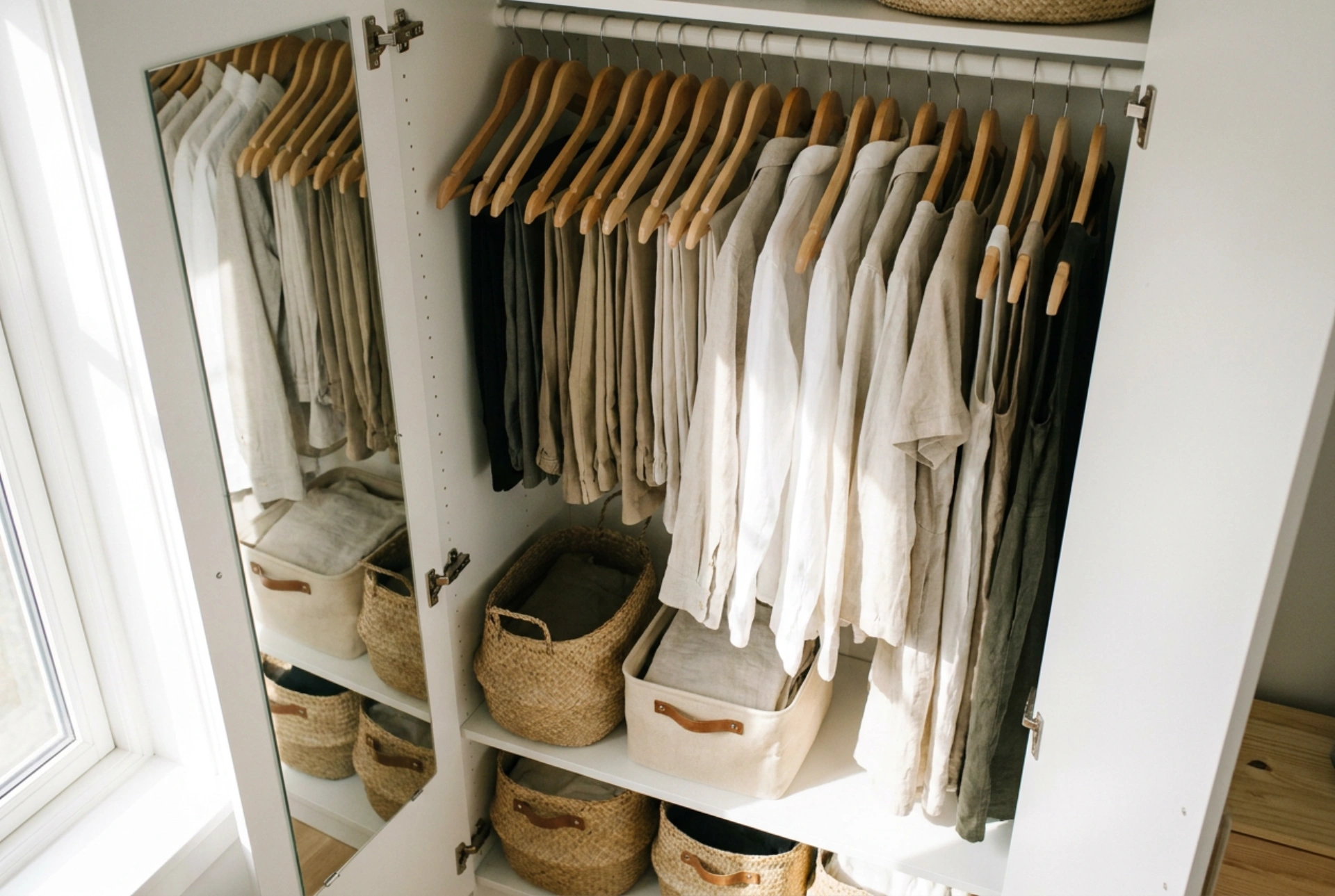
Mirrors function by reflecting light and creating an optical illusion of depth. However, if the area immediately adjacent to the mirror is cluttered with bulky coats or overflowing shelves, the reflection amplifies this visual chaos, making the room feel smaller. To maximise the utility of an integrated mirror, position light-coloured, low-density textiles near the glass. Hang structured garments like blazers or heavy woollen coats further back in the wardrobe. Additionally, use uniform wooden or slim velvet hangers. Velvet hangers increase surface friction, preventing garments from slipping off and piling up at the bottom of the wardrobe, while their slim profile reduces the overall lateral volume occupied by clothing by up to 30 percent.
Vertical Partitioning and the Physics of Stacking
When floor space is limited, vertical partitioning is your primary tool. However, stacking soft fabrics too high leads to structural instability, known as the domino effect, where the weight of the upper garments causes the pile to slide and jam the wardrobe door. To prevent this, implement modular storage baskets made of breathable natural fibres or lightweight polymers. Divide shelves into compartments no taller than 25 cm. For heavier items like knitwear, use the rolling method instead of traditional folding. Rolling distributes the fabric's mass more evenly and eliminates the vertical pressure points that cause stacks to collapse, keeping the threshold near the door completely clear.
The Order of Operations for Daily Accessibility
An efficient wardrobe relies on a strict hierarchy of access based on frequency of use. Divide the wardrobe into three distinct zones: the active zone, the passive zone, and the deep storage zone.
- Active Zone: Place daily essentials, shirts, and trousers here. Keep this area highly organised using pull-out trays to avoid reaching blindly and disrupting surrounding items.
- Passive Zone: Utilise the base of the wardrobe for sturdy, heavier storage boxes containing shoes or seasonal accessories. This lowers the centre of gravity of the entire wardrobe unit, increasing its physical stability.
- Deep Storage Zone: Reserve the top shelves for vacuum-sealed bags containing off-season clothing. Vacuum sealing removes ambient air, reducing the volume of textiles by up to 75 percent and protecting them from dust and moisture.
By maintaining this strict spatial division, you eliminate the need to rummage, which is the leading cause of wardrobe chaos and door obstruction.