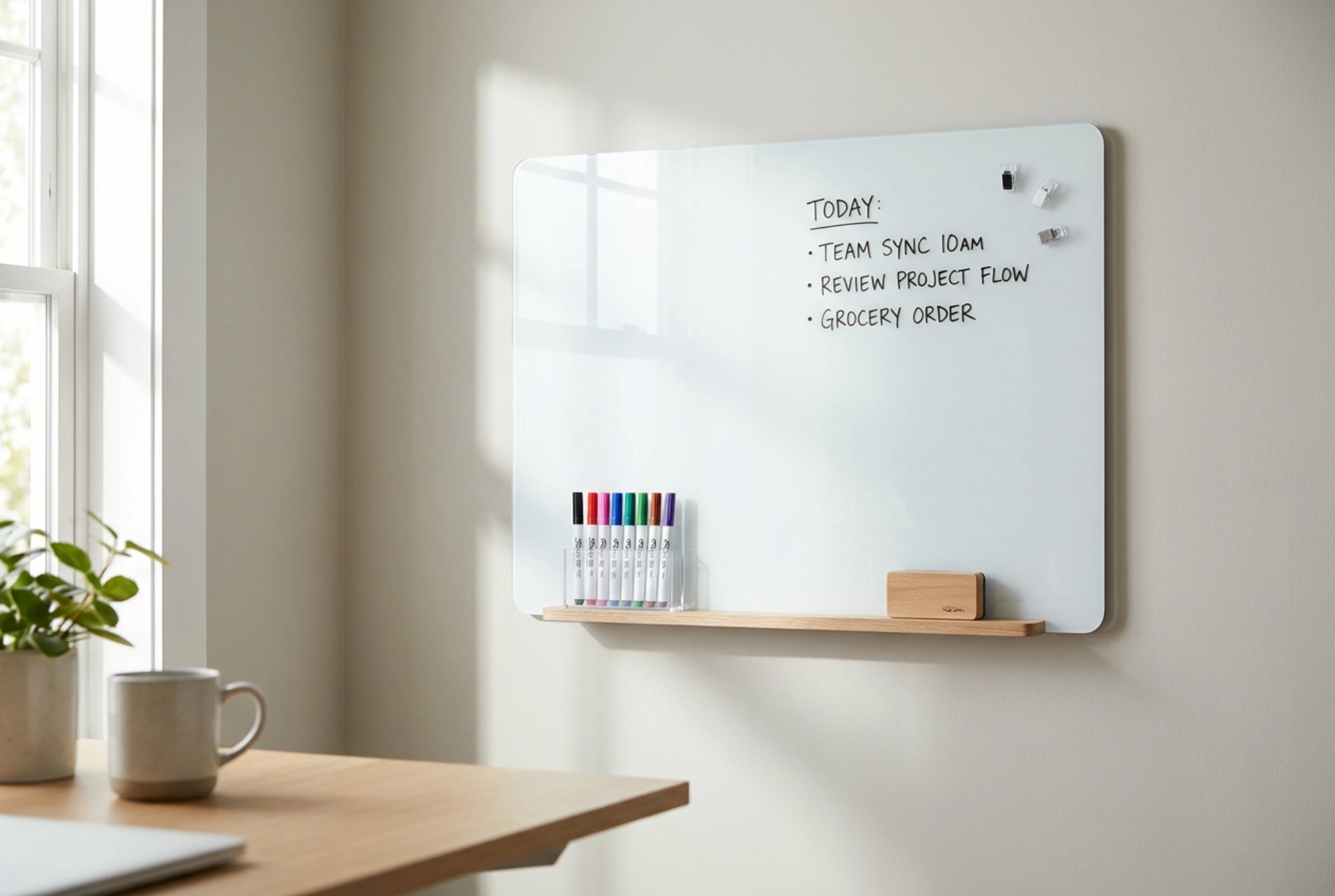


Integrating a dry-erase whiteboard into a child's daily learning routine provides a powerful cognitive tool that translates abstract schedules into physical, manageable tasks. Utilizing the science of visual learning and tactile feedback, a structured whiteboard helps children develop self-regulation and spatial organisation.
The Physics and Chemistry of the Dry-Erase Surface
A high-performing dry-erase board relies on a highly hydrophobic, non-porous surface. Standard materials include melamine, painted steel, or tempered glass. Melamine, a synthetic resin, is highly affordable but contains microscopic pores that degrade over time. Tempered glass, by contrast, offers a completely non-porous silicate lattice that prevents ink molecules from penetrating. The markers used on these surfaces rely on a distinct chemical formula: pigments, an alcohol solvent such as ethanol or isopropyl alcohol, and a release agent made of a silicone-based polymer. When writing, the solvent evaporates rapidly, leaving behind a dry, cohesive film of pigment held together by the release agent. Because the release agent prevents the pigment from adhering strongly to the non-porous board, a simple dry wipe easily detaches the film.
Cognitive Offloading and Haptic Feedback in Learning
Using a vertical writing surface provides unique neurodevelopmental benefits. Visual planning serves as a form of cognitive offloading, a process where the brain externalises memory requirements onto a physical space. This frees up working memory, allowing a child to focus on the actual cognitive task of studying rather than remembering what to do next. Furthermore, the physical movement of writing on a vertical surface engages different motor pathways than writing on a flat desk. Vertical writing promotes shoulder joint stability, wrist extension, and spatial awareness. The large-muscle movements provide deep haptic feedback that reinforces muscle memory and cognitive retention, making the learning process more interactive and memorable.
Structuring the Daily Learning Board
To maximise the psychological and practical utility of the board, structure it with a logical visual hierarchy. Divide the surface into three key functional zones: the chronological schedule, the active task list, and the feedback block. Use high-contrast colour-coding based on visual processing principles. For example, use dark pigments like black or blue for primary structures, green for completed items, and red sparingly for urgent milestones. The act of physically erasing a completed task offers a tangible reward mechanism, releasing small amounts of dopamine that encourage task completion and build positive reinforcement cycles in daily routines.
Optimising Board Lifespan and Ink Chemistry
Over time, dry-erase boards can suffer from ghosting, which occurs when pigment particles settle into microscopic surface imperfections. To clean this without damaging the delicate polymer layer, avoid abrasive scrubs or aggressive household solvents that strip the glossy topcoat. Instead, use a solution of 70% isopropyl alcohol. The alcohol breaks down the dried polymer binder of the ink, lifting the pigment particles back into suspension so they can be wiped clean with a microfibre cloth, which relies on tiny polyester and polyamide fibres to trap debris without scratching the surface.