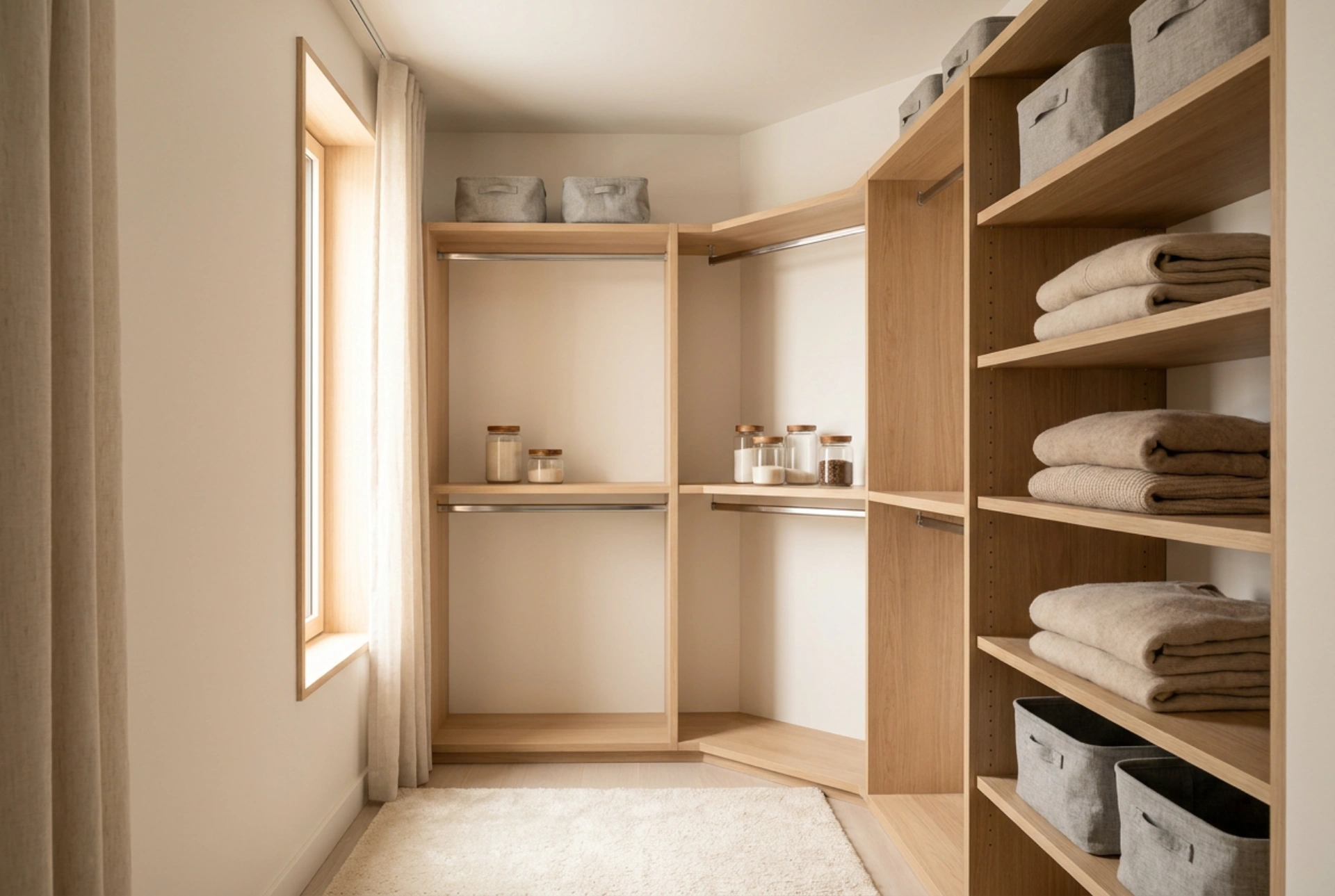


Corner wardrobes often turn into inaccessible dead zones where clothing disappears into dark, deep angles. Resolving this spatial challenge requires applying principles of ergonomics, structural geometry, and microclimate control to transform awkward architectural nooks into highly functional, accessible storage systems.
The Geometry of the Corner: Overcoming Depth and Reach Limits
The primary issue with corner wardrobes is the discrepancy between average human arm reach (approximately 60 to 70 centimetres) and the diagonal depth of a standard 90-degree corner unit, which often exceeds 100 centimetres. This creates an ergonomic blind spot. To bridge this gap, you must avoid static, deep shelving where items are stacked behind one another.
- Continuous Curved Hanging Rails: Instead of splitting the wardrobe into two separate compartments with a structural partition, install a continuous L-shaped or curved hanging rail. This allows hangers to glide seamlessly across the corner, bringing clothes from the deep recess directly into your field of vision.
- Pull-Out Corner Trays: Utilise heavy-duty runners fitted with wider, shallow trays rather than deep boxes. Pull-out mechanisms bring the contents of the corner out into the illuminated room space, eliminating the need to bend and reach into dark recesses.
- Rotating Carousel Shelves: For folded garments, specialised rotating shelves pivoting on a central metal axis allow you to access 360 degrees of storage space with a simple rotational movement.
Thermodynamics and Air Circulation in Corner Wardrobes
Corners, especially those situated against external walls, are highly prone to temperature differentials. Warm, humid indoor air meets the cold surface of an uninsulated external wall behind the wardrobe, causing the air temperature inside the deep corner to drop below the dew point. This leads to condensation, which ruins fabrics and fosters mould growth.
Preventative Ventilation Strategies
To mitigate this risk, never pack a corner wardrobe to maximum density. Air must circulate freely between garments. Leave a gap of at least 5 centimetres between the back panel of the wardrobe and the bedroom wall to promote natural convection. Additionally, swap solid wooden shelves for powder-coated wire baskets or slatted shelves; these structures allow air to move vertically and horizontally, preventing moisture pockets from forming in stagnant zones.
Lighting the Blind Spots: Optical Principles of Wardrobe Interiors
Ambient bedroom lighting rarely penetrates the deep interior of an L-shaped wardrobe, casting shadows that make organising difficult. To solve this, employ dedicated interior illumination designed around light-emitting diode (LED) technology. LEDs are essential because they emit virtually no infrared or ultraviolet radiation, meaning they will not degrade delicate textile fibres or cause colour fading over time.
Position low-profile LED strips vertically along the inner front face of the wardrobe frame rather than horizontally on the ceiling of the unit. Vertical lighting casts a uniform wash of light across all shelf levels, eliminating the shadows created by upper shelves blocking overhead light sources. For safety and ease of installation without complex electrical modifications, utilise low-voltage, motion-activated LED strips powered by rechargeable lithium-ion cells.
Zoning Strategy by Weight, Frequency, and Accessibility
A scientific approach to storage organisation relies on zoning based on frequency of use and the physical weight of stored items. Dividing your corner wardrobe into distinct physical tiers optimises both daily ergonomics and structural integrity:
- The High-Altitude Zone (Above 180 cm): Reserved for low-frequency, lightweight items such as seasonal duvets or pillows. Store these in breathable canvas bags rather than airtight plastic containers to prevent mustiness.
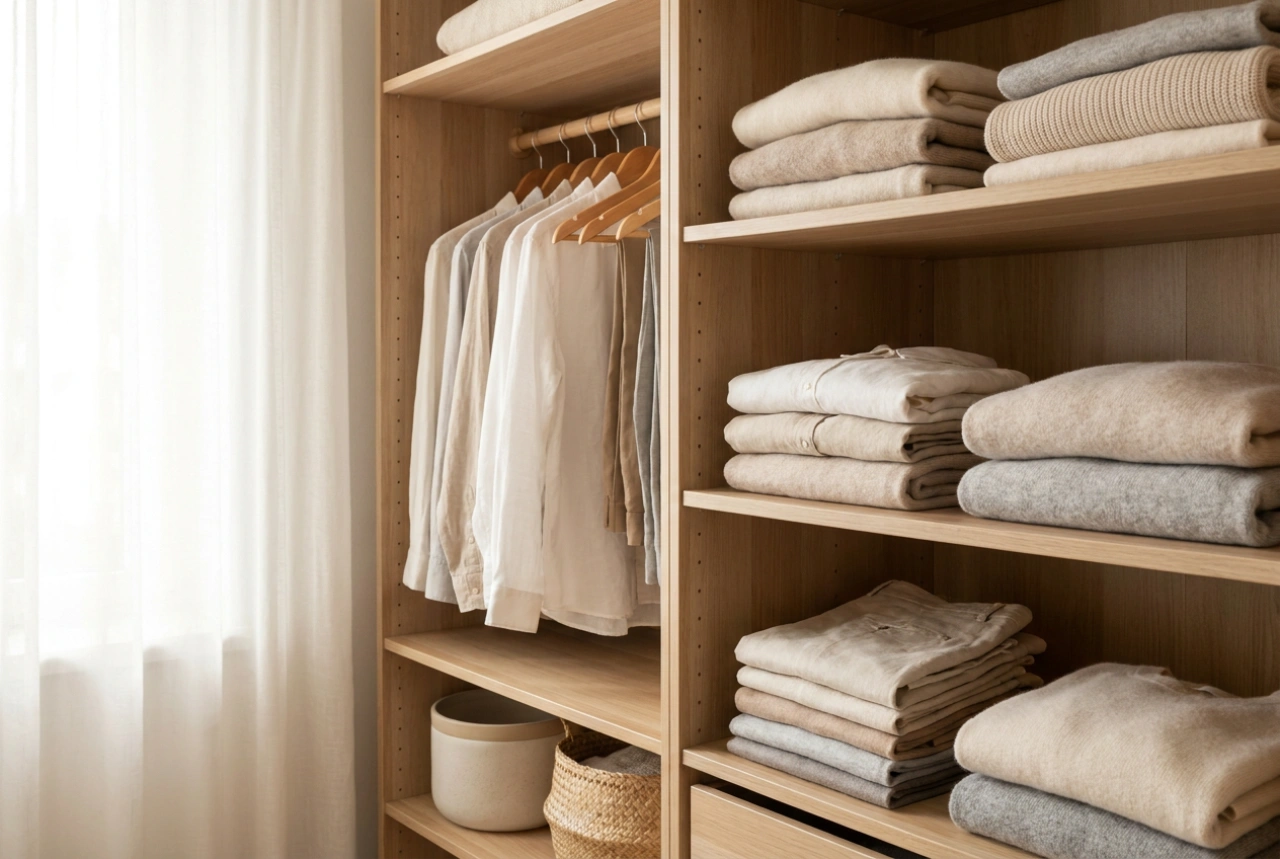
- The Active Zone (70 cm to 180 cm): This is the prime ergonomic window. Position your curved hanging rail and daily wear here. Clothes should be hung sorted by length, which frees up floor space directly beneath shorter garments for additional low-profile storage bins.
- The Ground Zone (Below 70 cm): Ideal for heavy items like luggage, shoes, or heavy-duty drawers. Utilise fully extendable drawer slides to ensure you do not have to kneel down to locate items stored at the very back of the bottom shelf.