

Achieving spotless, residue-free cutlery in a dishwasher with a dedicated cutlery drawer relies entirely on understanding fluid dynamics and preventing the "spray shadow" effect.
Fluid Dynamics and the Spray Shadow
Inside a modern dishwasher, water is distributed via rotating spray arms that project highly pressurized streams of heated water and detergent. In models featuring a top cutlery drawer, this water originates from a dedicated spray arm located directly beneath the tray, and sometimes an additional ceiling spray nozzle. For water to effectively mechanical-wash and chemically sanitize every piece of cutlery, there must be an unobstructed line of sight between the spray nozzles and the soiled surfaces. When cutlery is packed too tightly or overlapping, it creates a "spray shadow"—a physical barrier where water cannot reach, leaving food residues and detergent films trapped on the metal.
The Geometry of Nesting: Why Spoon Placement is Critical
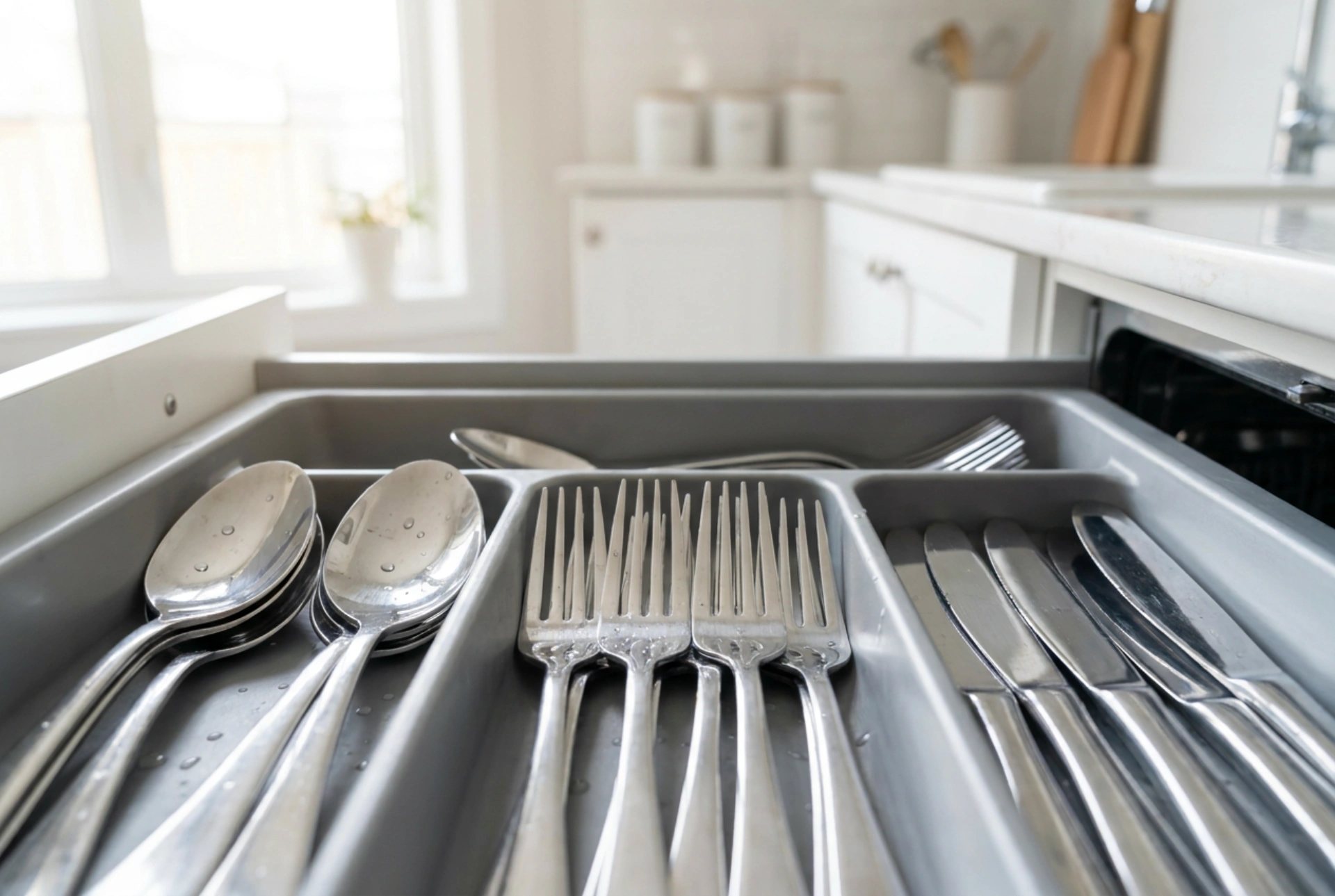
The most common cause of dirty cutlery is nesting, which primarily affects spoons and forks. Due to their concave and convex geometries, spoons easily slide into one another, forming a tight seal. When nested, capillary action draws water and food particles into the tiny gap between the spoons, but the physical block prevents the spray from flushing them out. To prevent this, cutlery must be loaded systematically. Most modern drawers feature molded tines or slots. Place spoons with their bowls facing downwards or alternate their direction—one spoon facing up, the next facing down. Alternatively, alternate spoons with forks and knives. This physical disruption ensures that water can circulate freely around the curved surfaces of each utensil.
Knife Placement: Protecting Edges and Managing Water Flow
Knives require specific placement not only for safety but also to protect their structural integrity. High-quality cutlery knives should always be laid flat in their designated slots with the sharp edge facing downwards. This prevents accidental cuts when unloading and protects the plastic-coated tines of the dishwasher rack from being sliced, which can lead to rust on the rack itself. From a chemical perspective, prolonged exposure of the blade edge to high temperatures and highly alkaline detergents can dull the micro-edge of the steel. Placing them flat ensures water cascades off the spine of the blade, minimizing chemical pooling on the cutting edge.
Overcoming Surface Tension and Water Spotting
Water spots are caused by mineral deposits (calcium and magnesium) left behind when water droplets evaporate from a surface. To avoid this, cutlery must be loaded at an angle. Modern cutlery drawers are designed with subtle inclines. Placing spoons, forks, and knives on their sides within the slots, rather than completely flat, allows gravity to overcome the surface tension of the water. This encourages the rinse water—which contains surfactants from the rinse aid to lower surface tension—to slide off the metallic surfaces rapidly before the drying cycle begins, leaving a streak-free finish.
The Order of Operations: Unloading Without Contamination
The physical process of cleaning is only complete once the dry cutlery is safely stored. A common mistake is unloading the top cutlery drawer first. During the cycle, water can pool on the concave undersides of mugs and bowls on the middle rack. If you pull out and unload the cutlery drawer first, you risk shaking these pooled droplets down onto the clean, dry dishes below. To maintain hygiene and prevent water spots, always unload the appliance from the bottom up: start with the lower plate rack, move to the middle cup rack, and finish with the top cutlery drawer.