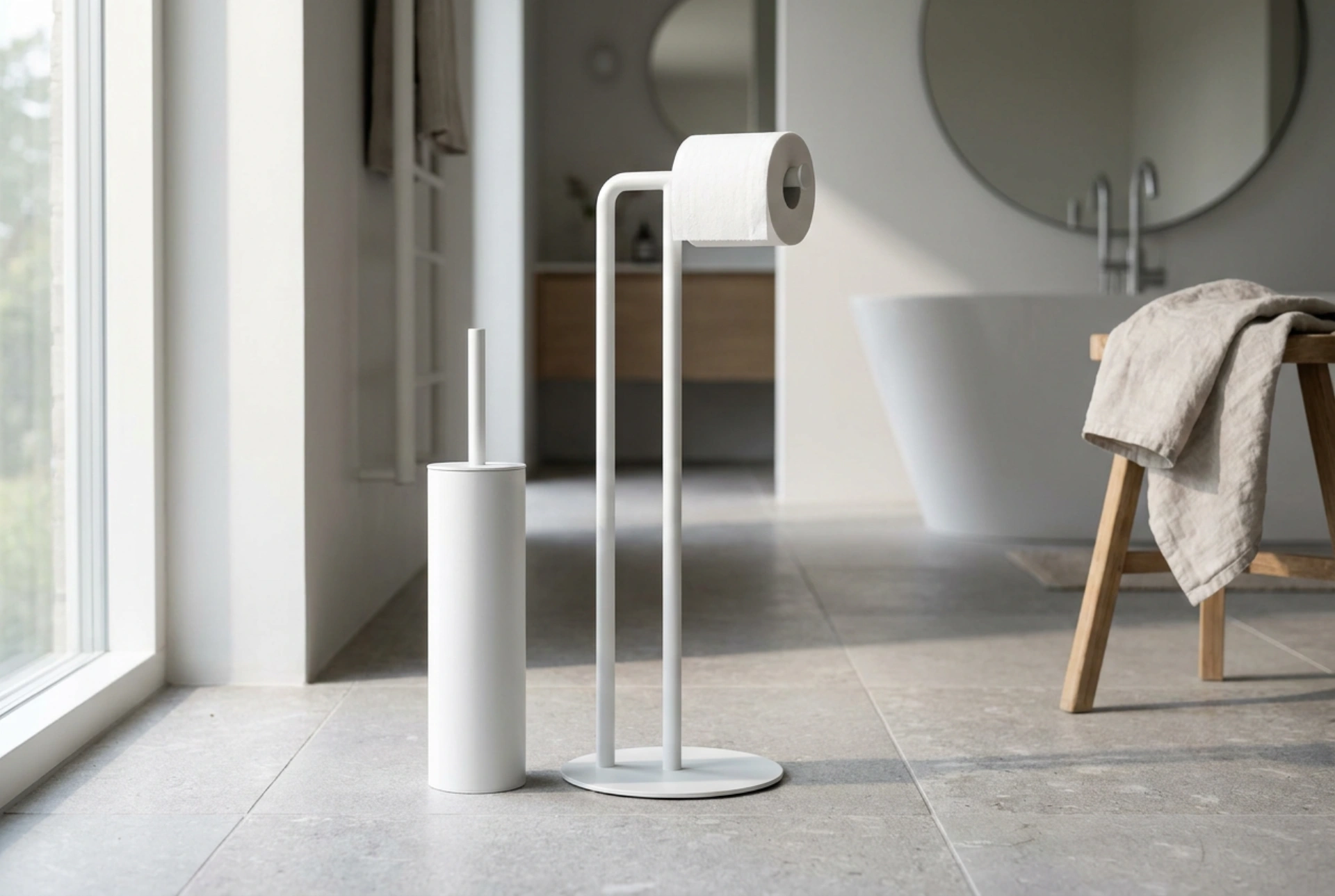


Positioning a toilet paper and brush stand involves more than just spatial convenience; it requires a strategic approach to prevent aerosol contamination and bacterial growth. Understanding the mechanics of bathroom airflow, material science, and sanitary distances is essential to keeping these high-touch accessories genuinely hygienic.
The Physics of Toilet Plume and Safe Distances
Every time a toilet is flushed with the lid open, it creates a phenomenon known as "toilet plume"—an aerosol cloud of microscopic droplets laden with bacteria and viruses. These particles can launch up to 1.5 metres into the air and settle on surrounding surfaces.
To protect both the clean toilet paper and the brush stand from this bio-aerosol deposition, the stand must be placed outside the primary fall zone. Ideally, position the unit at least 30 to 40 centimetres away from the outer rim of the toilet bowl. If space allows, placing the stand slightly forward of the toilet bowl, rather than directly adjacent to or behind it, reduces the risk of falling droplets settling directly onto the toilet paper roll. Furthermore, always establish a household habit of flushing with the lid closed to physically block the upward trajectory of these droplets.
Material Selection and Biofilm Prevention
The material of your stand directly influences how easily pathogens can colonise its surface. Microscopic scratches in cheap plastics or raw wood provide excellent anchor points for organic matter and moisture, leading to the formation of a biofilm—a slimy layer of bacteria that resists basic wiping.
Opt for non-porous, high-density materials such as high-grade stainless steel, powder-coated metals, or sealed ceramics. Powder coating creates a hydrophobic surface tension that causes water droplets to bead up and run off rather than spread out and cling. This reduces the surface moisture required for bacterial replication. When selecting a stand, ensure the toilet brush container is suspended or elevated within the frame, allowing air to circulate beneath it, rather than sitting directly on a damp floor tile where condensation accumulates.
Mitigating Moisture and the Brush Drying Protocol
A major hygiene failure in integrated stands is the accumulation of stagnant water in the bottom of the brush holder. When a wet brush is returned directly to its sheath, it creates a dark, highly humid microclimate perfect for anaerobic bacteria, resulting in unpleasant odours and pathogen growth.
To break this cycle, employ a strict drying protocol. After scrubbing the bowl, do not immediately place the brush back in the stand. Instead, wedge the handle of the brush under the toilet seat, suspended over the bowl, to let gravity draw the excess water down for 10 to 15 minutes. Alternatively, spin the brush rapidly inside the bowl below the rim to remove bulk water using centrifugal force. To sanitise the holder itself, rinse it weekly with a solution of oxygen bleach or isopropyl alcohol, which breaks down the cellular walls of bacteria without emitting the harsh, corrosive fumes associated with chlorine bleach.
Spatial Airflow and Maintenance Access
Air circulation is your primary natural defence against mould and bacterial growth. Avoid doctoring the stand into tight, unventilated crevices between the toilet and the wall. These stagnant zones trap cold, damp air, preventing the brush and paper from drying out after use.
Position the stand where it can benefit from the room's natural convective airflow—typically between the toilet and the bathroom door or near an active extraction vent. Ensuring at least 5 centimetres of clearance between the stand and any wall allows air to circulate freely around the entire unit, speeding up evaporation rates. This simple adjustment in spatial planning significantly lowers the ambient humidity surrounding the toilet paper, keeping the outer sheets dry and sanitary.