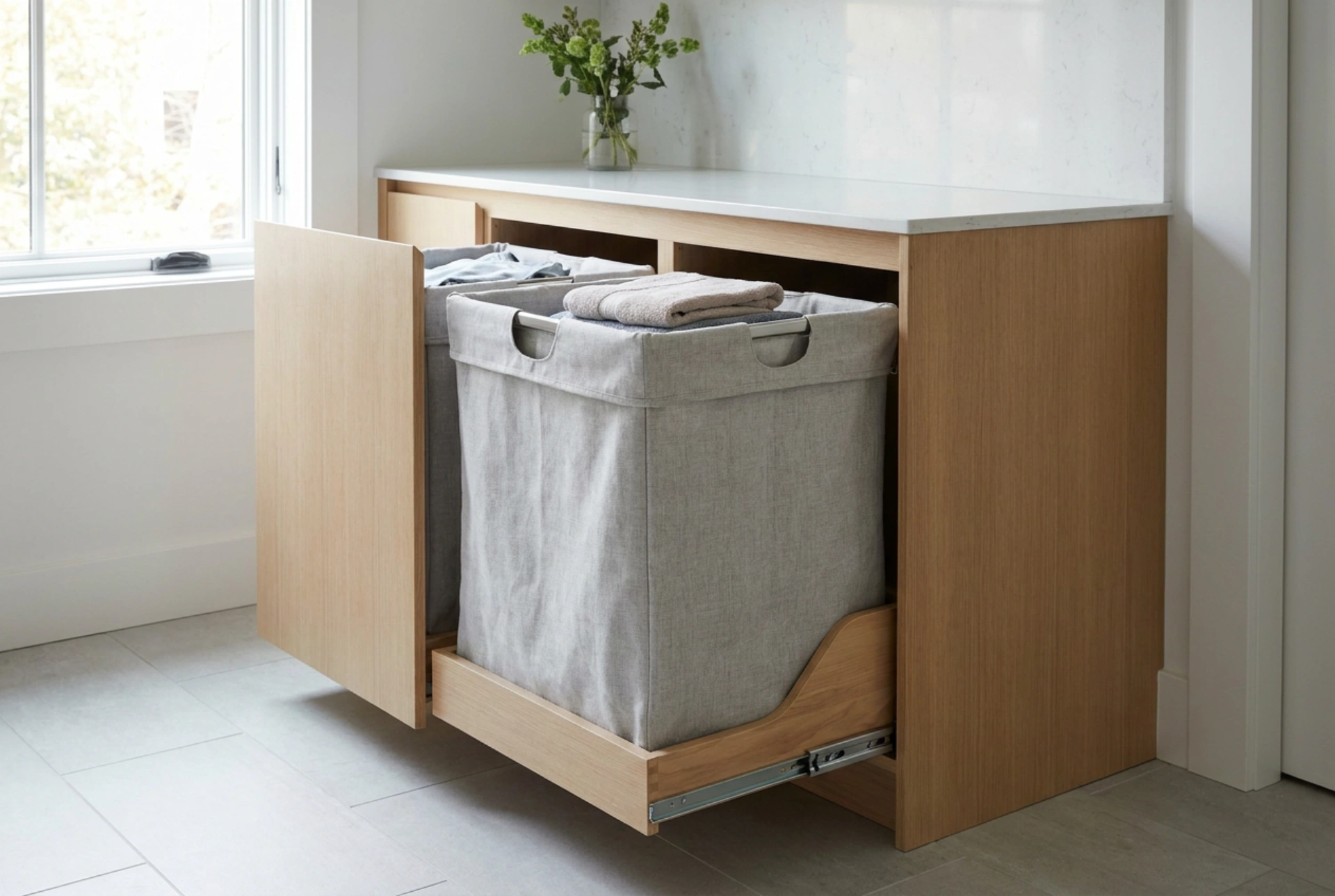


Integrated cargo laundry baskets transform the daily chore of clothes sorting from a chaotic visual clutter into a highly efficient, hygienic, and ergonomically optimised workflow. By embedding segregation systems directly into bespoke cabinetry, you protect both your living space aesthetics and the integrity of your fabrics before they even reach the washing machine.
Air Circulation and the Prevention of Mould in Enclosed Systems
Dirty laundry is rarely completely dry. Perspiration, ambient humidity, and residual moisture from damp towels create a microclimate inside a closed hamper that is highly conducive to microbial proliferation. In an enclosed cabinet, this risk increases exponentially due to stagnant air. To prevent the growth of Aspergillus niger and other common household moulds, cargo systems must be designed with thermodynamics and airflow in mind. Opt for baskets with perforated walls—such as open-wire steel meshes or breathable polymer grids—which facilitate passive convection. As air flows through the cabinet plinth or rear ventilation grilles, it carries away moisture, preventing the relative humidity within the hamper from reaching the critical 70% threshold required for fungal spore germination.
Mechanical Stress and Load-Bearing Dynamics
Fully loaded laundry cargo baskets can easily weigh upwards of 15 to 20 kilograms, particularly when heavy textiles like denim or wet bath towels are involved. This places significant physical strain on cabinet runners. To ensure smooth operation and prevent cabinet warping, the system must utilise heavy-duty, full-extension ball-bearing runners with integrated dampening (soft-close mechanisms). The load-bearing capacity should ideally be rated for at least 30 to 50 kilograms to absorb the dynamic forces exerted when pulling the drawer open. Proper under-mount installation is crucial; under-mount runners distribute the gravitational force more evenly across the cabinet base, preventing the lateral shearing forces that can gradually loosen screw threads in engineered wood panels.
Material Selection: Chemical Resistance and Odour Control
The materials housing your dirty laundry must be chemically inert and non-porous. Natural wicker or untreated wood baskets absorb organic compounds, skin oils, and sweat, turning into permanent reservoirs for volatile organic compounds (VOCs) that emit sour odours. Instead, utilise powder-coated steel, high-density polyethylene (HDPE), or removable, washable synthetic canvas liners. Powder-coated finishes resist the corrosive action of residual laundry detergents and body acids. If fabric liners are used, they should be made of hydrophobic fibres like polyester or treated nylon, which do not absorb water molecules into their polymer chains. This makes them easy to clean and quick to dry, preventing bacterial colonies from establishing a foothold.
Optimising the Pre-Sorting Workflow
Efficient laundry management relies on sorting clothes at the point of disposal rather than immediately before washing. A well-designed cargo cabinet should feature at least two, and ideally three, separate compartments. This layout allows for immediate segregation based on wash chemistry and temperature requirements:
- Light-coloured fabrics: requiring mild detergents and moderate temperatures to prevent dye transfer.
- Dark and highly pigmented garments: requiring colour-safe formulations and cold water to preserve dye bonds.
- Heavy-duty or heavily soiled items: such as towels and bedding, that undergo high-temperature sanitisation cycles.
By implementing this physical separation within a single pull-out unit, you minimise fabric friction, reduce sorting time, and protect delicate fibres from abrasive zippers or heavy hardware on other garments.