

Managing a compact freezer compartment requires more than just neat stacking; it demands an understanding of thermodynamics, thermal mass, and food preservation physics. By mastering spatial efficiency and freezing science, you can maximise your storage capacity without compromising the shelf life or quality of your ingredients.
The Physics of Freezing: Thermal Mass and Airflow
In a small freezer compartment, maintaining a stable temperature is a constant challenge. Every time the door opens, warm ambient air rushes in, raising the internal temperature. To counteract this, you must understand the concept of thermal mass. Solidly frozen items act as cold reservoirs, absorbing heat fluctuations and protecting neighbouring foods. However, packing a freezer completely solid blocks the essential convective currents that distribute cold air evenly. The ideal fill rate for a small freezer is approximately 70 to 80 percent capacity. This balance provides sufficient thermal mass to stabilise temperatures while leaving enough open space for the compressor to circulate cold air efficiently.
Furthermore, placing warm items directly into a small freezer can trigger a dangerous thermodynamic reaction. The latent heat released by the warm food transfers rapidly to surrounding frozen packages, causing partial thawing on their surfaces. This micro-thawing creates ice crystals when refrozen, degrading food texture and promoting cellular breakdown. Always pre-chill food in the main refrigerator compartment to 4 degrees Celsius before transferring it to the freezer.
Optimising Shape and Surface Area for Rapid Freezing
The speed at which food freezes directly dictates its quality upon thawing. Slow freezing forms large, jagged ice crystals that rupture cellular walls, leading to mushy textures and moisture loss. Rapid freezing forms microscopic crystals, preserving the cellular integrity of proteins and vegetables. To achieve rapid freezing in a compact space, you must maximise the surface-area-to-volume ratio of your food packages.
- Flat Freezing: Store liquids, purees, and stews in heavy-duty, reusable silicone or food-grade plastic bags. Lay them completely flat on a metal baking sheet inside the freezer. Metal acts as an excellent thermal conductor, drawing heat away from the food rapidly. Once frozen solid into thin planks, these bags can be filed vertically like books, saving immense amounts of space.
- De-boning and Compacting: Remove bones, excess fat, and bulky packaging before freezing meat. Bones are poor heat conductors and take up valuable space without providing nutritional value. Solid, uniform blocks of meat freeze faster and stack more efficiently.
- Vacuum Sealing: Oxygen is the enemy of frozen food. Air pockets inside containers act as thermal insulators, slowing down the freezing process and causing sublimation, commonly known as freezer burn. Expelling all air from storage bags ensures direct contact between the food and the cold environment, accelerating heat transfer.
Rotational Systems and Inventory Control
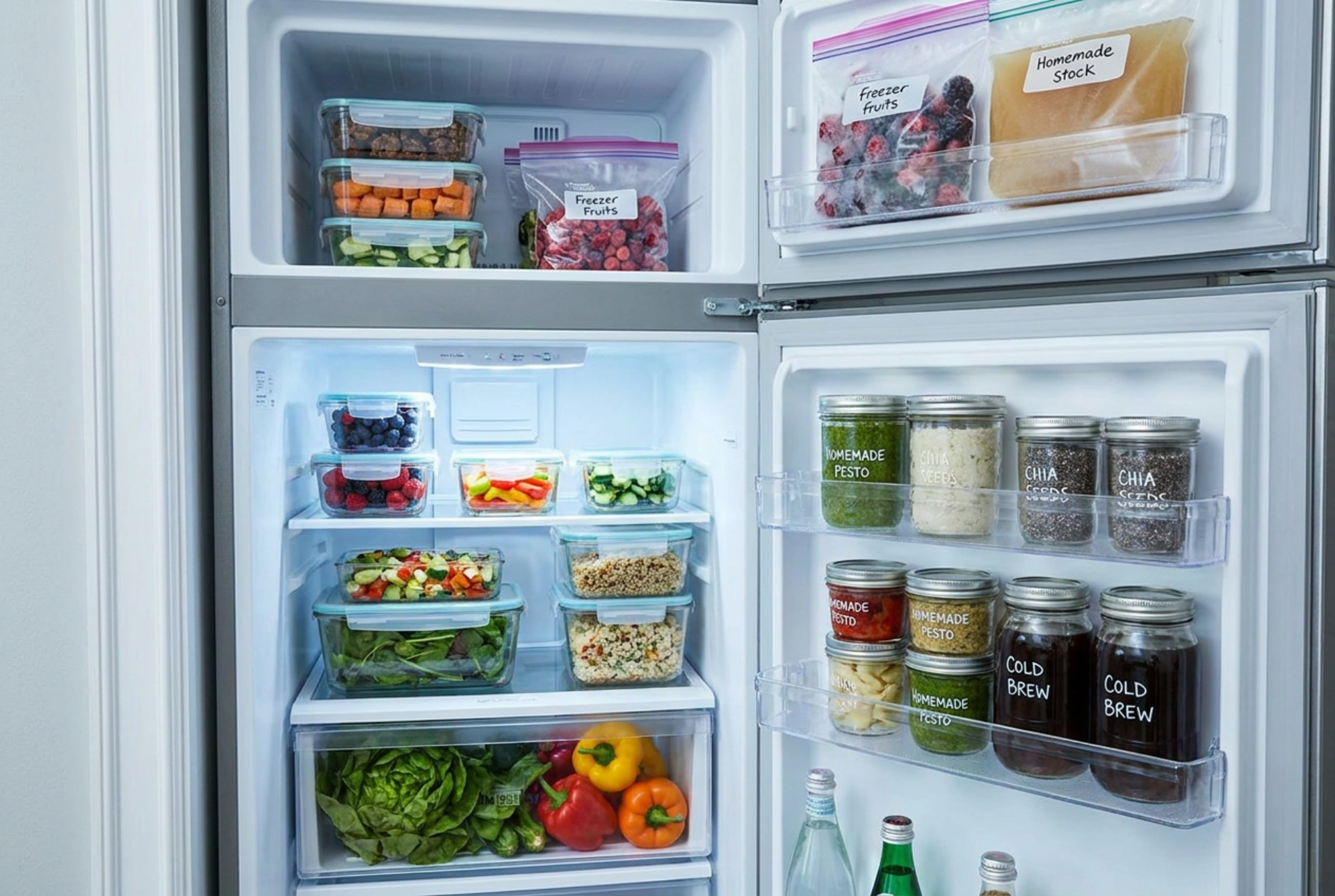
A small freezer can quickly become a graveyard for forgotten ingredients if a strict rotational system is not enforced. Implement the First In, First Out protocol. When introducing new items, place them at the back or bottom of the compartment, moving older items to the front. Because visibility is limited in compact spaces, clear labeling with waterproof ink is essential. Write the date of freezing, the exact contents, and the quantity on every package.
To prevent condensation and subsequent frost build-up during inventory checks, keep the freezer door open for the shortest time possible. Ambient humidity entering the compartment condenses on the cold evaporator coils, forming frost. Over time, this frost layer acts as an insulator on the cooling coils, forcing the appliance to work harder and reducing its volumetric efficiency.
Smart Volume Management: Concentrates and Pre-Reduction
To make the most of limited volumetric space, change how you process raw ingredients. Avoid storing high-water-content items in their raw state. For example, fresh tomatoes or leafy greens contain high percentages of water, which expands upon freezing and takes up unnecessary space. Instead, reduce stocks, sauces, and purees by simmering them to evaporate excess water content. You can easily rehydrate these concentrates with water or broth during final cooking, saving up to 75 percent of the physical storage space in your freezer.