

Washing a down jacket at home often causes anxiety due to the risk of clumping down and unsightly detergent streaks. Understanding the physics of feather loft and the chemistry of specialised detergents allows you to restore your jacket's insulation and volume safely in a standard domestic washing machine.
The Science of Down: Why Standard Detergents Ruin Insulation
Natural down consists of thousands of highly flexible, three-dimensional protein structures that trap air to create warmth, a property known as loft. Feathers are naturally coated with a microscopic layer of protective lipids (wax and oils) that keeps them resilient, supple, and hydrophobic. When you use standard laundry detergents, their aggressive anionic surfactants strip these natural oils. This leaves the down brittle, dry, and highly prone to permanent clumping.
To preserve the structural integrity of the feathers, you must use a specialised down wash. These are mild, non-ionic surfactant solutions formulated at a neutral pH. They clean the outer technical fabric of dirt and body oils without degrading the natural lipid barrier of the internal feathers, ensuring the down retains its ability to loft after drying.
Mechanical Preparation and Washing Machine Calibration
Proper preparation prevents physical damage to both the jacket shell and its internal baffles—the fabric chambers that keep the down evenly distributed. Before placing the jacket in the drum, complete the following mechanical steps:
- Empty all pockets: Hard objects can puncture the thin outer nylon or polyester fabric.
- Fasten all closures: Zip up the main zip, pocket zips, and secure velcro tabs. Loose metal or plastic teeth can snag and tear the delicate technical shell.
- Turn the jacket inside out: This protects the outer Durable Water Repellent coating from direct friction against the drum.
- Purge the detergent drawer: Pull out the drawer and thoroughly rinse away any remnants of regular laundry powder or fabric softeners. Fabric softeners coat down feathers with a silicone-based film, completely flattening their loft.
Select a gentle or wool cycle with a water temperature of 30°C. Cold water protects the synthetic face fabric and prevents the down proteins from shrinking or warping.
Eliminating Detergent Streaks: The Rinse and Spin Strategy
White or dark streaks on a dry down jacket are not dirt; they are concentrated deposits of surfactant residue that have migrated to the outer fabric during the drying process. Because down is highly absorbent, it holds onto soapy water tenaciously.
To prevent this, you must run at least two or three consecutive rinse cycles after the main wash. This ensures that all surfactant molecules are thoroughly flushed out of the dense feather matrix. When it comes to spinning, high speeds can tear the internal baffles due to the immense centrifugal force exerted on heavy, waterlogged down. Set your machine’s spin cycle to a maximum of 800 RPM. This is fast enough to extract bulk water without risking structural damage to the jacket's internal seams.
Drying Techniques: Breaking the Hydrogen Bonds
When wet, down feathers clump together tightly due to the strong hydrogen bonds formed by water molecules clinging to the microscopic plumules. If left to dry in these clumps, the down will rot, develop mildew, and permanently lose its insulating capacity. The drying phase requires continuous mechanical agitation to break these bonds.
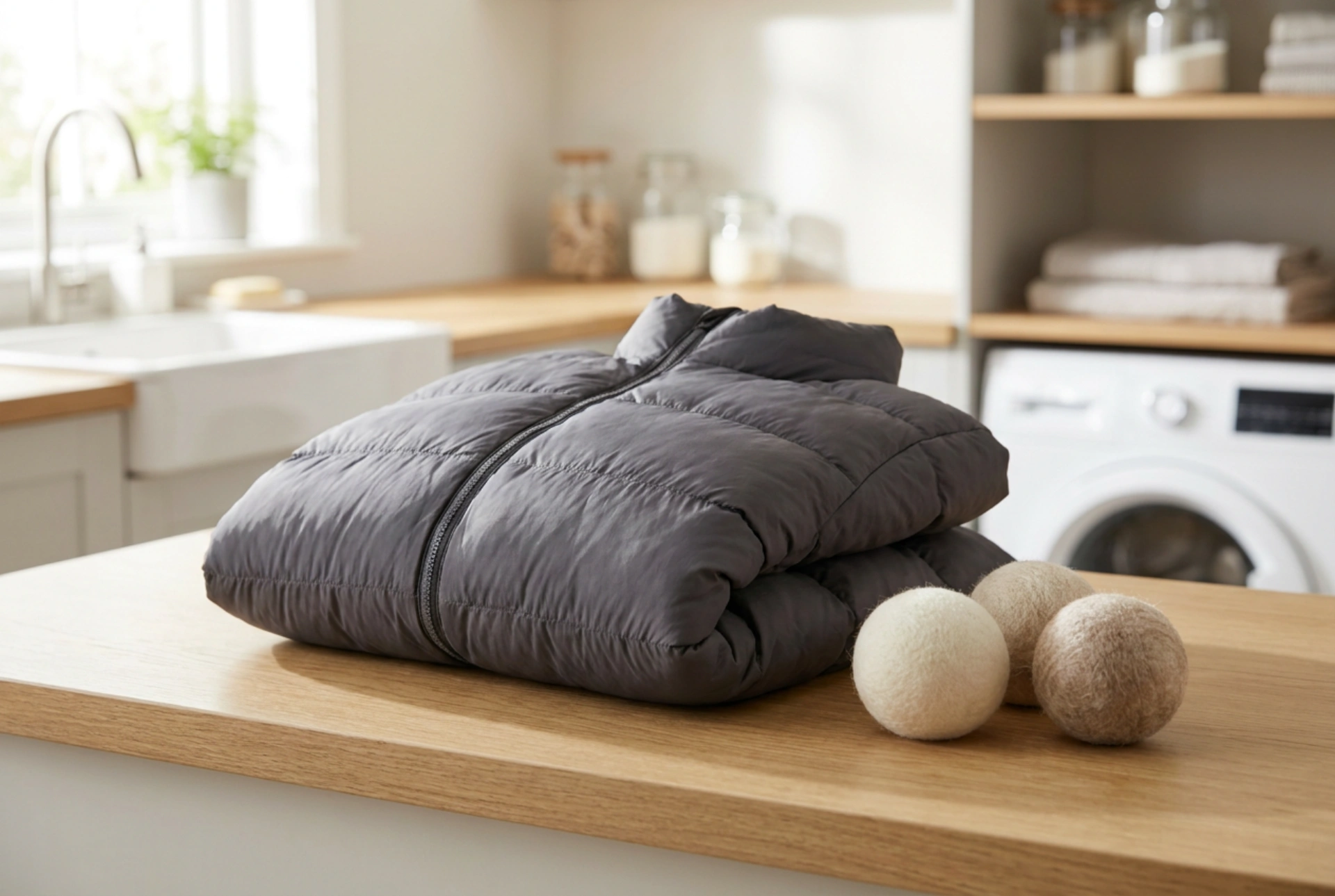
The most efficient method is using a tumble dryer on a low-heat setting (no higher than 40°C to protect synthetic outer shells). Add three to four clean wool dryer balls to the drum. As the drum rotates, the heavy balls physically strike the wet clumps of down, separating the individual feathers and reintroducing air into the baffles. Expect this process to take several hours; do not stop until the jacket feels completely light, airy, and entirely free of thick, heavy cold spots.
If you must air-dry, place the jacket horizontally on a flat drying rack in a well-ventilated room. Never hang it vertically, as gravity will pull the heavy, wet down to the bottom of the chambers, permanently stretching the fabric. Every two hours, manually pat and shake the jacket from all angles, gently massaging any clumps with your fingers to redistribute the feathers as they dry.